bkoep Staff Lv 1
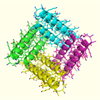
Last week the Baker Lab ordered materials to construct the latest batch of Foldit designs in the lab for experimental testing! The following eight protein designs were selected based on visual inspection by our scientists and folding predictions by the Rosetta@home distributed computing project. For each design below, we've included an image of the Foldit player's design on the left; and on the right, a folding funnel with the energy and Cα-RMSD for 100000s of Rosetta@home predictions in red, as well as an image of the lowest-energy prediction. We like to see that the lowest-energy prediction also has a low RMSD (explained here).
For more information about the types of experiments in store for these Foldit player-designed proteins, see our previous blog post.
Monomer Designs
In monomer designs, we were looking particularly for diverse topologies containing some β-sheet secondary structure. Such topologies are significantly more difficult to design than the helical bundles that have been so successful in the past. Consequently, these folding funnels may appear less pristine, but we are still very excited to experiment with them in the lab!
<p style="float:left">reefyrob
retiredmichael
Beta Folders, Puzzle 991</p>

<p style="float:left">Galaxie
gmn
Anthropic Dreams, Puzzle 995</p>

<p style="float:left">jamiexq
Anthropic Dreams, Puzzle 1029</p>

<p style="float:left">viosca
Anthropic Dreams, Puzzle 1029</p>

Symmetric Oligomer Designs
For designs of symmetric homooligomers, we do a similar analysis to make sure the monomer will fold up as expected.
We also want to make sure that, once folded, the monomer units are likely to bind to each other in the correct orientation. The most common reason a design fails this "docking" test is that its interface is completely hydrophobic and featureless. In such a case, two properly folded monomers can usually come together in a number of different ways to bury the same amount of hydrophobic surface. The best way to ensure specific binding in the correct orientation is to design rugged, complementary surfaces (e.g. large interdigitated side chains) and incorporate hydrogen bond networks at the interface.
The following symmetric designs performed decently for both monomer folding and docking tests (data not shown), and we are excited to try them out—however, we think there is room for improvement in the design of specific interfaces!
<p style="float:left">johnmitch
Puzzle 1018b</p>

<p style="float:left">johnmitch
Puzzle 1018b</p>

<p style="float:left">gmn
MurloW
Anthropic Dreams, Puzzle 1027b</p>

<p style="float:left">TomTaylor
Puzzle 1027b</p>

The players responsible for the above designs certainly deserve recognition, but there are many, many more exciting designs that just missed the cut or are still under analysis. We can't wait to see what Foldit players come up with next—keep up the great folding!