Deleted user
Hi all, neilpg628 here to tell you about a new puzzle series we have planned to introduce a secondary structure to Foldit for the first time!
The poly-proline helix
All of the proteins that we have passed to you before have been composed mainly of α-helices and β-sheets. We want to introduce you to the poly-proline helix, which is much tighter than an α-helix, but is less stable because there is no internal hydrogen bonding between residues.
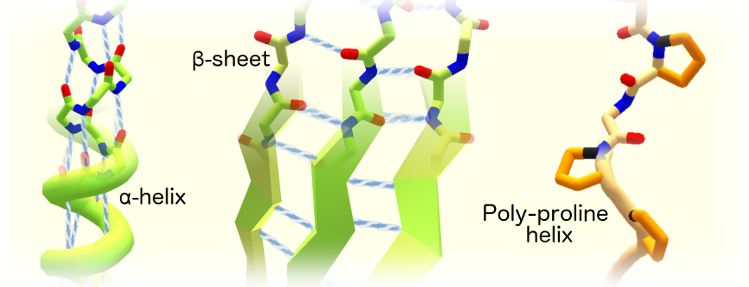
α-helices and β-sheets have hydrogen bonds which keep the structure together. The poly-proline helix has no such bonds
While these helices are typically made almost-entirely out of proline, they can be made out of other amino acids, as long as the bond geometry is roughly the same as that of a regular poly-proline helix. They are found in many proteins, and we want to incorporate them into Foldit to make your contributions relevant to a wider range of proteins!
Unsatisfied polar atoms
Unlike α-helices, poly-proline helices have polar oxygens pointing out from the protein backbone (see above figure). It will be important to satisfy these polar oxygens with hydrogen bonds, to ensure that any protein incorporating a poly-proline helix stays folded!
These special helices have not been used much in the field of protein design, but they are found throughout nature! Collagen is a protein composed of 3 poly-proline helices, bundled together so that the backbone oxygens can make hydrogen bonds. Collagen has exceptional tensile strength, and is responsible for the toughness of animal connective tissue.

Collagen’s hydrogen bond network makes it extremely stable even though it is composed of these unstable poly-proline helices
New design puzzles with the poly-proline helix
In our first poly-proline helix puzzle, we’ll provide a small 38 residue protein with a frozen poly-proline helix and designable residues on either side. We want you to redesign the starting structure into a compact protein that can support the poly-proline helix. We're starting with a small protein, but we plan to introduce poly-proline helices attached to larger proteins in the future, to see if you can design more complex poly-proline helix proteins!
Promising designs will be tested in the lab for stable folding! This work could open up new opportunities to apply poly-proline helices in environments where they would not normally fold. Check out Puzzle 1763: Poly-Proline Helix Design: Round 1 now!
Happy designing!