@Elfi I don't know how they're coming up with the starting compound but it looks like its the same (with different reductions/mods) each puzzle.
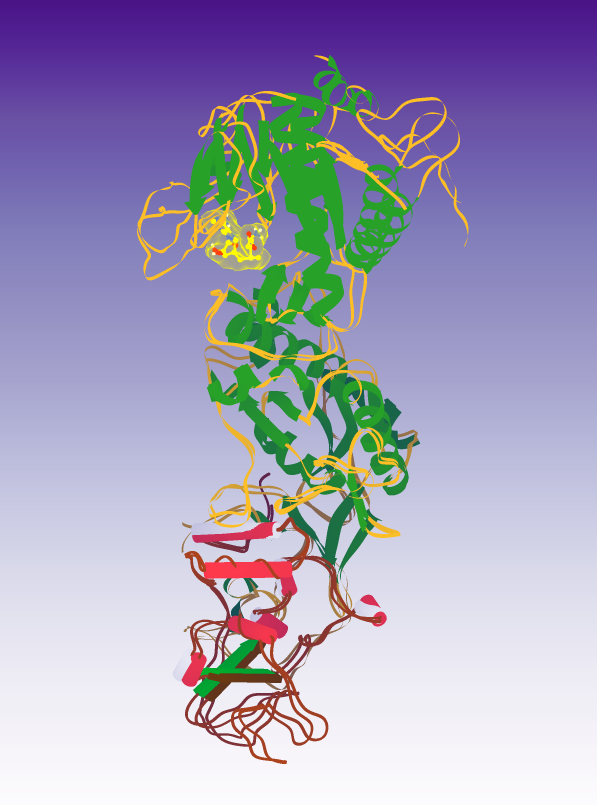
The exact structure of 2709 can be found in the PDB (5EK0) as it is shown in the 3D graphic (https://www.rcsb.org/3d-view/5EK0/1)
and is also listed as the best binding ligand known yet. (https://www.rcsb.org/ligand-validation/5ek0/5P2).
Based on this observation I would assume that the starting compound is based on IRL data.
Normally, I only use the starting compound to estimate which areas of the protein should be used.
Modifying the starting compound can be a solid structure but IMO you can probably find (theoretically better structures) by educated guesses.
I've also looked it up for the CCHFV, but (at least the PDB) has no entry with the suggested Starting compound. But I guess it isn't the best solution (revisited) because otherwise higher scores are reached easier which is probably a bit unfair.
I also compared the highest scores of the original CCHFV rounds (sadly no molecules) and I come to the conclusion that there's probably no connection (or they're reducing the best structure heavily, so you can't just shake+wiggle and get 25k).
As far as I know the starting ligand also depends on puzzles, sometimes it'd be mentioned in description or comments. Maybe need to ask devs to confirm.
btw just a note here, the ligand validation report on pdb is about fitting in electron density, not about affinity 😉
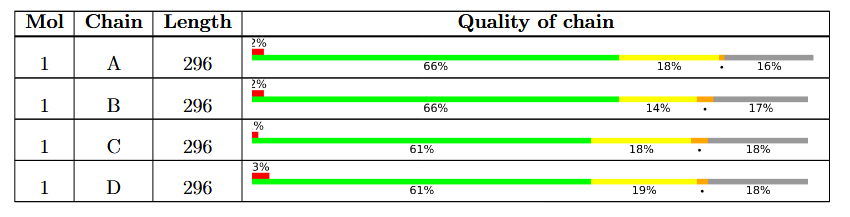
@Floddi, thx for the background info on the best known fit so far. It is nice seeing it in the PDB structure viewer. When I compare with the full validation report on 5EK0, the two ligands (C and D) that have the best fit data, are also the ones where the protein chains have the worst data.
Page 2 bottom in the Full report under Structure summary.
I think you are perfectly right about your suspicion about that the ligand is made so one can't wiggle ones way to 25K. Which was exactly what I tried the first couple of rounds, before realizing that I was supposed to modify the structure. ;)
It also took me a while to understand what the ligand library was for. Plus when I did, I couldn't get it running. So one round early on I hand build the structure I was evolving on from the previous round, because I wanted to see if it was known and suddenly I was temporarily nr 1, quite undeserved.
Thanks, @rosie4loop, this is helpful also. I missed your comment while I was writing an reply. Your comment on fit of the ligand makes good sense. To get the clearest view of the structure of the ligand in 3D space, the view of the protein will suffer. And vice versa.
@Elfi @Floddi The starting molecule for small molecule puzzles is generally given to us by the experimental collaborators. They're prospective ligands which the collaborators think might be worth expanding upon.
That said, there's certainly no requirement to stick close to them - feel free to redesign them completely. Often times what the collaborators are interested in is the location & interactions the molecule is making, rather than the precise internal structure of the compound itself. If we need you to stick close to the starting molecule, there will be an objective for that.
@Floddi Regarding View options, what do you think of the Small Molecule Design view preset? Is there particular reasons you don't recommend just using that?
@rmoretti, thx for solving the mystery about where the starter molecules comes from.
Thanks a lot for this. It's interesting to add to the wiki (with pictures of the groups mentionned).
Personally, if building from scratch, I use the default small molecule view without the voids (because I don't see anything with these voids, and they are in the way when trying to select an atom or add a band), but I enable the voids when expanding the molecule 'to the voids".
For banding HBonds, I set length to 2.8 because the default 3.5 is too long, and I find zero to small.
I always verify that there is at least one HBond (or a band) before to wiggle, otherwise the molecule leaves the pocket.
When starting from the given compound or from a library one (or from my best performing compound so far), I first try to maximise the bonus. I end with the torsion quality because it can be treated with MM or wiggle. With a positive torsion (preferably >= 700), I let the recipes do the job. If it remains to small, I do what you suggest (adding or linking atoms).
When the library bonus is huge, I preferably test library compounds or I limit the hand fold to some very small changes (in many cases, these manual changes keep the bonus because it's a library "brother"): it gives better result to test parent library compounds with hand fold than loading the compound because loading moves the original molecule.
In puzzles without library bonus, it can pay to simply try to make as many HBonds possible (within the bonus constraints) but I wonder if this is very relevant for science because we end with strange kind of long chains.
But my main problem so far is to correctly place existing compound (e.g. from library) in the pocket. With exactly the same compound, it's easy to get very different score even after days. Because of that, after a first clean up of the starting compound, I realised that my second best score often is close to the starting molecule (but never good ranked enough, something like 2000 pts lower than the top score).
These puzzles are still puzzling: that's why your "tutorial" is usefull: personally, I still try too much at random (which wastes a lot of time).
Thanks for the contribution @"Bruno Kestemont" !
I use bands on zero and full force if nessecary because I can't wait :s and disable them after a few seconds :D This is working fine enough for me.
Good to know, sadly, CL-bonuses are missing at the moment. I prefer them for more realistic results. Otherwise, new molecules need to be invented to be added I guess. Both is good in some scenarios.
You dont have to end in long chains you can also make 1,3,5-benzens. You don't have to add them in a line. NaV1.7 (2709) works best with 3 rings bound together as it seems.
I have ended doing what @"Bruno Kestemont" also does, which is to generally turn off voids. I did so too with pulsing.
However I have found a way to make good use of both the Voids and Spheres setting that @Floddi mentioned. I use them when I need to expand the molecule and have run out of the easy to see spaces. The isosurface never fits all the way around the ligand or it can be hard to see anyway. So there are areas where I have no idea if it is useful expanding the ligand.
However here the voids can help spill of such good places. So I turn on voids and spheres at the same time and slowly spin the whole protein around. If there is a hole somewhere with a void blinking through, then I remove spheres and check if that void is also close to the ligand. If it is, I know this is a place I can expand. I have had luck expanding in such a way on the ligand both last round and this one and gain points.
I also wanted to add a link to my post "Medicine making puzzles" as it kind of belong here too.
https://fold.it/forum/suggestions/medicine-making-puzzles
Plus I found one of @LociOiling's posts "SMD - small molecule design tips and tricks" which is very helpful.
https://fold.it/forum/discussion/smd-small-molecule-design-tips-and-tricks
Additionally, you can turn voids on/off by "Shift+V" - The information is too valuable to be ignored even though I understand that voids can be annoying esepecially when starting a new puzzle