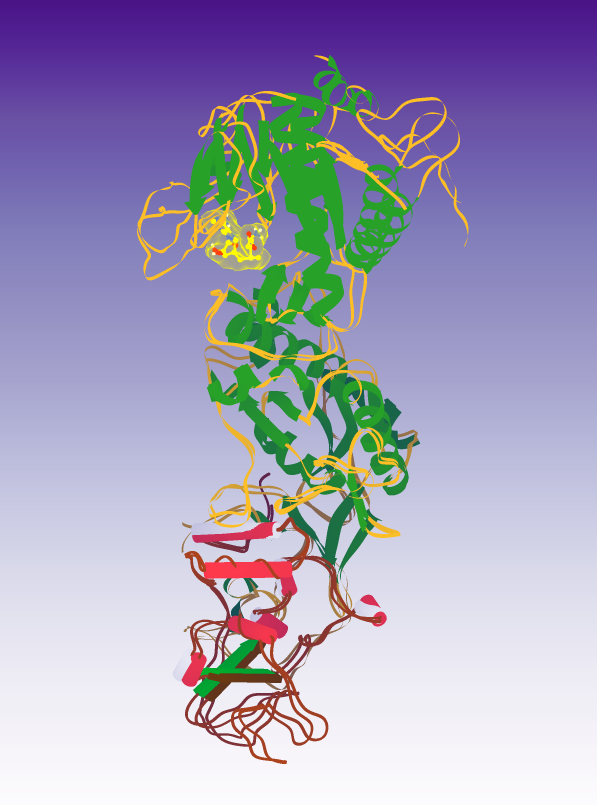
The torsion quality filter is currently split into a number of levels of ~300 points each, resulting in some less-than-ideal score changes during wiggle (e.g. wiggle follows the energy landscape and pushes the score to, say, 31940, only for the filter to kick in and drop the score to 31650). Having a smooth torsion filter should minimize surprises and reduce score-exploits that depend on using the last wiggled state that does not hit another level of the filter.
Huh… Read Guba et al. 2015, and it sure looks like the torsion program itself outputs discrete values: green, orange, red. That makes this request impossible. Bah! If only this stuff is more like Rosetta's ideality terms!
I suppose you people can still take the tolerance data and brew your own program that produces a smooth output. But that sounds like a lot of extra work.
I agree with this.
Although what I want should be harder to implement than the continuous filter mentioned by Artoria2e5 and others. The "dream" solution imo would be adjusting the scoring function to better consider the ligand torsion, so the torsion filter wouldn't be needed.
Ideally, the score itself, with filters disabled, would be correlated to experimental binding energies, or more exhaustive computational calculation. This likely require further optimization, more than a better torsional term. Filters would be used for guiding the physiochemical properties of designs, but not as a workaround to overcome the limit of the current scoring function.
Even further as a dream, that exploring the different binding poses of a ligand could (relatively) accurate in sampling the energy landscape, interactively, in real time, without the need to GPU accelerated simulation. Just a kind of dream anyway.
The Robetta scoring functions, especially beta_genopt, sounds closer to what rosie4loop is looking for. https://new.rosettacommons.org/docs/latest/rosetta_basics/scoring/Overview-of-Seattle-Group-energy-function-optimization-project The paper describing it seems to be https://doi.org/10.1021/acs.jctc.0c01184 (open access). Rosetta documentation does not link to the paper yet – someone should add it.
There are also more experimental energy terms involving orbitals https://new.rosettacommons.org/docs/latest/rosetta_basics/scoring/NC-scorefunction-info#Partial-Covalent-Interactions-Energy-Function-(Orbitals) that could be even closer to the real thing.
From a practical perspective, a smooth filter should be good enough for wiggle to find the gradient on and implicitly optimize for it. That's great for me as a gamer.