I think having the Grid from the Contact Map always available would really help with Banding, like for Cysteines. It could still show the Structures on the Backbone and the non-banded connections, but no predictions or percentages. The Map would also help band inner segments that are hard to get a cursor on.
Thanks! E.
Showing the Grid from the Contact Map even on non-Contact-Map puzzles would give us more practice seeing the relationship between the 3D protein structure and the 2D Contact Map.
Folks could also display the 2D Contact Map when they share images of their proteins to Chat. The 2D Contact Map for a protein should be the same no matter how the protein is oriented in 3D space. The 2D Contact Map should also be the same no matter what angle the protein is viewed from in 3D space.
The Contact Maps would help tell if 2 proteins that look very different in 3D space look different just because they are shown from a different angle or instead because they are actually folded differently. The ones that are actually folded differently would look different in 3D and would also give different-looking Contact Maps.
http://fold.it/portal/node/997773 shows examples of plots I used during CASP 2014 to pick structures to submit for Go Science.
5 of the plots show distances between pairs of alpha-carbons for 5 different structures with the same sequence. These plots are somewhat like Contact Maps, but they use shades of gray to show gradual transitions from the closest alpha-carbon pairs (shown in black) to the most distant alpha-carbon pairs (shown in white). Here, structures 1, 2, and 5 show alpha-carbon-to-alpha-carbon distances up to 38.360 Angstroms. Meanwhile, structures 3 and 4 show alpha-carbon-to-alpha-carbon distances up to 46.246 Angstroms. It is odd that structure 1 has at least one non-zero distance as low as 3.092 Angstroms while the rest all have non-zero distances of 3.752 or more Angstroms. Why might this be so?
The 6th plot (in the lower right) shows the alpha-carbon rmsd (root-mean-square deviation) values between each pair of the 5 structures. The smaller the rmsd value, the more similar the two protein structures are. The lowest rmsd (0 Angstroms) is in black while the largest rmsd (about 14 Angstroms) is in white. The diagonal is all black because each structure is identical to itself and so gives an rmsd of 0 Angstroms. Structure 5 is fairly similar to structure 4 and so gives dark spots in the lower right. Meanwhile, structure 5 is pretty different from structures 2 and 3 and so gives white spots in the bottom row and right-most column.
The recipe DistMap0 (http://fold.it/portal/recipe/101659) makes Distance Maps almost as in the above comment, but, instead of using shades of gray, DistMap0 makes these maps using the #'s 0-9 (0=closest alpha-carbons, 9=furthest apart alpha-carbons).
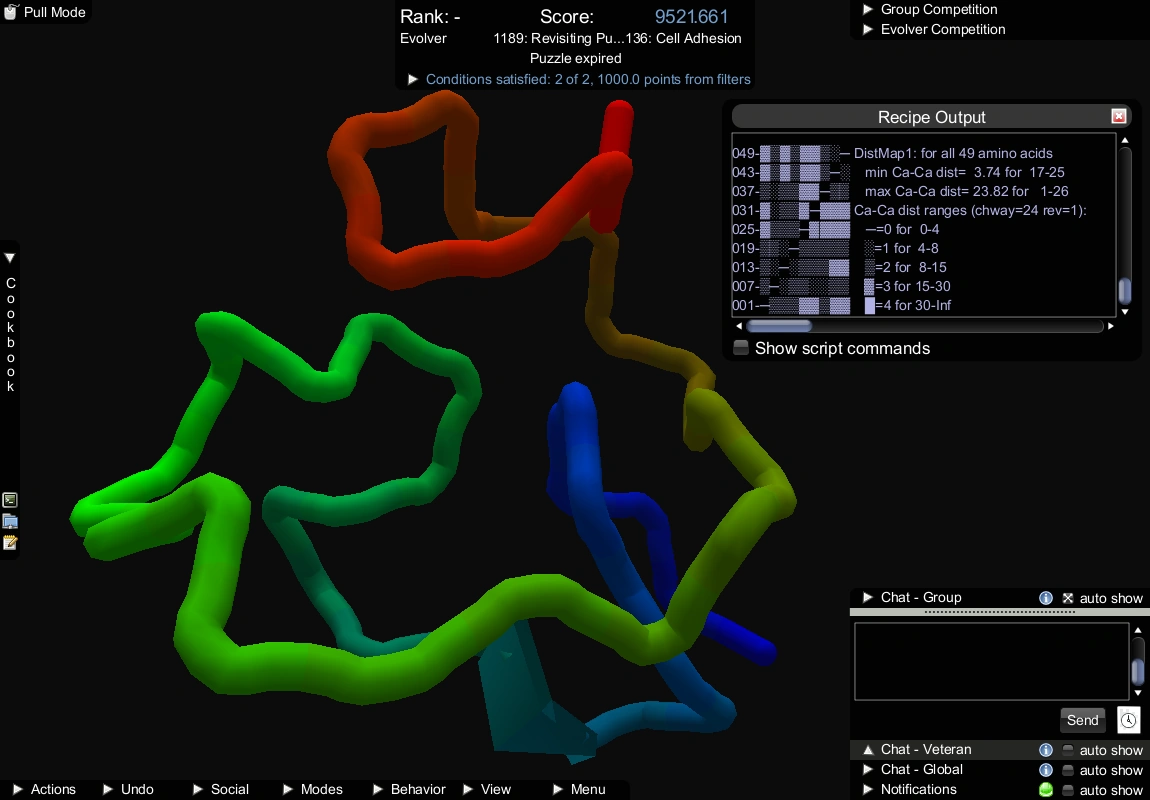
The recipe DistMap1 (http://fold.it/portal/recipe/101679) can do like DistMap0, but it can also use a variety of character sets that appear dark for the closest alpha-carbons and light for the furthest apart alpha-carbons. In addition to that, DistMap1 can make *.eps image files where different Ca-Ca distances are shown with different shades of gray. DistMap1 can also make a variety of charts that can be input into spreadsheet programs like Excel. These charts give statistics on the distribution of distances among the alpha-carbons, etc.
I think it would be neat if players who regularly share 3D images of their structures when each puzzle ends would also use DistMap1 to make distance map images for these same structures and share them. Then we could build a collection of both 3D images and their respective distance maps for a wide variety of structures. I think including distance maps would make the diversity of solutions found for each puzzle more apparent.
I have been gathering 3D Images and Distance Maps for various known protein structures at http://foldit.wikia.com/wiki/Distance_Maps and http://memorize.com/protein-distance-maps
Both sites show side-by-side the 3D Image and Distance Map for each structure.
The latter site can also scramble the image pairs to give you practice recognizing them.
It has multiple choice and matching modes.
Please check out these sites and add more images to them if you'd like.
I think they will help more of us learn to read Distance/Contact Maps.
That text file didn't come out so good.