
nspc Lv 1
After changed a loop into an Helix, I can change AA as Glycine on it, and it can be detected as an non ideal loop.
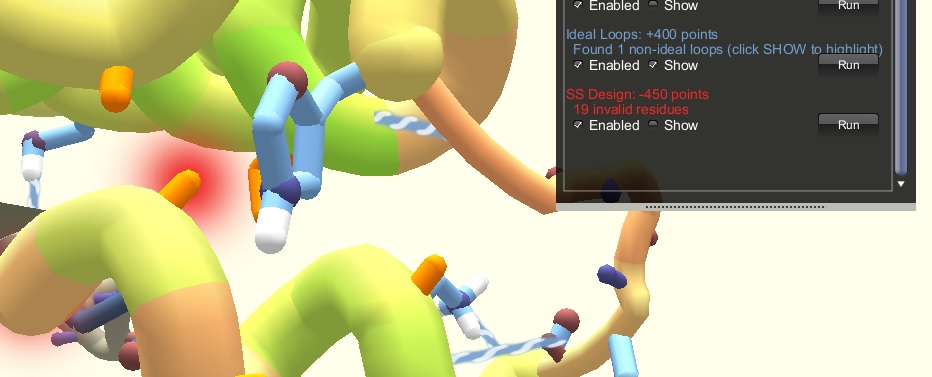
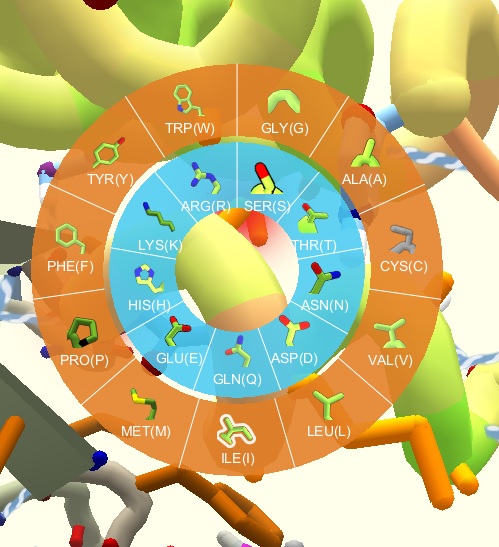
After changed a loop into an Helix, I can change AA as Glycine on it, and it can be detected as an non ideal loop.

To clarify, the Ideal Loops and SS Design Objectives detect helices based on H-bonding patterns. These Objectives will only treat your residue as a helix if the backbone makes an H-bond to another residue 3-4 residues away. You can use Auto Structures to see where these Objectives actually see a helix.
The "Assign Helix" tool is different, and it doesn't actually create the H-bonds that make a real helix. Assign Helix is a way for you to mark where a helix should be. Then you can use the Idealize SS tool to actually reshape the region that is Assigned Helix, so that those residues make the correct H-bonds.
I know this can be confusing. When Foldit was first released 12 years ago, it was designed to work with helices a bit differently than it is now. Foldit has changed significantly since then, and the Assign Helix feature is sort of a relic from the past, but still useful in some cases.
Thanks. I understand more how its works now.
I thought secondary structure was in ADN code, but not at all. So, it become and Helix a Sheet or a Loop only with amino acids we choose, if I understand. It is the same atoms, just differents positions and bound ok. (I thought backbone was different).
That means, if a tripple helix is not enough stable, some residues can become a Loop or a Sheet instead of a Helix we wanted, in reality?
That's exactly right. The atoms (and chemical structure) of a helix and sheet are exactly the same. They are just folded up differently.
If you want your designed protein to fold into a 3-helix bundle, then you have to pick amino acids carefully so that the helix bundle is more stable than sheets or loops. If the amino acids are more stable in a sheet than in a helix, that means the amino acids will fold up into a sheet in reality.
This blog post goes into some deeper discussion about the theory of protein design.

Marking this closed.