Let me describe in a little more detail what I'm up against. There are several renewable energy technologies worthy of studying, Hydrogen is one of them. Among the many technical hurdles for hydrogen is producing it both economically and with substantially less impact to the environment. Several renewable approaches exist and using photosynthetic algae is one of these. A researcher can take many approaches to studying hydrogen from algae and we can divide those into physical experiments and virtual experiments. Since I don't have a lab I am limited to growing algae on my window sill. Alternatively I focus my efforts on the theoretical experiments.
We can consider several approaches to studying biohydrogen, we can gain a better understanding of what occurs on the molecular level by modeling the known chemical interactions or we can propose ways to engineer a biochemical method. Both of these are relevant to my work which has mostly dealt with understanding what methods can be applied.
Let me describe first how these methods have been applied to enhance our understanding and then I would like to describe directions I want to take with Hydrgen@Home.
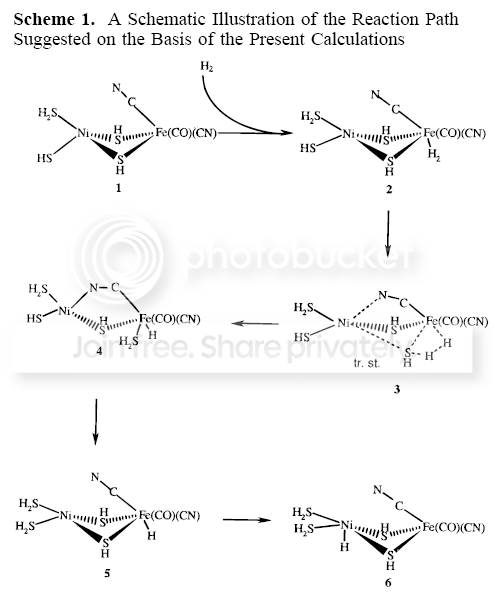
Here is a model for the active site of the enzyme NiFe-Hydrogenase responsible for reducing protons into molecular hydrogen.
These enzyme acts reversibly, meaning it can take in hydrogen or it can produce hydrogen. Here is the mechanism in the direction of taking in hydrogen which should provide insight on the reverse reaction.
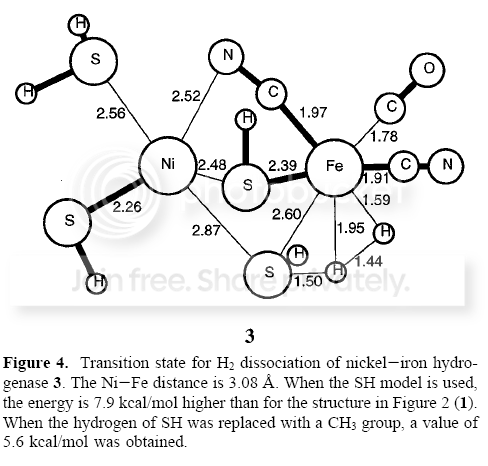
A more precise model of these reaction intermediates can be derived using an electronic structure application which employs quantum modeling techniques to predict the geometry of each intermediate. Here is a proposed transition state structure.
There are several varieties of hydrogenases known to reduce protons into hydrogen but they all suffer from being inactivated by oxygen, which accumulates in the cell from the first step of photosynthesis. So our theoretical problem is developing an enzyme that is efficient in reducing protons and ambivalent to oxygen. Now let me outline some approaches
Computational methods have predicted structures for reaction intermediates and mechanism for diffusion of various ions and molecules to the active site. This information can help us engineer better enzymes:
Using Rosetta Design, one could mutate side chains along the proton tunnels so until they are no longer permeable to oxygen, though this may reduce the efficiency of the enzyme by slowing the passage of protons.
The active site of hydrogenase contains a metallic co-enzyme. I don't know exactly how the oxygen turns off the enzyme, but oxygen does have a tendency to bind to iron.
Catalysts are typically discovered through serendipity, what I am proposing is using computational methods to screen for novel catalysts. David Baker and several research groups are achieving this for certain reactions where they are able to obtain transition state structures through electronic structure analysis and a degree of chemical intuition.
A transition state structure represents the coordinates of reaction intermediates at the maximum energy. Predicting these structures is necessary to design a catalyst. Catalysts serve to stabilize these structures to make a given reaction more thermodynamically favorable. Some transition state structures are fairly simple composites of the substrate and product. While others such as the above, are reaction complexes with non-obvious bindings.
Primarily I have been investigating brute force methods of investigating many combinations for achieving a proton reduction. This is incredibly problematic and depending on the methods taken it may not be possible to achieve such a thorough survey.
I won't give up on that approach but I am interested in the prospect of turning it into a game where participants can propose a intermediate steps using a library of molecules and a grid of computers can calculate the energies of each step and evaluate the probability for a given reaction path.
Alternatively, the participant can construct their own molecules using a java molecule builder like JChemPaint. We can take advantage of several GPL electronic structure packages.
The users would propose new catalysts that are either organic or inorganic and identify these non-obvious bonds. If a given transition state structure looks plausible, we can start designing proteins that stabilize these structures.
I am not quite sure how to implement this, but I would like to know if anyone is already working in this direction or have suggestions.
Best regards.