If I want to change the folowing ligand part
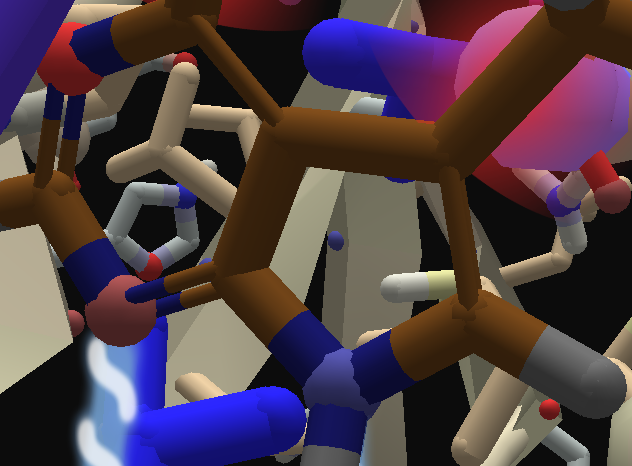
to the following:
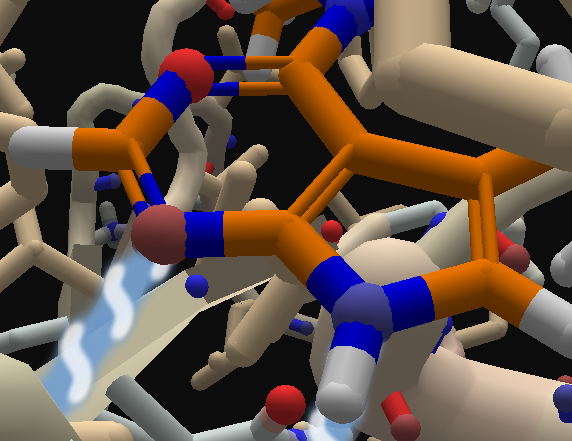
Foldit automatic returns to the previous one (when I change the latest C-N link). I tried many different ways. One path succeeded (but i don't remember how I did).
If I load an almost finished design to library, the same happens (similarity 0.7 but I always get the previous back).
HOWEVER the second one is a Library-aproved ligand as well (when I got it, it remained in the library and it ended as my to scoring solution later on on a previous puzzle).
I don't get any error message saying that this is not chemically feasible.
Is this a bug ? Or is there any reason for this automatic reconstruction ?
This happened to me many times. May be considered a bug, sometimes is annoying, but most of the times I could realize what I wanted to. I have no sufficient background knowledge to evaluate it as a clear bug or not.
If I'm interpreting the images correctly, you've discovered resonance.
If you have a ring of alternating single and double bonds, it turns out that each atom wants to have one single and one double bond in the ring, but it doesn't care to which atom it's single bonded and to which it's double bonded. So the double bonds can play "musical chairs"/"pass the parcel" and move one spot over, as long as all other double bonds also move one spot over.
In fact, it's so easy to do you don't actually get "alternating" states, instead you get a quantum superposition effect where it's not alternating single and double bonds, but rather you get a sort of "one and a half bond" situation. (Called "aromatic bonds" for historical reasons.)
While we can handle the situation computationally, the "one and a half bond" situation is terrible for visualization purposes, particularly with the editing tools as they are. As such, we display things as alternating single/double bonds. But which bonds get displayed as double and which get displayed as single is arbitrary. Which is why an edit can cause things to swap between the two states. They're the same molecule, though, and it doesn't scientifically matter which one is "single" and which one is "double" – both forms should be considered identical for the Compound Library purposes.
Thank you for the response. The interpretation is correct (we were thinking on it), but sometimes the addition of new atoms can be harder a little bit, if we get an unfavorable version of bonds due resonance.
Thanks for the explanation. I thought I had another molecule.