Provide an efficient way in handling strained conformation of cyclic aliphatic compounds

Started by rosie4loop

rosie4loop Lv 1

In puzzle 2330, its recommended to replace aromatic moieties with something else. The easiest approach would be replacing all the double bonds with single bonds if we aim a similar length of fragment and hydrophobic interaction, e.g. replace phenyl group with cyclohexyl.

Now the ring is flexible. There are more conformations it can adapt comparing to the rigid aromatic ring. This make me wonder how Foldit handle such flexibility?

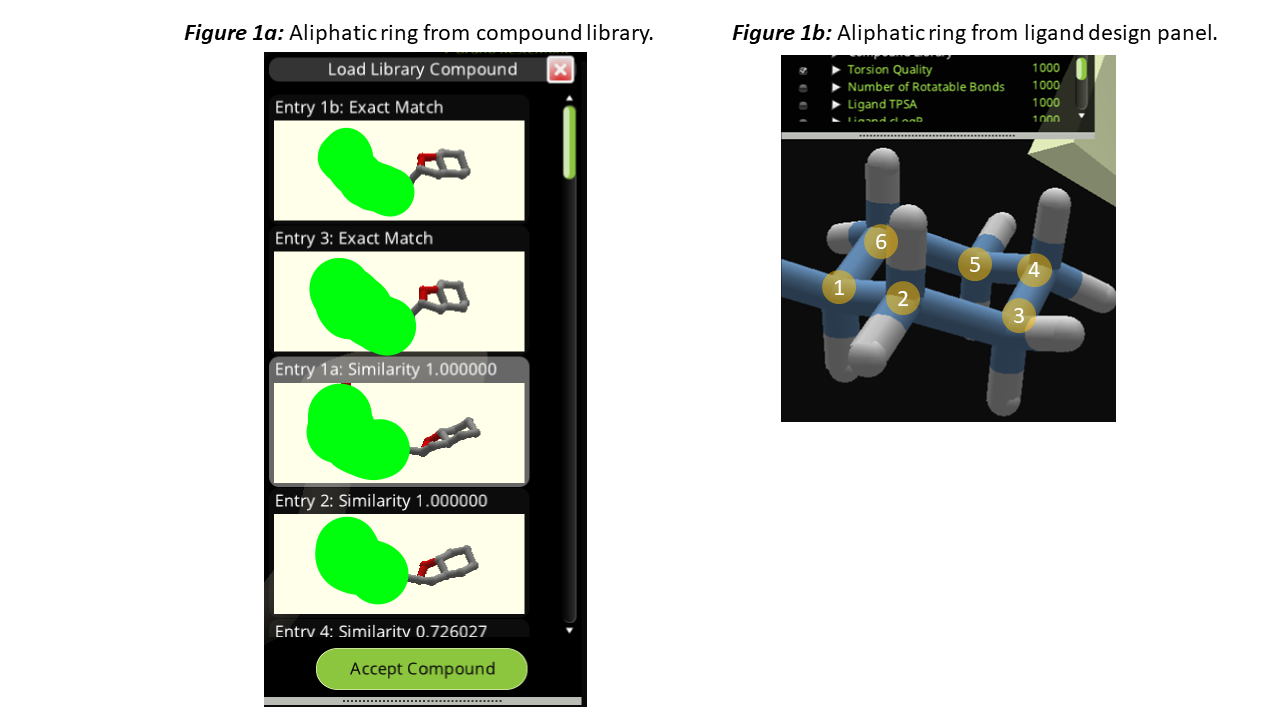
The compound library automatically returns the more stable chair form of the compound, which is good (Figure 1a). Fragments from the "Ligand Design Panel" also use the chair conformation, no problem here (Figure 1b).
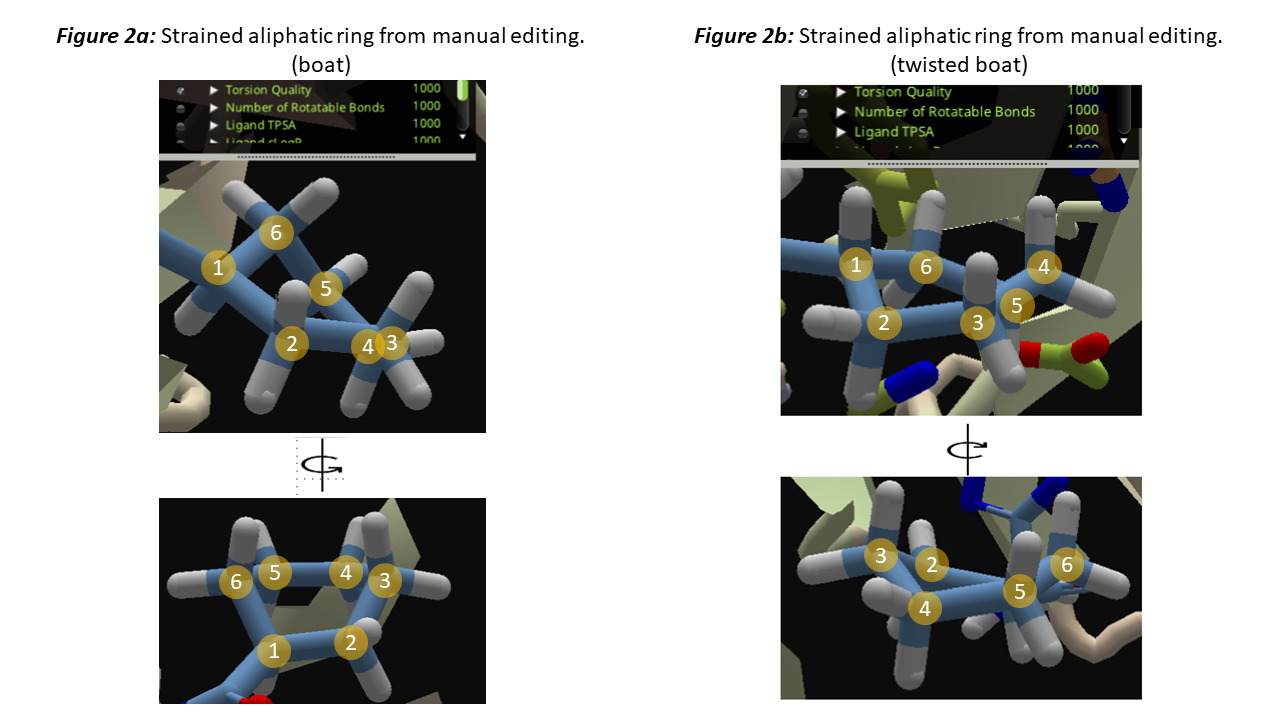
However, there would be some issues if a strained ring is built manually. Why it'd happen? A strained ring may appear when we delete atoms to convert a bicyclic ring into a monocyclic ring, or when trying to point a substituent towards a residue without considering the strain on the ring.

Figure 2a is an example of the boated form of the cyclohexyl group. I built this strained conformation from the fragment in figure 1b, by replacing a hydrogen that point downwards at position 3, single-bond it to carbon 1, then delete the original carbon 2. then I adjust the torsions of other parts of the compound to get rid of the torsional penalty. Some wiggles / MMFF wiggles /shake sometimes (not always!) could slightly relax the ring from boated form to the less strained (still less stable than chair) twisted boat form (Figure 2b). It could not relax to the more stable chair form by itself, assuming due to the high energy barrier of the half-chair form if it need to convert from twisted boat to chair form.
Limits of Foldit in handling the rings can be summarized as follow:

  1. No efficient way to fix the conformation of strained aliphatic ring
  2. No major penalty nor warning for the less stable form of the ring. I assume the clashscore or other subscore would be lower, but its not significant enough for us to identify whether the issue is from within the ligand or from protein.

It would be much appreciated if the strain could be highlighted like unrealistic torsions of linear chain, or even better if this can be handled in a similar way as a strained linear chain by tweaking torsions.

Further readings about the conformations of cycloalkanes:

  1. Conformations of cyclohexane:
  2. Conformation of other aliphatic rings

(Edit: fixing typos and links)

jeff101 Lv 1

Have you tried wiggling, mmff, or shaking at different clashing importance (ci) values?
Perhaps setting ci to 0.03 or even 0 would let the cyclohexane switch its conformation.
Also, if you select just the ligand and then use the left or right arrows, Foldit will cycle
among different ligand conformations (I don't know if it ever repeats itself). You can
also use bands to help the ligand change its conformation.

If the Compound Library always gives the ideal structure, you could send your structure
with the wrong cyclohexane conformation to the library. If you get an exact match, use
the exact match version from the library instead.

rosie4loop Lv 1

I'm thinking a warning on the strain would be useful, quick way to fix it like a torsion would be great but I assume it should be difficult to implement.

Sometimes one may not be awared of a strained ring when building the ligand. Its not reflected in the score, too, that in some tests the boated form score better than the chair form.

Usually it's like an unrealistic torsion that's hard to fix by changing CI, generally behave like a rigid ring. Running AFK3 or FastRelax or BlueFuze or similar scripts that test different CI would not fix it.

If the ring has severe clashes with protein or has bulky groups attached, then mmff wiggle or wiggle may change the conformation more. May even get it to the chair form if the clash is severe enough, or if the bulky attachment pushing it too much.

Bands could help indeed without altering other parts of the compound, just need a band for each atom on ring before wiggling for the best result. It requires fewer clicks to fix it by editing, but using band is also a good option.

Currently, other than using bands the easiest way to fix is like how I built it, add a carbon to hydrogen pointing upwards at position 3, connect to carbon 1, then delete carbon 2.

The ligand queue (left-right arrow) of quick conformation sampling only seems to change the torsions of linear chain (at least in the several trials I did). I think its not considering the protein and usually causing clashes, not ideal for fine-tuning the pose.

Actually it's reasonable if it's not easy to sample conformation of flexible rings, depends on method using the same way as linear chain would make the ring totally messed up.

I agree that if it's exact match and if it align well accepting from library could be useful, but in the example of figure 1a the alignment on ring is flipped, so it'd be more work to do to fix it this way.

Replacing with the correct fragment from ligand design panel is also useful, but if the ring has multiple substituent we cannot use this way.

(Edit: notes on scores and fixing with bands)

rmoretti Staff Lv 1

Shake should (theoretically) sample different ring conformations, and can "fix" a poor ring conformation. However, it will only do that if the fixed ring is better in score than the non-fixed ring, which, depending on the particular situation it's in might not be the case.

One limitation, though, is that the current conformer generator we're using for shake is a little slow. We've attempted to fix that by using a background thread to generate conformers, but that might not be fully done by the time you hit Shake for the first time. (So you may need to stop and restart Shake a couple of times to get all the conformers.) The other issue is that due to the slow speed, we don't generate as many samples as we really should. As such, we may miss potential good-scoring conformations, so the score-based issue may still occur.