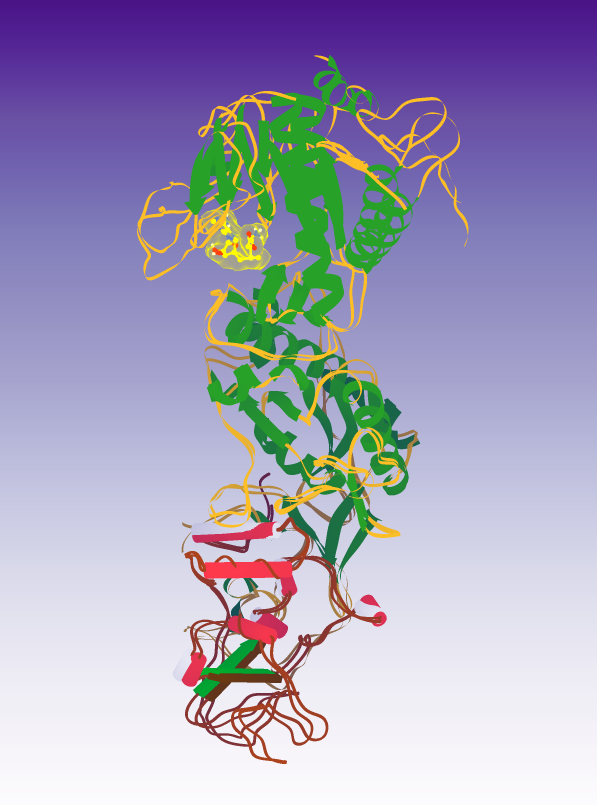
I propose a new kind of puzzle:
Ligand binds to protein A AND does NOT bind to protein C
This is a modification of:
Ligand binds to protein A AND binds to protein B (we had this kind of problem as a binder between two peptide sequences in past Foldit binder puzzles)
I am thinking that Foldit may be great for trying to find such ligand. Can we get the extension proposed?
Justification:
There might be many promising drug candidates that have been discarded in the past. They may be binding well to their target protein, but unfortunately they are also binding to something else that causes trouble.
Let the drug rapamycin serve as such an example. The drug rapamycin binds to the mTOR protein complex that comprises mTORC1 and mTORC2 subcomplexes in human. Rapamycin seems to bind to both subcomplexes.
In the book of Peter Attia: Outlive, he is mentioning “A rapamycin analog or rapalog that selectively inhibited mTORC1 but not mTORC2 would thus be ideal for longevity purposes, but no one has successfully developed one yet.” page 78.
If a ligand could be found that was binding to mTORC1 as the drug rapamycin, but our ligand did not bind to mTORC2 then we would get a preventive drug for extending the healthy segment of human life (ligand binds to mTORC1, but does NOT bind to mTORC2 in a Foldit puzzle).
Details about rapamycin:
The rapamycin is used for the binding with the mTORC2 (after kidney and liver transplants it lowers the autoimmune response). The mTORC1 binding seems to cause favorable effects that may extend the healthy segment of life (check out the book for references).
As the rapamycin lowers the autoimmune response (binding to mTORC2), no one in their right mind would allow such a drug to be used by healthy people. But if a modified ligand would bind to mTORC1, but definitely NOT to mTORC2?
Go-go, Foldit players.
Interesting idea although this would be challenging in my opinion. It's already challenging to have a good binder, it's also challenging to predict what cannot bind.
From my personal experience, aiming a specific binder that binds A but not B, e.g. exploiting a difference in hydrogen bonding residue or making use of a change in pocket shape with a bulky residue being replaced by alanine, in reality the experimental results can be opposite. I'm never a good designer, though.
This maybe due to the limit of the scoring scheme or modelling method of structure based design, for example alternative binding poses, the change in pocket conformation in reality, interaction in binding pathway or hidden pocket. Or effects of other factors that only happens in the test tube or in cells, like solvent envionment changing the protonation state, metabolism that the molecule would breakdown before reaching A, or another protein C capturing the drug instead.
But it'd be cool if a player can be success in here.
Designing for specificity and selectivity is absolutely something we're interested in.
However, we haven't figured out a good way of setting up a puzzle to make that work. Puzzles where you're making something as good as you can have an obvious way of scoring. However, puzzles where you're attempting to make something worse are hard. You can't just invert the score or look at a delta, as there are thousands of ways to make the current structure worse without correctly getting the structure (and score) the compound would have had in the best case scenario.
You need to set up incentives such that you predict the best binding mode (best score) you can to protein C, but where the original designer is disincentivized to get a high absolute score for that best binding mode. That's hard to do as a single-player effort, as the incentives clash. And setting things up as a multi-player "versus" competition doesn't really work with the way Foldit is currently structured. (Besides, the score of the original designer would then be contingent on how well or poorly the second player does, and we have a range of player skills and time-spends with Foldit.)
If someone has ideas for a good design on how that would work and how the incentives are structured - one which fits in well with how the Foldit client is currently set up and how the current player base is currently structured - we'd certainly be interested in hearing them. There's a bunch of hurdles which make putting together a complete setup tough, though, so we can't make any promises about converting things to an actual implementation, though.
Let A be the target and C be the off-target. Assuming A and C shares the same or a similar substrate and their pockets are similar in shape.
Instead of doing a two-protein puzzle, which would be difficult for the non-binding criteria, a possible way could be using ONLY target A but exploit the difference between A and C in objectives. For example,
- giving a penalty to H-bond with a residue presence in both A and C but not essential to binding
- giving bonus to interaction with unique residues in A that have opposite properties in C, e.g.
- an hydrophobic patch thats found in A, while the same position in C is polar,
- or a hydrogen donor/acceptor only found in A but not C.
- residue with opposite charge in A vs C, e.g. Lys vs Glu.
I can't think of the (pairs of) proteins to be example, though, except for the unsuccessful attempts in the past that's still confidential.
As always, balancing the score/penalty distribution can still be difficult if doing it this way.
(Edit: fix typos and protein name for clarity)
The bonus/penalty thing sounds a bit tough to do. I was going to suggest that a clashing interaction score might be easier to implement (considering we had shape complementary filters before – vancomycin binder puzzles) than the bond and charge ones, but then… why do that dynamically at all?
What if we have a manually-triggered bonus (like the library) that tries to wiggle your substrate into protein B by starting with its position in protein A, then returns a score on the final state? It can be on the player-end too, but the point is that we somehow make it free of human interaction and hope the hinted autodock does well enough.
(Of course this still only takes care of the case where no large conformation changes or other surprising modes of binding happen.)
The bonus/penalty is actually inspired from the objectives in the KLHDC2 puzzle series where there's bonus for certain hydrophobic interaction and certain hydrogen bonds. It's not my original idea, sorry if it sounds like that.
Let me clarify a bit. In my post I'm just talking about having a single protein A as a puzzle, but penalty or bonus as the guide on what to avoid or which residue to favor, imagine the ligand would be in a similar position in the second protein, without actually putting the second protein C in game.
It's a single protein approach in game, but indeed it would require more assumption than a two-protein puzzle. Developer have to decide what's important first, players cannot play with the second protein C in game.
This approach also restrict to a pair of highly similar protein pockets to (relatively) safely assume a similar binding mode.
Again it's true that many things like alternative pose or conformation change cannot be considered. Post processing, evaluation in second protein C, etc would be more important with this approach.
(Edit: clarifying)
What if we have a manually-triggered bonus (like the library) that tries to wiggle your substrate into protein B by starting with its position in protein A, then returns a score on the final state? It can be on the player-end too, but the point is that we somehow make it free of human interaction and hope the hinted autodock does well enough.
As far as I know, direct comparison of a score/energy between two protein-ligand complexes in the bounded state can be irrelevant, since the different proteins would have difference scores between themselves with or without the ligand. It maybe more relevant if e.g. use a common known binder of A and C as reference point to compare the scores.
If the score is quantitatively relevant and if it's doable, I agree it'd be more useful than the single protein bonus/penalty approach.
Getting the bounded unbounded cycle and entropy contribution would be better but generally these would be done with a more accurate computationally demanding methods, too time-consuming and demanding for the players side.