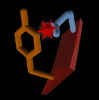
Integrins are cell adhesion receptors that are normally inactive on the surface of cells. Once activated by a ligand, integrins can induce changes in cell cycle, growth factor signaling pathways, cytoskeletal organization, and movement. Recently, integrins have emerged as a key target in anti-cancer therapy as integrins are involved in promoting tumor metastasis and cancer blood vessel formation. Integrin antagonists have already proven successful in halting invasion and migration of tumors.
The challenge for Foldit players is to help design a binder for the integrin binding site that will induce full antagonism.
In the previous iterations of this puzzle, we excised the binding portion of the integrin as the target. For the ligand, we froze the 9 amino acid domain where the RGD loop resides, and allowed Foldit players to design 65 residues flanking the frozen loop domain. In Round 1, Foldit players reported wiggle/shake times were too long, due to the puzzle size. In Round 2, we reduced the puzzle size and added a core-filter bonus to ensure good folds. The puzzle solutions proved to be promising!
Many of the best scoring designs made great contacts with the integrin target, but lacked a good hydrophobic core, which makes them unlikely to fold in solution. While making more contact with the target is good, hydrophobic core interaction is an important driving force in the folding of soluble protein domains. That being said, the solutions that had great cores often lacked stabilizing contact with the target outside of the loop.
As such, we've revised the objectives in this puzzle. High scoring solutions should have stable cores. Many previous solutions had too much alanine in the core, and not enough larger hydrophobic residues, so we've adjusted the score function to discourage alanine. Second, the proteins should make at least one other major contact with the target. Let’s give cancer a good fight!
Sorry for the lack of info—that was simply an oversight! Objective details are below.
We are not allowing players to load solutions from previous puzzles, because we would prefer for players to try new approaches and designs (to improve design diversity), rather than spend time refining previous solutions.
Residue IE Score (max +500)
Monitors that all PHE, TYR, and TRP residues are scoring well.
Core Existence (max +820)
Ensures that at least 25% of residues are buried in the core of the designed binder.
Residue Count (max +275)
Penalizes extra residues inserted beyond the starting 60, at a cost of 55 points per residue. Players may use up to 65 residues in total.
Would it be possible in the next round to lock the bacbone but let us manipulate the sidechains ? part of the issue I see is it is difficult to create a core because there are limited number of pockets where things can be tucked in, and it is difficult to create contacts because sidechains are locked in place which pushes the larger structures out and away.
I don't see any contradiction. Maybe I misunderstand you?
Often, when we allow loading from previous puzzles, we see that players spend most of their efforts refining their previous solutions. Rather than start over with a new idea, they start from their previous high-scoring solution—gradually improving the score but rarely making substantial changes to the design.
Many solutions from the previous Puzzle 1664 look very good already, so we see no reason for players to spend more time refining those solutions. It seems to me that would be a waste of resources.
Instead, we'd like for players to focus on trying new ideas, generating new and different designs with greater diversity.
This is an excellent suggestion. In the first iteration of this puzzle, we locked the backbone of the target but let players manipulate side chains. Unfortunately, this extended wiggle/shake times. In the second iteration, we froze both the backbone and the side-chains of the target entirely, but this may have exacerbated finding nice core pockets. In the next iteration, we can free up at least some of the side chains in the target, especially those around the binding core. Definitely worth pursuing! Thanks!
I opened blueprint to try to shift a loop on a "solution" and the puzzle crashed….
At one point I tried to form some of the non-frozen part into helix and ended up with a big chunk of the "frozen" part also turning into helix which I could not undo
I still have no idea what I'm doing..tho I thought I was trying to bind protein near anything that gave access to the little orange dots.
I'll wait for more instruction and some examples as I'm stuck