



Deleted user
Residue Count (max +100)
Penalizes a residue count above 80 by 20 Foldit points per additional residue. The count is capped at 85.


Closed since over 6 years ago
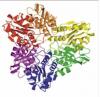
Intermediate Intermediate Intermediate Intermediate Overall Overall Overall Overall Design Design Design DesignThis is the third puzzle in our poly-proline helix design series! This is an 80 residue protein with a shorter 8-residue long frozen poly-proline helix, and designable residues on either side. Just like in Rounds 1 and 2, it will be necessary to satisfy the exposed oxygens on the helix backbone to ensure that the protein stays folded! Globular structures with a hydrophobic core will have the best chance of folding in the real world.
In addition we have upweighted the scores of any interactions with the proline residues by a factor of 5, to incentivize satisfying and bonding with the poly-proline helix.

Residue Count (max +100)
Penalizes a residue count above 80 by 20 Foldit points per additional residue. The count is capped at 85.

I'm having a hard time getting the bonds on the locked segment, but have a otherwise high score. I have tried to manually change AAs to get bonds, but that gets me a much lower score and if I do get a rise in score then mutate change the AAs that got that score.
This leads to just letting the scoring work and not getting bonds to the proline which is opposite of what you want. Any thoughts or solutions to this?
(I will try to manually change for a bit and send in a few that stabilizes)
Managed to get a few select AAs to bind and a score increase. But it took alot of fiddling!

Please share your low-scoring solution with scientists! There could be a lot of reasons to account for the low score (bad sidechain rotamers, clashing, etc.). It's important for us to understand what types of things can impede a H-bond network, so we are very interested in low-scoring solutions that have nice networks.
Glad you were able to find something that worked, in the end!

The recipe Loop rebuild 9.0b
(https://fold.it/portal/recipe/102944)
lets you specify which residues are
allowed to mutate. This helps if you
have bonds between certain sidechains
and want to prevent these sidechains
from mutating to other sidechains.

The usual late game LWS script unexpectedly kicked out a >300 point gain. So 11013 become 11386. Nice when that happens.
Comparing the two poses using "load as guide" and shaking, I don't see any difference, not a sidechain out of place.
Looking at the numbers from print protein, the ideality score of the locked segments gained ~220 points. The ideality gain is not reflected in the individual segment scores, however.
For the 11386 pose, the total of the segment scores is ~700 points lower than the total of all the individual subscores. For the 11013 pose, the discrepancy is only ~405 points.
The total of all subscores seems to be what goes into the overall score, as shown in this from print protein:
subscores + filter bonus + 8000 = 11386.995
Not sure what all this means, but it seems like a glitch to me. Certainly recipes that look at just segment scores (using current.GetSegmentEnergyScore) will be a little thrown off.
I wouldn't expect locked segments to gain ideality, especially when the LWS script I'm running carefully avoids touching them.
With a gain of hundreds of points, I'd expect to see some small difference in the two poses.
I've shared my 11013 and 11368 solutions with scientists.
I ran Jet overnight and it kicked up about 200-300 points. Did not reflect if it was from the locked or not though. It was the same last puzzle. Perhaps the prolines are the culprit?