

Placeholder image of a protein
Icon representing a puzzle

2264: SARS-CoV-2 Nsp3 CACHE Challenge 3: Round 1

Closed since about 3 years ago

Intermediate Overall Small Molecule Design

Summary


Created
February 10, 2023
Expires
Max points
100
Description

Compete in a challenge to design a drug targeting the SARS-CoV-2 Nsp3 macrodomain. Use the small molecule design tools and the compound library panel to find library compounds which bind to the active site of the enzyme. -- Only compounds which come from the Compound Library panel and get the Compound Library objective bonus will be experimentally tested.

Note: To get the most out of the small molecule design tools, we recommend changing you view settings to the Small Molecule Design Preset.

This puzzle is part of Foldit's participation in CACHE Challenge #3. From the set of all compounds submitted in the multiple rounds of puzzles, Foldit scientists will select up to 100 compounds based on the CACHE-provided criteria to be synthesized and experimentally tested. Only compounds which are in a commercially available library will be selected, so it's beneficial to make use of the Compound Library panel to search for library compounds similar to your current design. But don't limit yourself to the compound library. You're more likely to get good results by alternating: optimizing the molecule with the small molecule design tools, find the closest library compound, then further refine it with the design tools.

Participation in CACHE puzzles is subject to the CACHE Terms of Participation, in particular “the Challenge IP [including Challenge Compounds] will be made freely available in the public domain pursuant to Creative Commons Attribution Only (CC-BY 4.0 or subsequent versions) licensing terms, with the intent that such Challenge IP may be Used and practiced by Users for any purpose”.

Top groups


  1. Avatar for Contenders 100 pts. 27,324
  2. Avatar for Anthropic Dreams 2. Anthropic Dreams 70 pts. 26,727
  3. Avatar for Go Science 3. Go Science 47 pts. 26,625
  4. Avatar for Gargleblasters 4. Gargleblasters 30 pts. 26,173
  5. Avatar for Marvin's bunch 5. Marvin's bunch 19 pts. 25,836
  6. Avatar for Australia 6. Australia 11 pts. 25,740
  7. Avatar for chgf.vu.lt 7. chgf.vu.lt 7 pts. 25,030
  8. Avatar for FamilyBarmettler 8. FamilyBarmettler 4 pts. 25,009
  9. Avatar for Firesign 9. Firesign 2 pts. 24,456
  10. Avatar for L'Alliance Francophone 10. L'Alliance Francophone 1 pt. 20,579

  1. Avatar for vo@chgf.vu.lt 21. vo@chgf.vu.lt Lv 1 24 pts. 25,030
  2. Avatar for WBarme1234 22. WBarme1234 Lv 1 22 pts. 25,009
  3. Avatar for Crossed Sticks 23. Crossed Sticks Lv 1 21 pts. 24,891
  4. Avatar for maithra 24. maithra Lv 1 19 pts. 24,749
  5. Avatar for RWoodcock 25. RWoodcock Lv 1 17 pts. 24,630
  6. Avatar for alcor29 26. alcor29 Lv 1 16 pts. 24,619
  7. Avatar for Joanna_H 27. Joanna_H Lv 1 15 pts. 24,530
  8. Avatar for sgeldhof 28. sgeldhof Lv 1 13 pts. 24,502
  9. Avatar for Betty Jo Bialosky 29. Betty Jo Bialosky Lv 1 12 pts. 24,456
  10. Avatar for ProfVince 30. ProfVince Lv 1 11 pts. 24,267

Comments


rmoretti Staff Lv 1

Objectives

Objectives in this puzzle are driven primarily by the evaluation criteria used by CACHE.

Maximum bonus: +11 000

Compound Library (max +2000)
Gives a bonus if your current compound is in the library. This uses a local cached version of the Compound Library search results to determine if the compound is in the library. If you manually create a compound that happens to be in the library (or if you load a shared solution with an on-library compound), you may need to submit the compound to the compound library search and wait to get the results back before the objective can properly recognize that the compound is in the library. (If the objective is not updating, try wiggling the structure. See this forum post for more discussion.)

Acid groups (max +1000)
Certain groups like carboxylate and phosphate would make compounds not ideal for drug usage. This gives a bonus if the compound is missing these problematic groups. (Show highlights regions of the molecule at issue.)

Torsion Quality (max +1000)
Keeps bond rotations in a good range. Using Wiggle or Tweak Ligand can fix bad torsions. (Show highlights torsions to be rotated.)

Torsion Quality (max +1000)
Keeps bond rotations in a good range. Using Wiggle or Tweak Ligand can fix bad torsions. (Show highlights torsions to be rotated.)

Number of Rotatable Bonds (max +1000)
Intended to keep the ligand from getting too big and floppy. You can reduce rotatable bonds by deleting groups or forming rings. (Show highlights rotatable bonds.)

Ligand TPSA (max +1000)
Topological Polar Surface Area - Keeps the polar surface area (including buried polar surface) low. To improve, try removing oxygens and nitrogens. (Show highlights atoms contributing to higher TPSA.)

Ligand cLogP (max +1000)
A measure of polarity - Keeps the molecule from getting too hydrophobic. To improve, try adding polar oxygens and nitrogens. (Show highlights atoms contributing to higher cLogP.)

Fraction of four-bonded carbons (max +1000)
Measures how carbons with bonds to four atoms ("sp3 hybridized") there are. Too few (too many double and triple bonded carbons) is bad. (Show highlights carbon atoms at issue.)

Bad Groups (max +1000)
Gives a bonus for avoiding groups that interfere with assays, or which are far from the compounds in the library. (Show highlights groups at issue.)

Molecular Weight (max +1000)
Keeps the ligand a reasonable size.

Synthetic Accessibility (max +1000)
Keeps the ligand from going too far from the compounds in the library. (Show highlights parts of the molecule at issue.)


LociOiling Lv 1

No move tool?

The move tool icon is missing, and the hotkey 3 does nothing

The lack of a move tool makes it difficult to position the ligand. Pulling or banded wiggle usually bends the ligand, losing torsion quality.

rmoretti Staff Lv 1

The absence of the move tool was not intentional, and it took a bit to figure out why it wasn't coming up. The puzzle should now be updated to include the move tool as an option.

LociOiling Lv 1

Good to have the move tool. I found you have to restart Foldit to get it. Just reloading puzzle 2254 isn't enough, even if you refresh the puzzle menu.

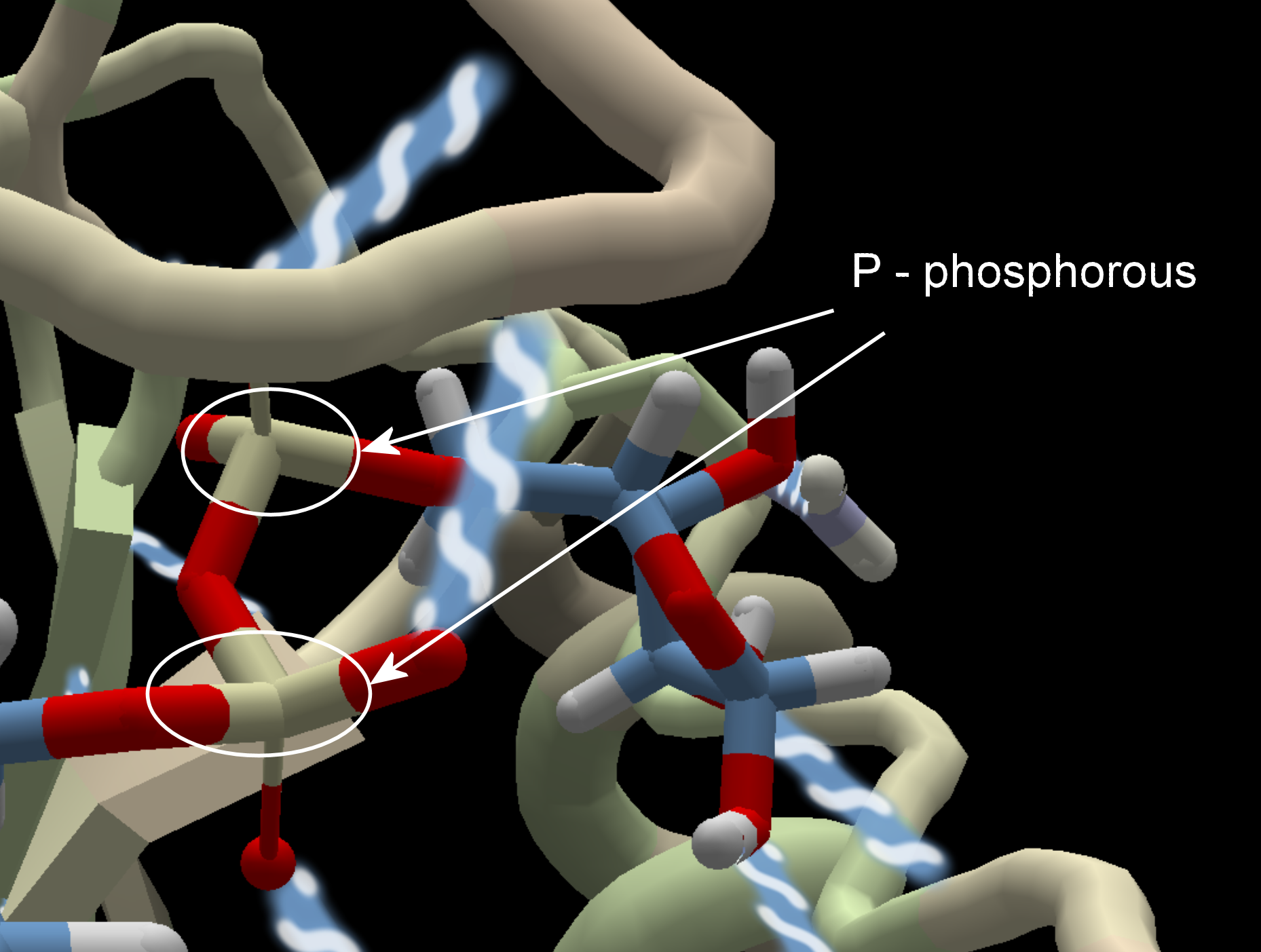
We also had a question on the two mystery atoms in the starting pose. They're phosphorous, and they're a little hard to work with.

Another question arrived in global chat: should the compound library be blank?

Good question, of course you have to submit a compound to search the compound library, then with luck, you get something to work with.

The starting compound in 2254 won't return any matches, in part due to those phosphorous atoms. So you'll need to delete a lot of atoms, but you'll find you can't just zap the phosphorouses (phosphouri?).

I'll post more on how to get rid of unwanted P. Meantime, here's a previous discussion on the difficulty in adding P in teh first place: https://fold.it/forum/bugs/answered-how-can-something-be-turned-into-phosphor

LociOiling Lv 1

Here are the two phosphorous atoms in the starting compound for 2254. The only clues are the color and the unusual bonding pattern. Both are bonded to four oxygen atoms, and there's a double bond to one oxygen for each.

Next, how to delete a phosphorous or two.

LociOiling Lv 1

Thanks to @HuubR, who found an easier way to remove unwanted phosphorus. I've added a new post below this one showing HuubR's method. I've also updated this post in a few spots.

Here's the updated version of my somewhat involved process for dealing with those two phosphorus atoms.

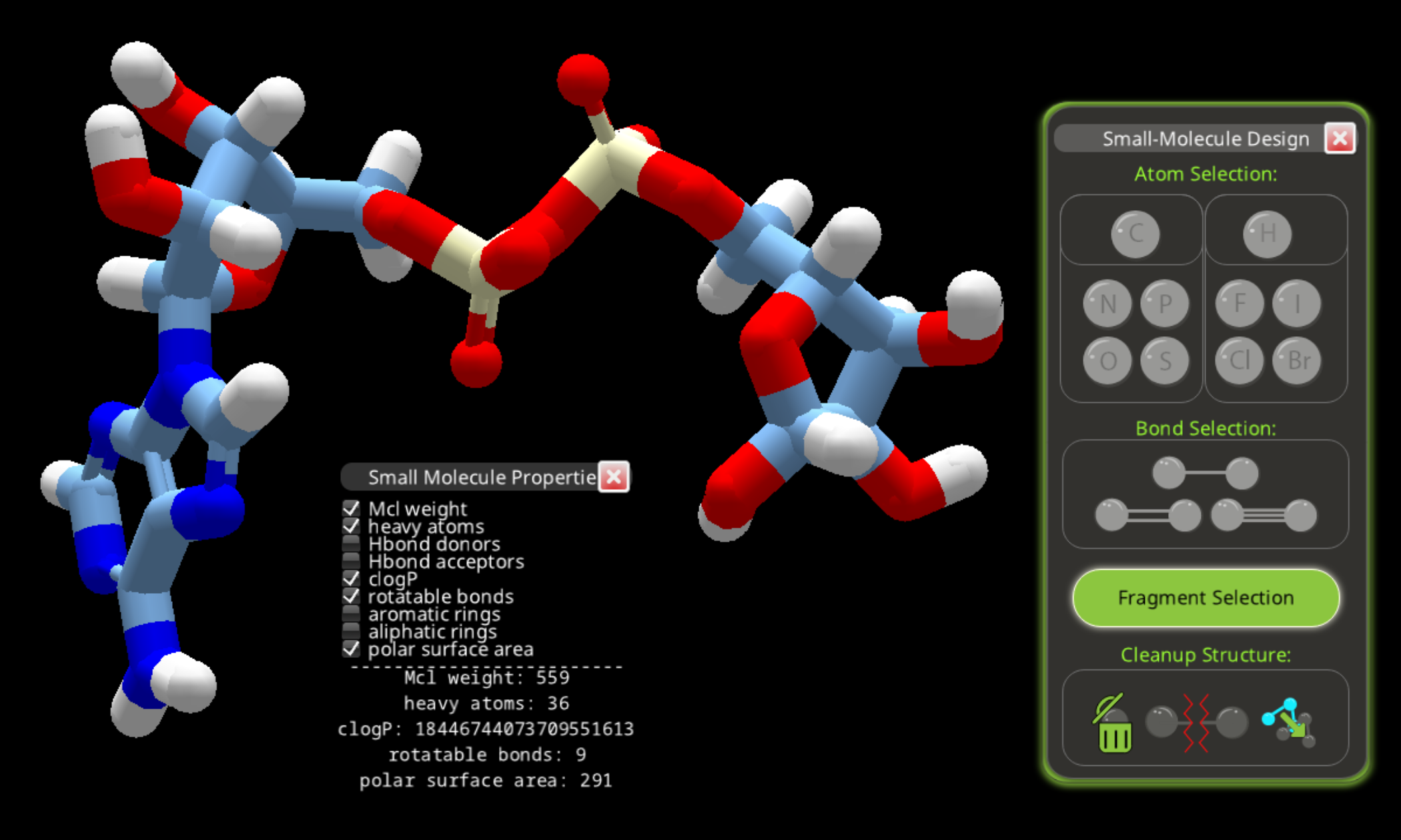
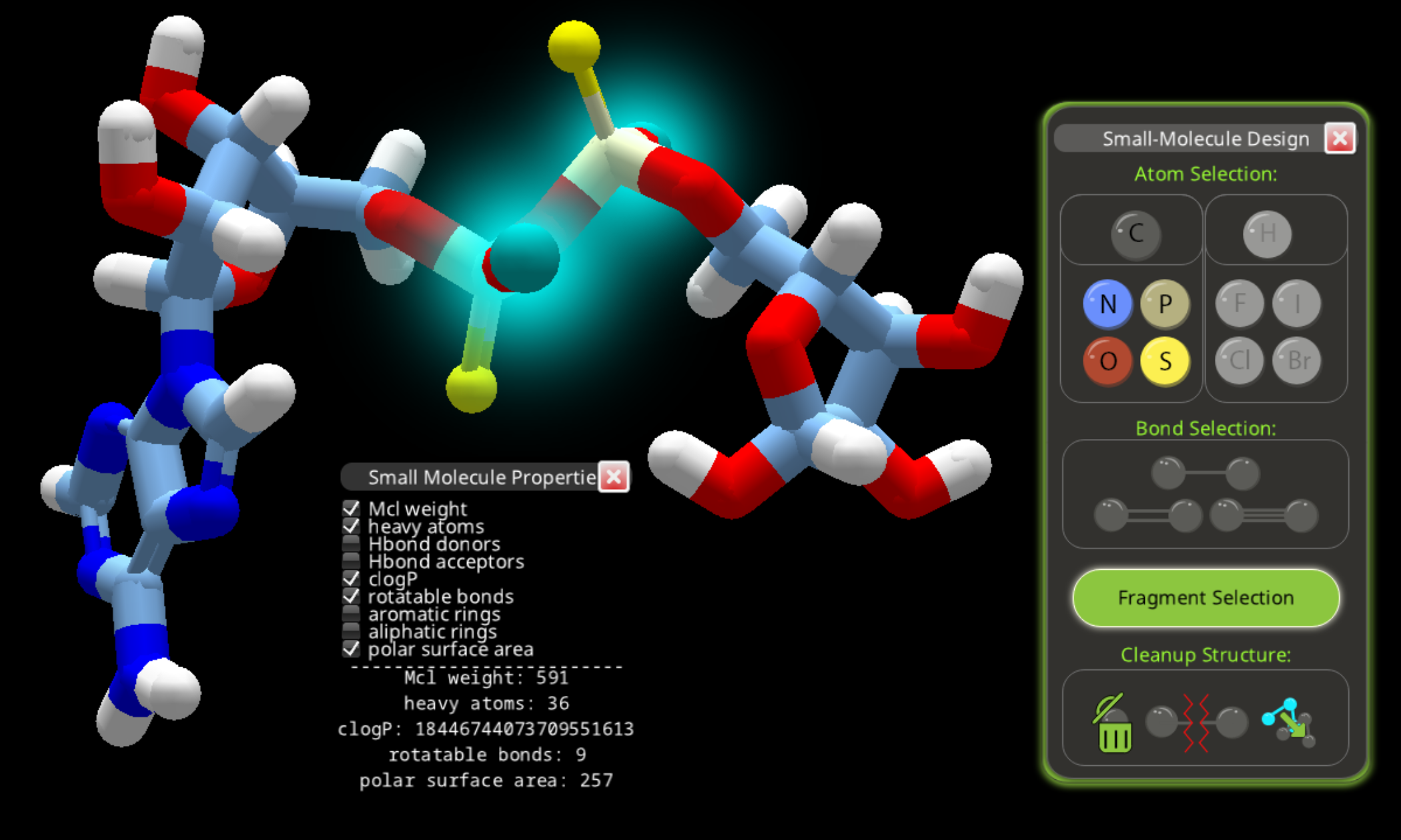
With the ligand moved away from the protein, here's the starting compound:

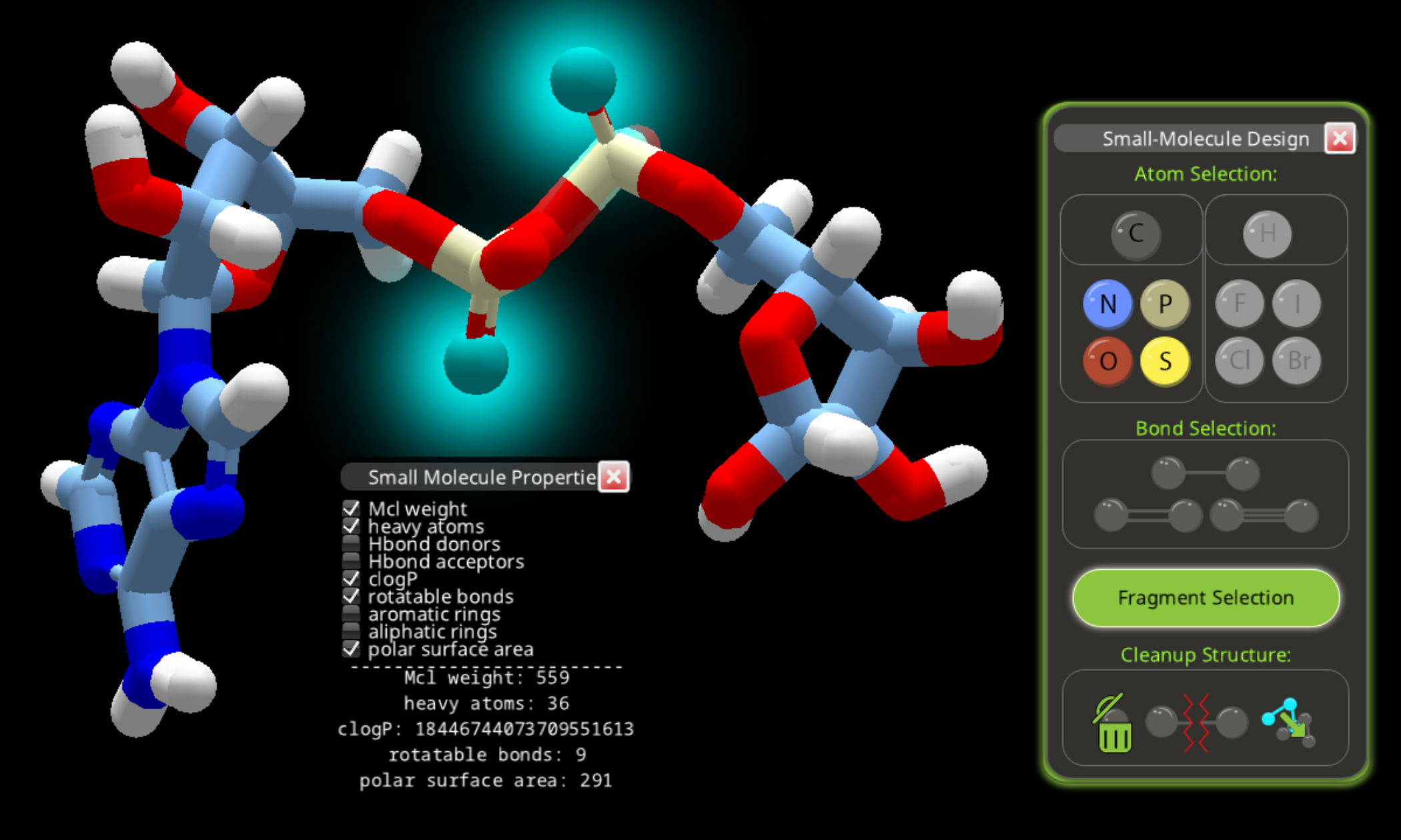
In my method, select the two oxygen atoms that are double-bonded to phosphorus. (HuubR's method selects the single-bonded oxygens instead.)

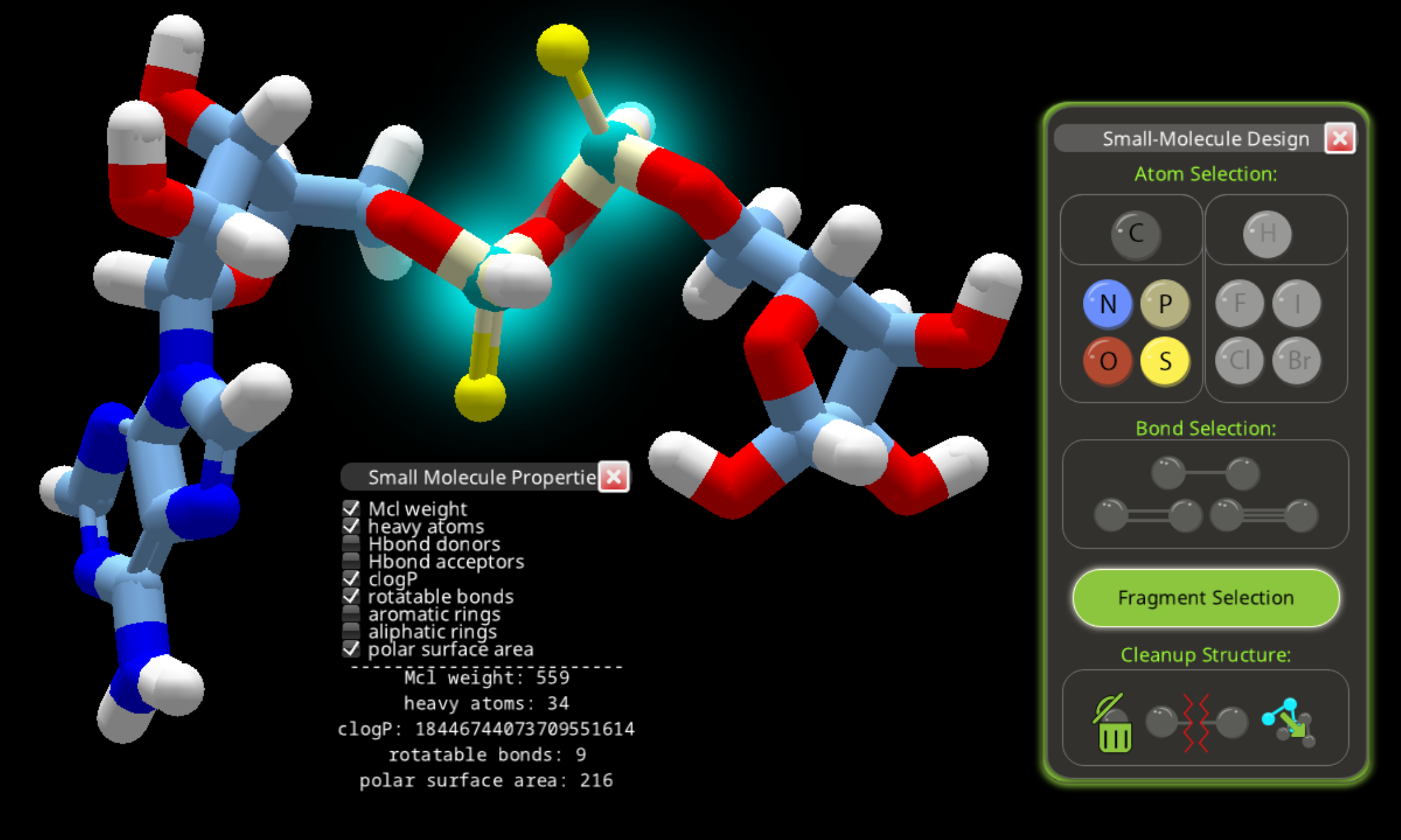
Then, in Atom Selection, click S for sulfur. (HuubR's method deletes the single-bonded oxygens.)

Now select the other oxygen next to each phosphorus, the one that isn't part of the backbone. (These are already gone in HuubR's method.)

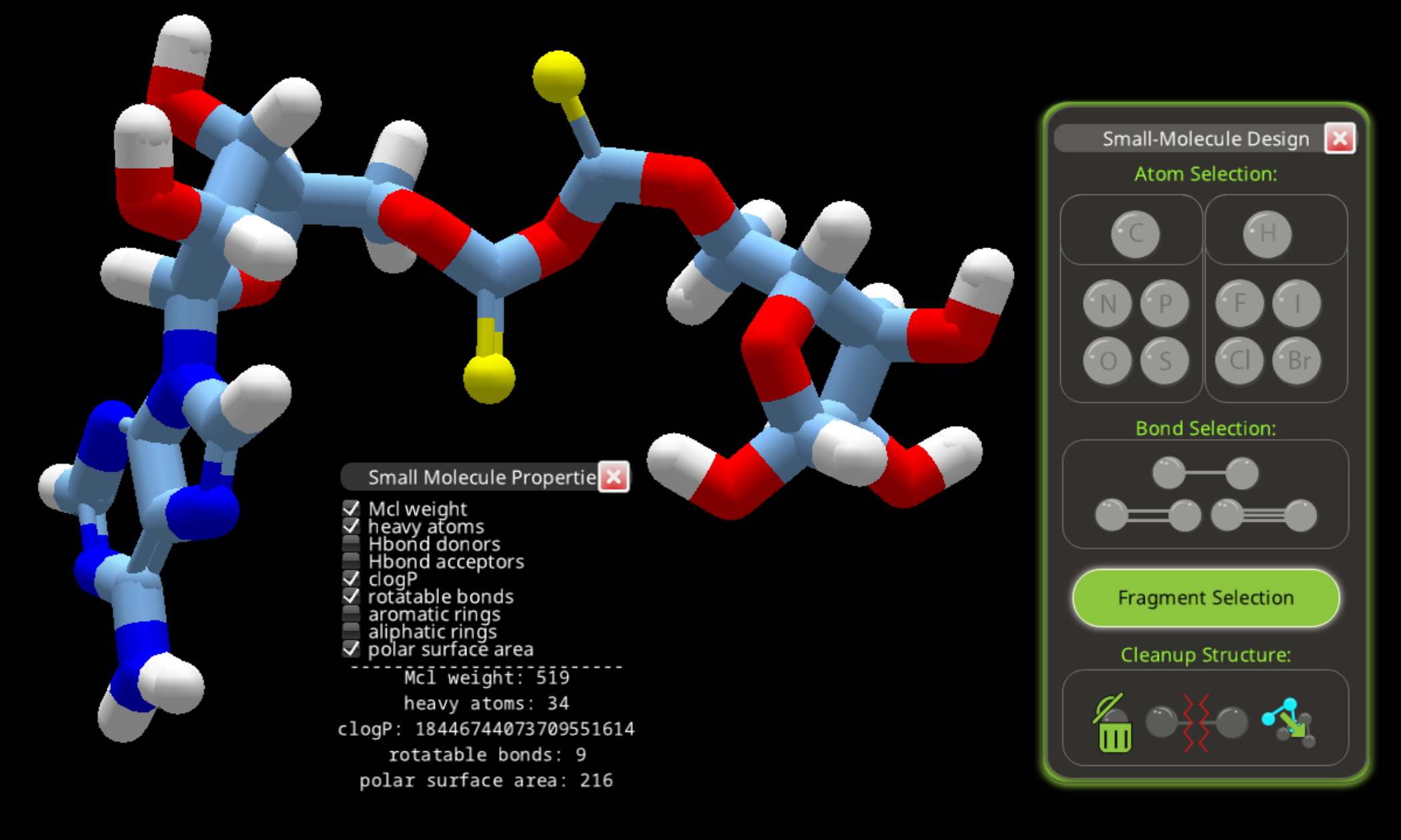
Use the trash can icon to delete the two oxygen atoms, then select the phosphorus atoms. (HuubR did this a few steps back.)

Click C for carbon to eliminate the phosphorus. (We are back in sync at this point.)

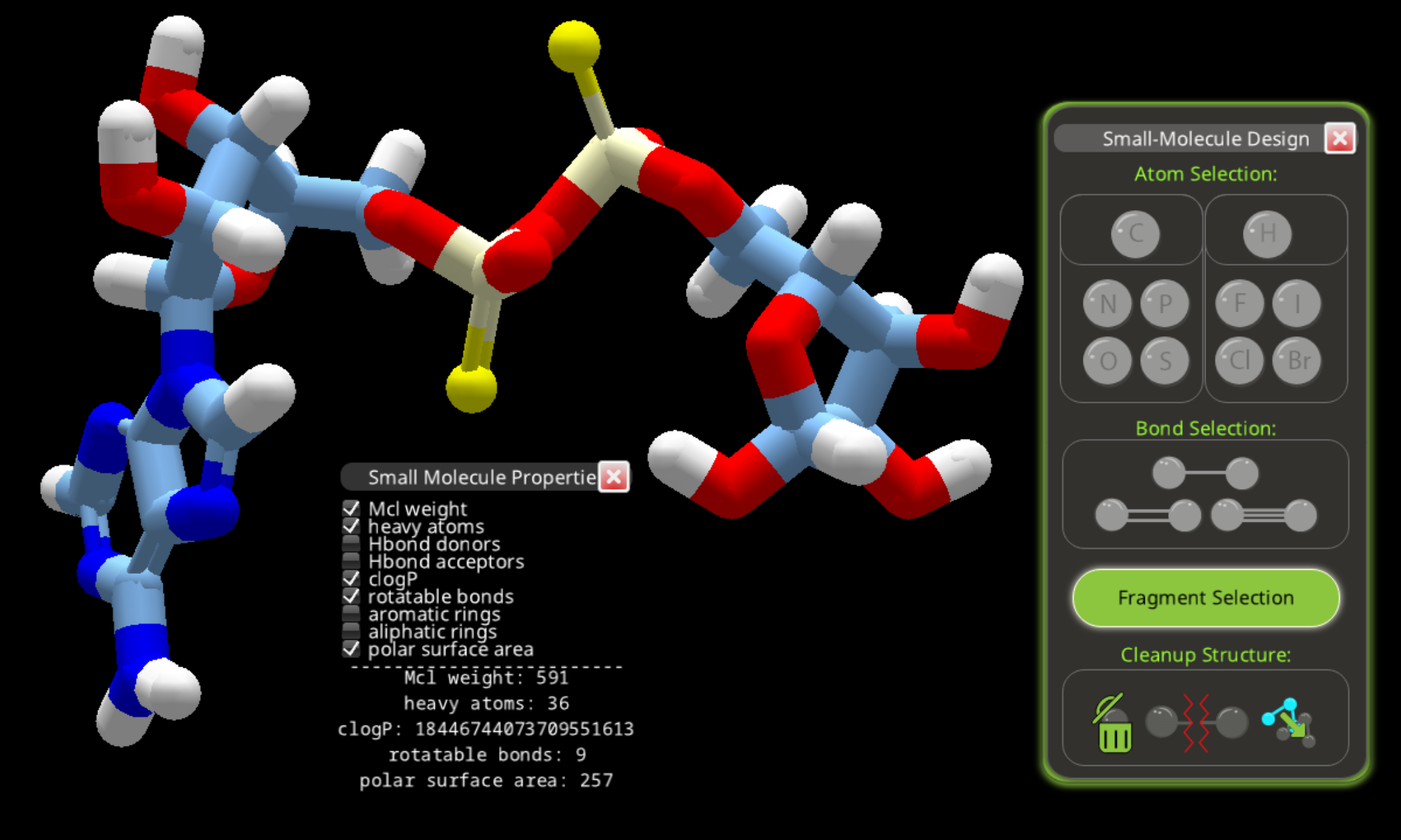
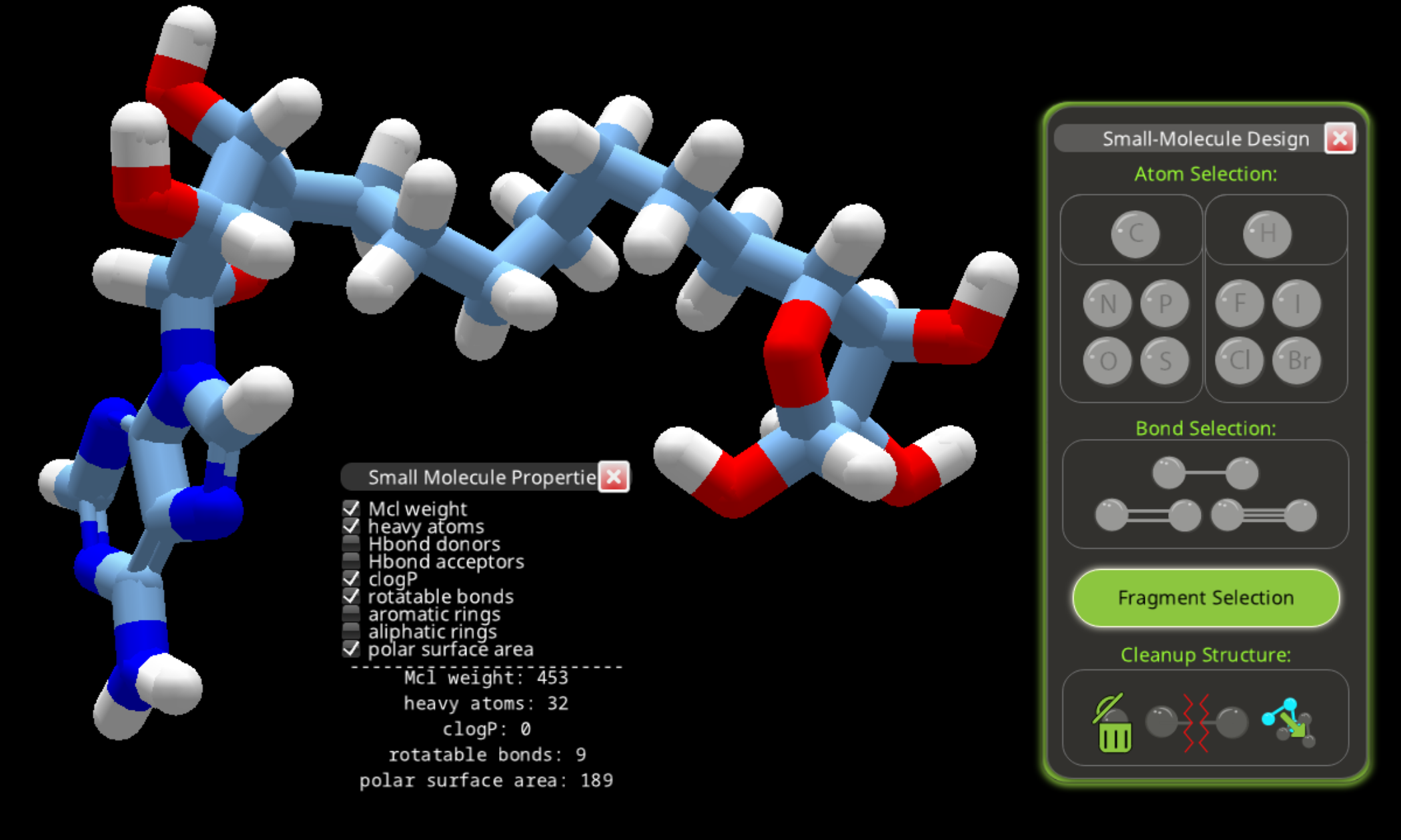
With the phosphorus gone, you'll see fewer "not chemically feasible" errors. The double-bonded sulfurs can now be deleted. Those oxygen atoms in the backbone can also be converted to carbon without any trouble. The result would be:

The resulting molecule is still too heavy, but it should be much easier to trim it now.