


Icon representing a puzzle

2316: KLHDC2 the Next Level: Round 3

Closed since over 2 years ago

Intermediate Overall Small Molecule Design

Summary


Created
June 16, 2023
Expires
Max points
100
Description

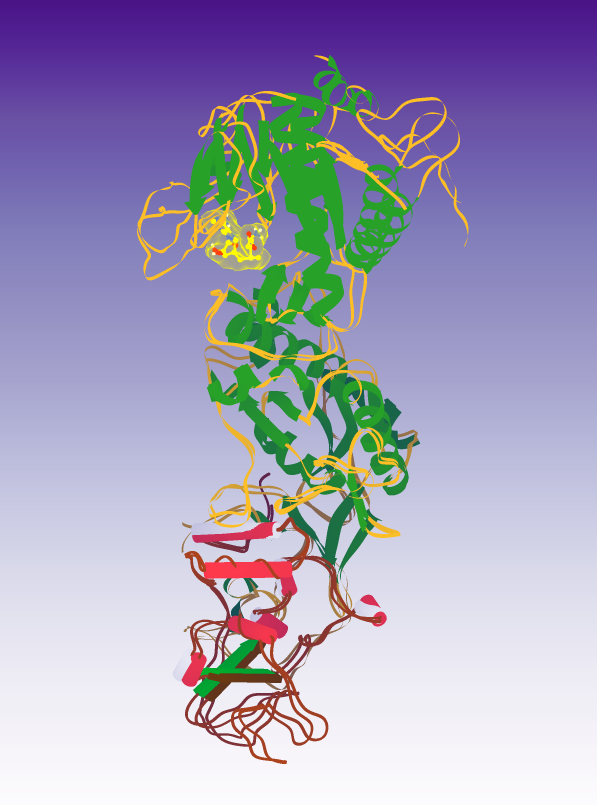
Foldit players have discovered a small molecule fragment which binds well to KLHDC2. Take this starting fragment and expand upon it.

Round 3 is very similar to Round 2 - but the updates to the Compound Library search should mean you find many more on-library compounds to test. We've also tweaked the objective parameters slightly.

Note: To get the most out of the small molecule design tools, we recommend changing you view settings to the Small Molecule Design Preset.

This is a project in collaboration with Boehringer Ingelheim. The structures of all compounds created as part of the collaboration puzzles as well as any experimental results from testing them will be made publicly available. All participants and game sponsors of current and future small molecule design games commit to complying with the Foldit Terms of Service including those pertaining to intellectual property.

Top groups


  1. Avatar for Go Science 100 pts. 23,499
  2. Avatar for Contenders 2. Contenders 70 pts. 23,486
  3. Avatar for Gargleblasters 3. Gargleblasters 47 pts. 23,292
  4. Avatar for Anthropic Dreams 4. Anthropic Dreams 30 pts. 23,289
  5. Avatar for Marvin's bunch 5. Marvin's bunch 19 pts. 23,285
  6. Avatar for BIchallenge 6. BIchallenge 11 pts. 23,283
  7. Avatar for AlphaFold 7. AlphaFold 7 pts. 23,279
  8. Avatar for VeFold 8. VeFold 4 pts. 23,247
  9. Avatar for Ogre's lab 9. Ogre's lab 2 pts. 23,234
  10. Avatar for L'Alliance Francophone 10. L'Alliance Francophone 1 pt. 23,115

  1. Avatar for Galaxie 11. Galaxie Lv 1 50 pts. 23,285
  2. Avatar for BootsMcGraw 12. BootsMcGraw Lv 1 46 pts. 23,284
  3. Avatar for julianfuchs 13. julianfuchs Lv 1 43 pts. 23,283
  4. Avatar for rosie4loop 14. rosie4loop Lv 1 40 pts. 23,280
  5. Avatar for gmn 15. gmn Lv 1 37 pts. 23,279
  6. Avatar for AlphaFold2 16. AlphaFold2 Lv 1 34 pts. 23,279
  7. Avatar for Bletchley Park 17. Bletchley Park Lv 1 31 pts. 23,277
  8. Avatar for carxo 18. carxo Lv 1 29 pts. 23,247
  9. Avatar for spvincent 19. spvincent Lv 1 26 pts. 23,246
  10. Avatar for dcrwheeler 20. dcrwheeler Lv 1 24 pts. 23,245

Comments


rmoretti Staff Lv 1

Objectives

Maximum bonus: +12 000

Core (max +1000)
Does the small molecule design contain the starting molecule as a substructure, or the essential features from one of the known binders?

HBond (max +1000)
Is the ligand making hydrogen bonds to the same groups on the protein as the starting structure does? (Show highlights the groups on the protein which need to be hydrogen bonded.)

Compound Library (max +1000)
Gives a bonus if your current compound is in the library. This uses a local cached version of the Compound Library search results to determine if the compound is in the library. If you manually create a compound that happens to be in the library (or if you load a shared solution with an on-library compound), you may need to submit the compound to the compound library search and wait to get the results back before the objective can properly recognize that the compound is in the library. (If the objective is not updating, try wiggling the structure. See this forum post for more discussion.)

Torsion Quality (max +1000)
Keeps bond rotations in a good range. Using Wiggle or Tweak Ligand can fix bad torsions. (Show highlights torsions to be rotated.)

Number of Rotatable Bonds (max +1000)
Intended to keep the ligand from getting too big and floppy. You can reduce rotatable bonds by deleting groups or forming rings. (Show highlights rotatable bonds.)

Ligand TPSA (max +1000)
Topological Polar Surface Area - Keeps the polar surface area (including buried polar surface) low. To improve, try removing oxygens and nitrogens. (Show highlights atoms contributing to higher TPSA.)

Ligand cLogP (max +1000)
A measure of polarity - Keeps the molecule from getting too hydrophobic. To improve, try adding polar oxygens and nitrogens. (Show highlights atoms contributing to higher cLogP.)

Ligand Hydrogen Bond Donors (max +1000)
Keep the number of ligand hbond donors low. (Show highlights atoms which are counted as hydrogen bond donors.)</li>

Bad Groups (max +1000)
Gives a bonus for avoiding groups that interfere with assays, or which are far from the compounds in the library. (Show highlights groups at issue.)

Element Counts (max +1000)
Gives a bonus for not having too many of particular elements. (Show highlights atoms which are over represented.)

Molecular Weight (max +1000)
Keeps the ligand a reasonable size.

Synthetic Accessibility (max +1000)
Keeps the ligand from going too far from the compounds in the library. (Show highlights parts of the molecule at issue.)

jeff101 Lv 1

Is it possible to make the HBond bonus incremental instead of all-or-nothing for future puzzles in this series? In 2313 it wanted 5 specific hydrogen bonds to form, but instead of giving 200 points as each one formed, it gave 0 points until all 5 formed. Having this bonus/objective be incremental might help tricky ligands form and maintain the 5 desired hydrogen bonds.

rosie4loop Lv 1

In my opinion, the weights of Core + Library bonus is too high (2000), giving a bias to small fragments taken from the compound library. Compound library bonus is actually 2000 instead of 1000 due to the conditional filter of core. It is not a good idea if the puzzle aim for the exploration of more diverse structures in the chemical space. Since its harder to create something bigger that pass both of these filters.

The starting fragment (compound 12) already gives 23116 points after a library search and some wiggles. It is rather difficult to get over that without a library hit, which could result in premature convergence to the same/highly similar structures even if there are 100 players designing independently without any discussion (its not evolutionary algorithms but us human may have similar behavior, eventually converging to something similar to the seed because of the bias).

Unless its intended to optimize the core fragment instead of making a drug-like compound with a certain degree of chemical diversity. Otherwise I believe it'd be better to re-balance the weights of the two filters.

Edit: additional comments on the possible aims of the puzzle
If the puzzle aim to "search for ideal core fragments from library search" it's more efficient to do it the standard way than asking human to do it. For those who are interested, here are some examples:

  • 2D similarity search (of ultra large database online) takes a few seconds,
  • 3D Pharmacophore search of existing 3D libraries (smaller database but still millions of compounds) takes a few minutes,
  • MD-aided docking-based virtual screening by downloading the 40K hits from ZINC purchasable or Enamine REAL via a default SmallWorld search -> generate 3D structures -> prepare receptors and ligands for docking -> docking -> rescoring top ligands with short MD takes at most 2 weeks on modern computers.
  • Even with limited CPU speed and cores and using old methodologies, vitural screening of the ZINC in-stock database (druglike/leadlike, with additional filtering and some clustering) can usually be done in a month.

I believe the niche of having human players designing a drug is the creativity and observing the "blind spot" of machines. Indeed to improve success rate we need some guidance on what is practical from the chemical/pharmaceutical perspective. It's probably not easy to find the right balance, good luck on that!

rmoretti Staff Lv 1

Due to logistics of testing, we're looking for purchasable molecules. There's not much room for custom synthesis on this project at this point. So we are indeed looking primarily at compounds which come from the library results.

We're also only interested in compounds which expand upon the preliminary experimental results. We've set the core objective to be rather generous with the pattern which is matched - it is extremely unlikely we'll experimentally test any compound which doesn't match the pattern.

That's the rationale behind the high value of the compound library objective and the core objective – things which don't pass both are probably not going to be considered for experimental testing.

rosie4loop Lv 1

I'd suspect a set of less diverse structures since it's not easy to score higher than the 23116 points of compound 12 even for compounds taken from the compound library. But its fully understandable. As long as it works in some way there's something worth publishing even with lower novelty.

There's still questions like "why spending 10 weeks for human to select compounds while conventional methods could achieve the same sooner than that, not too many compounds left in the library after applying the filters".

I do hope Foldit players could select molecules that traditional techniques would have falsely rejected!