





Icon representing a puzzle

2319: KLHDC2 the Next Level: Round 4

Closed since over 2 years ago

Intermediate Overall Small Molecule Design

Summary


Created
June 23, 2023
Expires
Max points
100
Description

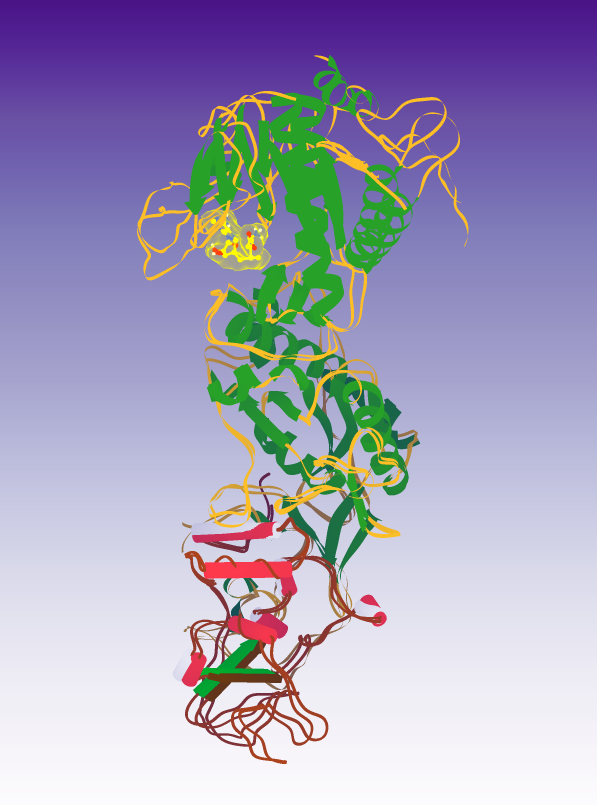
Foldit players have discovered a small molecule fragment which binds well to KLHDC2. Take this starting fragment and expand upon it.

For Round 4 we're asking you to concentrate on making hydrophobic contacts to three residues which we know are important for the binding of the original parent peptide. These are Tyrosine 23, Leucine 299 and Leucine 300, all on the "left" side of the pocket (when viewed with the carboxylate binding site at the top). You can use the TAB key when hovering over a residue to see the residue number. Alternatively, use the "Show" checkbox for the Ligand Hydrophobic Interaction objective to highlight in red those protein residues involved. You'll get a bonus for each of the three residues which are making a decent packing interaction with the ligand. -- Note that all the other objectives are still active, so you'll still have to keep the core in place. Grow the ligand to make the new interactions.

Note: To get the most out of the small molecule design tools, we recommend changing you view settings to the Small Molecule Design Preset.

This is a project in collaboration with Boehringer Ingelheim. The structures of all compounds created as part of the collaboration puzzles as well as any experimental results from testing them will be made publicly available. All participants and game sponsors of current and future small molecule design games commit to complying with the Foldit Terms of Service including those pertaining to intellectual property.

Top groups


  1. Avatar for Go Science 100 pts. 24,452
  2. Avatar for Anthropic Dreams 2. Anthropic Dreams 70 pts. 24,064
  3. Avatar for AlphaFold 3. AlphaFold 47 pts. 23,958
  4. Avatar for Contenders 4. Contenders 30 pts. 23,815
  5. Avatar for BIchallenge 5. BIchallenge 19 pts. 23,704
  6. Avatar for Australia 6. Australia 11 pts. 23,633
  7. Avatar for Gargleblasters 7. Gargleblasters 7 pts. 23,468
  8. Avatar for VeFold 8. VeFold 4 pts. 23,248
  9. Avatar for Marvin's bunch 9. Marvin's bunch 2 pts. 23,248
  10. Avatar for Ogre's lab 10. Ogre's lab 1 pt. 23,054

  1. Avatar for Sandrix72
    1. Sandrix72 Lv 1
    100 pts. 24,452
  2. Avatar for pr0tfold 2. pr0tfold Lv 1 93 pts. 24,349
  3. Avatar for rosie4loop 3. rosie4loop Lv 1 86 pts. 24,306
  4. Avatar for nspc 4. nspc Lv 1 79 pts. 24,182
  5. Avatar for Bruno Kestemont 5. Bruno Kestemont Lv 1 73 pts. 24,164
  6. Avatar for blazegeek 6. blazegeek Lv 1 67 pts. 24,131
  7. Avatar for gmn 7. gmn Lv 1 62 pts. 24,064
  8. Avatar for Galaxie 8. Galaxie Lv 1 57 pts. 23,990
  9. Avatar for AlphaFold2 9. AlphaFold2 Lv 1 52 pts. 23,958
  10. Avatar for abiogenesis 10. abiogenesis Lv 1 47 pts. 23,878

Comments


rmoretti Staff Lv 1

Objectives

Maximum bonus: +13 000

Core (max +1000)
Does the small molecule design contain the starting molecule as a substructure, or the essential features from one of the known binders?

HBond (max +1000)
Is the ligand making hydrogen bonds to the same groups on the protein as the starting structure does? (Show highlights the groups on the protein which need to be hydrogen bonded.)

Ligand Hydrophobic Interaction (max +1000)
Is the ligand making good hydrophobic packing interactions with specific residues? (Show highlights the residues on the protein which should be involved in the interaction.)

Compound Library (max +1000)
Gives a bonus if your current compound is in the library. This uses a local cached version of the Compound Library search results to determine if the compound is in the library. If you manually create a compound that happens to be in the library (or if you load a shared solution with an on-library compound), you may need to submit the compound to the compound library search and wait to get the results back before the objective can properly recognize that the compound is in the library. (If the objective is not updating, try wiggling the structure. See this forum post for more discussion.)

Torsion Quality (max +1000)
Keeps bond rotations in a good range. Using Wiggle or Tweak Ligand can fix bad torsions. (Show highlights torsions to be rotated.)

Number of Rotatable Bonds (max +1000)
Intended to keep the ligand from getting too big and floppy. You can reduce rotatable bonds by deleting groups or forming rings. (Show highlights rotatable bonds.)

Ligand TPSA (max +1000)
Topological Polar Surface Area - Keeps the polar surface area (including buried polar surface) low. To improve, try removing oxygens and nitrogens. (Show highlights atoms contributing to higher TPSA.)

Ligand cLogP (max +1000)
A measure of polarity - Keeps the molecule from getting too hydrophobic. To improve, try adding polar oxygens and nitrogens. (Show highlights atoms contributing to higher cLogP.)

Ligand Hydrogen Bond Donors (max +1000)
Keep the number of ligand hbond donors low. (Show highlights atoms which are counted as hydrogen bond donors.)</li>

Bad Groups (max +1000)
Gives a bonus for avoiding groups that interfere with assays, or which are far from the compounds in the library. (Show highlights groups at issue.)

Element Counts (max +1000)
Gives a bonus for not having too many of particular elements. (Show highlights atoms which are over represented.)

Molecular Weight (max +1000)
Keeps the ligand a reasonable size.

Synthetic Accessibility (max +1000)
Keeps the ligand from going too far from the compounds in the library. (Show highlights parts of the molecule at issue.)