





Bruno Kestemont Lv 1
Amazing puzzle. Does it really exist in the nature ?


Closed since about 2 years ago
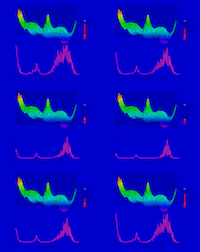
Novice Novice Novice Novice Novice Novice Novice Novice Novice Novice Overall Overall Overall Overall Overall Overall Overall Overall Overall Overall Prediction Prediction Prediction Prediction Prediction Prediction Prediction Prediction Prediction Prediction Electron Density Electron Density Electron Density Electron Density Electron Density Electron Density Electron Density Electron Density Electron Density Electron DensityThis is a structure that's been published previously, but we think it has some issues that need revision. This is a cryo-EM structure of a fibril isolated from a patient with Multiple System Atrophy. Although the structure in general could use work, we're especially suspicious of the positioning of the segment K80. Since it's a fibril, there's several copies of the protein stacked together here, making it a large puzzle, and so the trim tool is highly recommended.
 100 pts.
61,805
100 pts.
61,805

Amazing puzzle. Does it really exist in the nature ?
Please create functions to use the trim tool from recipes

Segment K80? I don't understand this designation. Segment 80 is a glycine. Did you mean segment #8, which is a lysine (K)?
I agree that K80 is a mystery. There's no chain K, chains A-J only, so K must mean lysine. But there's a lot of lysine in this puzzle.
Also, the 10 chains in this puzzle are a match for α-synuclein, which gets a lot of entries in the PDB, for example:
https://www.rcsb.org/structure/6CU7
6CU7 looks a lot like our puzzle. The description mentions "fibrils".
I guess this puzzle is a plaque of prions, or something like that.

@beta_helix @rmoretti You write: "we're especially suspicious of the positioning of the segment K80" What is it exactly that you are suspicious about and what IS segment K80 ?

Ah- K is indeed for lysine, and 80 is the segment number within each of the stacked fibrils. Each stack member of the stack has the same sequence. Does that now make more sense?
There are actually several similar structures in the PDB as this, many with the same sequence; they fibrils isolated from different patients that have the same protein forming fibrils in their brains.
So segment #67 (PDB A80) and its analogs in the other layers of the stack is the one in question. I then echo Bletchley Park's query. What do you think is suspicious about it??
I didn't really want to bias you as to what we thought might be suspicious to see what you think. But I'll give an outline of my thoughts on it.
It's a lysine, which are notorious for being quite flexible, and therefore the density for the sidechains are often incomplete. The thing that caught my eye is that it looks like that wasn't the assumption when its rotamer for it was chosen. Turns out, it seems like this might make a difference in how people interpret how these fibrils form in disease.

This isn't a protein, it's a chain-link fence.