




rmoretti Staff Lv 1
Objectives
Maximum bonus: +1 000
Torsion Quality (max +1000)
Keeps bond rotations in a good range. Using Wiggle or Tweak Ligand can fix bad torsions. (Show highlights torsions to be rotated.)

Closed since almost 2 years ago
Intermediate Intermediate Intermediate Intermediate Intermediate Intermediate Overall Overall Overall Overall Overall Overall Small Molecule Design Small Molecule Design Small Molecule Design Small Molecule Design Small Molecule Design Small Molecule DesignUse the Reaction Design Panel (no default hotkey) and the Compound Library (default hotkey H) to explore how different ligands bind to the protein.
This puzzle is part of the CASP16 competition. Foldit players are participating to see how well they can predict how small molecules can bind to proteins. Note that in contrast to prior drug design puzzles, we're not just interested in the top scoring small molecule, but instead are interested in getting good structures for each of the provided ligand compounds. Its worth dividing your time across all the compounds, rather than concentrating on a particular one.
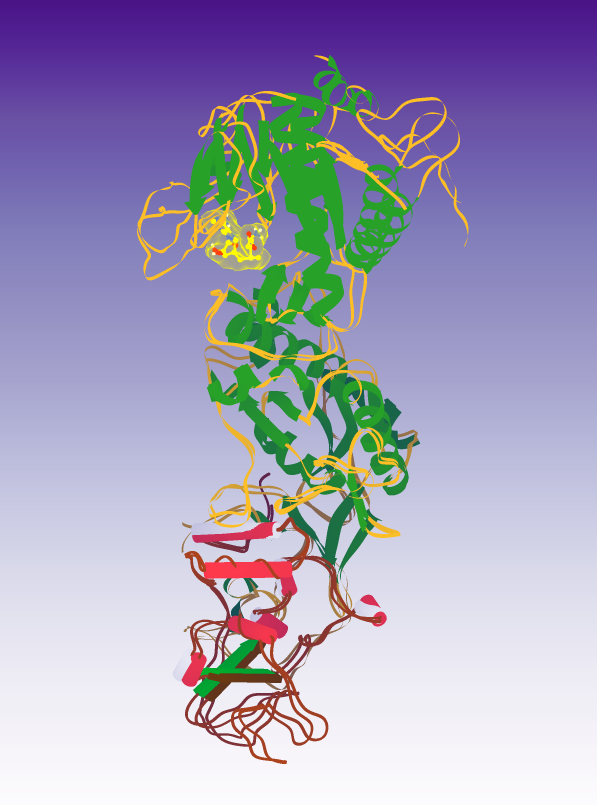
The protein target is rat autotaxin There are several dozen structures of this protein in the Protein Databank, many of them bound to ligands. There are 219 ligand structures of interest in this competition. The starting small molecule is one of the co-crystalized ligands, and is provided just to indicate the likely binding site. It's not one of the molecules in the competition - you'll need to use the Ligand Queue and Compound Library tools in order to load one of the other ligands.
Since the goal is to predict the structure of the protein ligand complex, we've allowed full backbone and sidechain flexibility on this puzzle. -- That said, all of the bound structures are highly similar to each other (and thus to the starting structure). The backbone is very unlikely to change at all from the starting conformation, and there a restraints (unchangeable bands) to the starting conformation -- these will show up as red lines if you move the backbone too far. It should also be noted that we haven't given you the full 846 amino acid long protein the CASP organizers are looking for, but just the ligand binding domain.
We're starting with a different protein backbone and seed ligand structure than with Rounds 1 & 2. But the list of compounds available in the Reaction Design panel as well as the Compound Library should be reduced from the previous rounds (146) -- these are the compounds we need more sampling on.
As with Round 2, the Reaction Design panel is set up for "single component" reactions: The "reactions" across the top are a selection of common substructures, and the reagents below are the various compounds you can select. All the ligands to test should be accessible directly from the Reaction Design panel.
For people who prefer it, the Ligand Queue is also enabled, with a set of compounds which is different than Round 1 & 2.
 100 pts.
25,892
100 pts.
25,892
Maximum bonus: +1 000
Torsion Quality (max +1000)
Keeps bond rotations in a good range. Using Wiggle or Tweak Ligand can fix bad torsions. (Show highlights torsions to be rotated.)

The full list of compounds on the wiki has been updated since the last round: CASP16 L3000 compounds
HuubR added molecule viewer links for each of the 219 compounds. Most of the compounds now have a complete set of small molecule properties.
Right now, the molecule viewer is ailing, but the full list of SMILES is also available as a standalone: CASP16 L3000 compound SMILES
Maybe your molecule viewer uses a different path, but Jmol uses the same cactus.nci.nih.gov server that the molecule viewer links do. The cactus server seems to be ailing. Hopefully, it will be back soon.
There's also now a list with the details of the isomers found in the 219 compounds. With the help of jeff101, we've identified eight pairs of isomers in the original 219 compounds. These isomers have the same molecular weights, but differ in the arrangement of atoms. The list is still a work in progress, but is available here: https://foldit.fandom.com/wiki/CASP16_L3000_isomers
There are also several compound library hits which returned multiple entries, in some cases up to four. We still haven't begun to deal with that yet.
We'll also try to identify the compounds that are available in round 3. The puzzle comments indicate it's now a smaller list.
Good news for reaction design fans. Round 3 had no reaction design duplicates, where round 2 had quite a number of them. Round 3 reaction design produces 146 compounds by my count. (Edit: round 2 reaction design produced 147 compounds, plus a lot of duplicates.)
HuubR also tackled the isomers issue, and produced CASP16 L3000 identical weights. I like his approach, which highlights the differences.
Just in time for the puzzle to expire, the CASP16 L3000 compounds list has been updated with the reaction design results for round 3. You may need to scroll right to see them, since there a lot of columns now.
The isomers column has been moved next to molecular weight, where it belongs.
The entries for a number of the isomers have been corrected. This affected only the compound library and reaction design results for round 2, which in some case identified the wrong isomer in a pair.
Compound L3031 remains a mystery. If anyone has seen it, please post its properties and how you found it. Its molecular weight is 400.32 Da.
The compound library results for rounds 1 and 3 haven't been analyzed yet, so it's possible the L3031 is lurking in there somewhere.