


Placeholder image of a protein
Icon representing a puzzle

2482: KCNQ1 Round 3

Closed since over 1 year ago

Intermediate Overall Small Molecule Design

Summary


Created
July 12, 2024
Expires
Max points
100
Description

KCNQ1 is a critical gene that helps regulate the heart's rhythm by encoding the Kv7.1 potassium ion channel. Mutations in KCNQ1 can cause congenital long QT syndrome (LQTS), an inherited heart condition that increases the risk of sudden cardiac death, especially in young people. In this puzzle, your challenge is to design a new activator for KCNQ1 that can restore function in variants linked to LQTS. For this puzzle we're going to switch up the task just a little. Now we want to target the Voltage Sensing Domain (VSD) of KCNQ1. It has been found that mutations to the VSD affect how effectively a protein is transported from its site of synthesis to the plasma membrane also known as trafficking. See blog post for more details, but note that we are looking at a different target site for KCNQ1 for this puzzle.

Join us in this exciting quest to develop new treatments for LQTS and make a real difference in heart health! Your innovative designs could be the key to creating effective therapies for this serious condition.

*Note: While it may be possible to accept compounds not in the Compound Library for further testing, compounds from the CL have the highest likelihood to be selected.

Top groups


  1. Avatar for VeFold
    1. VeFold
    100 pts. 20,051
  2. Avatar for Go Science 2. Go Science 68 pts. 19,850
  3. Avatar for Gargleblasters 3. Gargleblasters 44 pts. 19,510
  4. Avatar for Contenders 4. Contenders 27 pts. 18,823
  5. Avatar for Void Crushers 5. Void Crushers 16 pts. 18,146
  6. Avatar for Anthropic Dreams 6. Anthropic Dreams 9 pts. 17,961
  7. Avatar for Australia 7. Australia 5 pts. 17,851
  8. Avatar for L'Alliance Francophone 8. L'Alliance Francophone 3 pts. 17,356
  9. Avatar for Russian team 9. Russian team 1 pt. 17,154
  10. Avatar for Team China 10. Team China 1 pt. 17,153

  1. Avatar for nicobul 21. nicobul Lv 1 21 pts. 17,356
  2. Avatar for LociOiling 22. LociOiling Lv 1 19 pts. 17,345
  3. Avatar for vybi 23. vybi Lv 1 17 pts. 17,332
  4. Avatar for Galaxie 24. Galaxie Lv 1 16 pts. 17,315
  5. Avatar for rinze 25. rinze Lv 1 14 pts. 17,300
  6. Avatar for akaaka 26. akaaka Lv 1 13 pts. 17,284
  7. Avatar for blazegeek 27. blazegeek Lv 1 12 pts. 17,211
  8. Avatar for Anfinsen_slept_here 28. Anfinsen_slept_here Lv 1 10 pts. 17,209
  9. Avatar for Merf 29. Merf Lv 1 9 pts. 17,209
  10. Avatar for Steven Pletsch 30. Steven Pletsch Lv 1 8 pts. 17,172

Comments


Sciren Staff Lv 1

Objectives

Maximum bonus: +8000

Compound Library (max +1000)
Gives a bonus if your current compound is in the library. This uses a local cached version of the Compound Library search results to determine if the compound is in the library. If you manually create a compound that happens to be in the library (or if you load a shared solution with an on-library compound), you may need to submit the compound to the compound library search and wait to get the results back before the objective can properly recognize that the compound is in the library. (If the objective is not updating, try wiggling the structure. See this forum post for more discussion.)

Torsion Quality (max +1000)
Keeps bond rotations in a good range. Using Wiggle or Tweak Ligand can fix bad torsions. (Show highlights torsions to be rotated.)

Number of Rotatable Bonds (max +1000)
Intended to keep the ligand from getting too big and floppy. You can reduce rotatable bonds by deleting groups or forming rings. (Show highlights rotatable bonds.)

Ligand TPSA (max +1000)
Topological Polar Surface Area - Keeps the polar surface area (including buried polar surface) low. To improve, try removing oxygens and nitrogens. (Show highlights atoms contributing to higher TPSA.)

Ligand cLogP (max +1000)
A measure of polarity - Keeps the molecule from getting too hydrophobic. To improve, try adding polar oxygens and nitrogens. (Show highlights atoms contributing to higher cLogP.)

Bad Groups (max +1000)
Gives a bonus for avoiding groups that interfere with assays, which are far from the compounds in the library, or which otherwise have issues. (Show highlights groups at issue.)

Molecular Weight (max +1000)
Keeps the ligand within a reasonable size limit.

Synthetic Accessibility (max +1000)
Keeps the ligand from going too far from the compounds in the library. (Show highlights parts of the molecule at issue.)
HuubR Lv 1

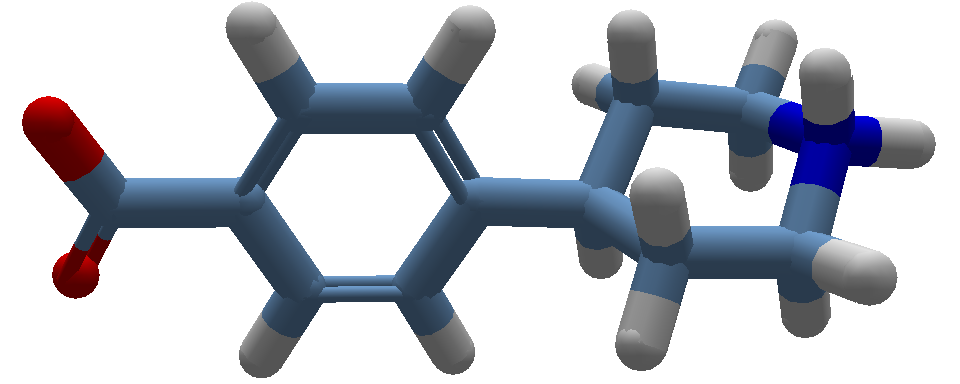
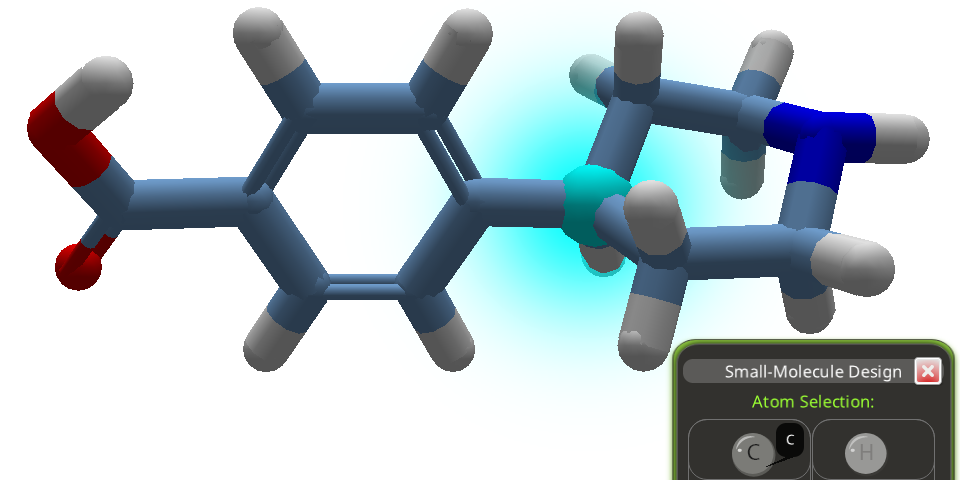
It's a bit surprising (to me, at least) that the starting ligand has a COOH group, including a hydrogen. And on the other side (literally), there is a nitrogen in an aliphatic ring, with only one hydrogen.
I've come to expect, during the past Small Molecule Design puzzles, that a carboxyl group would lose its hydrogen under the conditions used in Foldit ("deprotonation": C(=O)OH becomes C(=O)[O-]), and that any amine that is not close to a double bond would get an extra hydrogen ("protonation": NH will turn into [NH2+]).
A simple experiment will show this behaviour: when I select an arbitrary carbon in the starting ligand,
and "modify" that carbon into itself,
the carbonyl (left) will indeed be deprotonated and the amine (right) protonated.

Is there a specific reason why the starting ligand is different from the "normal" protonated / deprotonated state?
Or is it simply irrelevant, because the starting ligand is just a placeholder?

rmoretti Staff Lv 1

When molecules are generated within Foldit, there's code which gets called which attempts to make the molecule be protonated like it would be "physiologically" – that's what you're seeing when you do the C->C modification. The molecule gets passed through the protonation code and gets "fixed" to what it should be.

The reason why the starting molecule has a different protonation state is because Foldit accepts the description of molecules built outside of Foldit as-is. It just so happened that the version of the molecule we got has the "neutral" protonation state, rather than the physiological one. The neutral state is what synthetic chemists (who usually work in non-polar solvents) typically think of the molecule as, so there's a bit of translating which needs to happen between the "chemist view" and the "biochemist view", and that sometimes gets missed.

It shouldn't really matter here, though. Any modification made to the ligand should "fix" the protonation state. Only the starting molecule should thus have the incorrect neutral state. We're only interested in new compounds, not the starting molecule, so any mistakes in scoring the starting molecule really don't matter as we'll be ignoring it anyway.