
Placeholder image of a protein
Icon representing a puzzle

2512: KCNQ1 VSD Round 1

Closed since over 1 year ago

Intermediate Overall Small Molecule Design

Summary


Created
September 20, 2024
Expires
Max points
100
Description

KCNQ1 is a critical gene that helps regulate the heart's rhythm by encoding the Kv7.1 potassium ion channel. Mutations in KCNQ1 can cause congenital long QT syndrome (LQTS), an inherited heart condition that increases the risk of sudden cardiac death, especially in young people. While previous puzzles have focused on one domain of KCNQ1, in this challenge we're taking a similar but different approach by targeting the Voltage Sensing Domain (VSD) of KCNQ1.

It has been found that mutations in the VSD affect how effectively the protein is transported from its site of synthesis to the plasma membrane—a process known as trafficking. Proper trafficking is essential for the Kv7.1 channel to function correctly in regulating heart rhythm. To tackle this issue, we conducted blind docking of compounds that have been tested in the lab for their ability to modulate trafficking. Blind docking is a computational technique where compounds are docked to a protein without predefined binding sites, allowing us to identify potential interaction regions. Interestingly, the docked poses showed consensus in this critical region of the VSD, indicating a potential hotspot for modulating trafficking.

Join us in this exciting quest to develop new treatments for LQTS and make a real difference in heart health! Your innovative designs could be the key to creating effective therapies for this serious condition.

*Note: While it may be possible to accept compounds not in the Compound Library for further testing, compounds from the CL have the highest likelihood to be selected.

Top groups


  1. Avatar for Go Science 100 pts. 21,458
  2. Avatar for Anthropic Dreams 2. Anthropic Dreams 73 pts. 21,206
  3. Avatar for Contenders 3. Contenders 52 pts. 21,038
  4. Avatar for Gargleblasters 4. Gargleblasters 36 pts. 20,533
  5. Avatar for VeFold 5. VeFold 24 pts. 20,238
  6. Avatar for FamilyBarmettler 6. FamilyBarmettler 16 pts. 20,055
  7. Avatar for Marvin's bunch 7. Marvin's bunch 10 pts. 19,411
  8. Avatar for Australia 8. Australia 6 pts. 19,369
  9. Avatar for L'Alliance Francophone 9. L'Alliance Francophone 4 pts. 19,319
  10. Avatar for Void Crushers 10. Void Crushers 2 pts. 19,159

  1. Avatar for zerodab
    1. zerodab Lv 1
    100 pts. 21,440
  2. Avatar for gmn 2. gmn Lv 1 94 pts. 21,201
  3. Avatar for BootsMcGraw 3. BootsMcGraw Lv 1 87 pts. 20,701
  4. Avatar for blazegeek 4. blazegeek Lv 1 81 pts. 20,678
  5. Avatar for nspc 5. nspc Lv 1 76 pts. 20,571
  6. Avatar for HuubR 6. HuubR Lv 1 70 pts. 20,533
  7. Avatar for spvincent 7. spvincent Lv 1 65 pts. 20,471
  8. Avatar for NinjaGreg 8. NinjaGreg Lv 1 60 pts. 20,468
  9. Avatar for LociOiling 9. LociOiling Lv 1 56 pts. 20,431
  10. Avatar for JuliaBCollet 10. JuliaBCollet Lv 1 52 pts. 20,238

Comments


Sciren Staff Lv 1

Objectives

Maximum bonus: +8000

Compound Library (max +1000)
Gives a bonus if your current compound is in the library. This uses a local cached version of the Compound Library search results to determine if the compound is in the library. If you manually create a compound that happens to be in the library (or if you load a shared solution with an on-library compound), you may need to submit the compound to the compound library search and wait to get the results back before the objective can properly recognize that the compound is in the library. (If the objective is not updating, try wiggling the structure. See this forum post for more discussion.)

Torsion Quality (max +1000)
Keeps bond rotations in a good range. Using Wiggle or Tweak Ligand can fix bad torsions. (Show highlights torsions to be rotated.)

Number of Rotatable Bonds (max +1000)
Intended to keep the ligand from getting too big and floppy. You can reduce rotatable bonds by deleting groups or forming rings. (Show highlights rotatable bonds.)

Ligand TPSA (max +1000)
Topological Polar Surface Area - Keeps the polar surface area (including buried polar surface) low. To improve, try removing oxygens and nitrogens. (Show highlights atoms contributing to higher TPSA.)

Ligand cLogP (max +1000)
A measure of polarity - Keeps the molecule from getting too hydrophobic. To improve, try adding polar oxygens and nitrogens. (Show highlights atoms contributing to higher cLogP.)

Bad Groups (max +1000)
Gives a bonus for avoiding groups that interfere with assays, which are far from the compounds in the library, or which otherwise have issues. (Show highlights groups at issue.)

Molecular Weight (max +1000)
Keeps the ligand within a reasonable size limit.

Synthetic Accessibility (max +1000)
Keeps the ligand from going too far from the compounds in the library. (Show highlights parts of the molecule at issue.)

Sciren Staff Lv 1

@jeff101 In the previous puzzles we used the vsd for some of the puzzles, but a different starting conformation therefore the backbone and sidechains in the vsd will be different. For this puzzle series we narrowed down our search region and are only focusing on the vsd, and more specifically areas that are completely or nearly completely enclosed by the vsd so that when integrated to the full model, the cell membrane will not pose an issue.

jeff101 Lv 1

What do you mean by vsd? Is it a certain range of segments in Puzzle 2512?

Does this mean we should put our ligands anywhere inside the protein visible in Puzzle 2512?
Should we try to keep our ligands near certain protein segments? If so, which ones?
Should we avoid having our ligands lie on the outer surface of the protein visible in Puzzle 2512?

jeff101 Lv 1

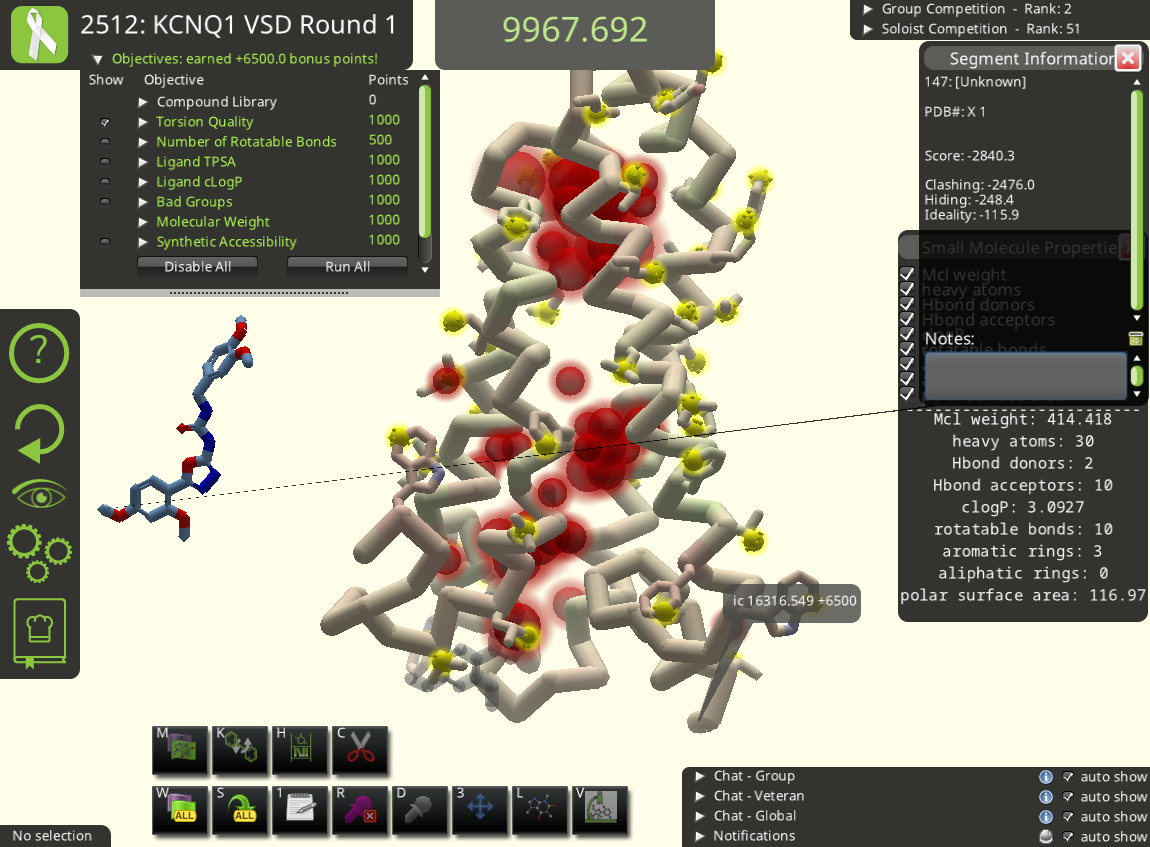
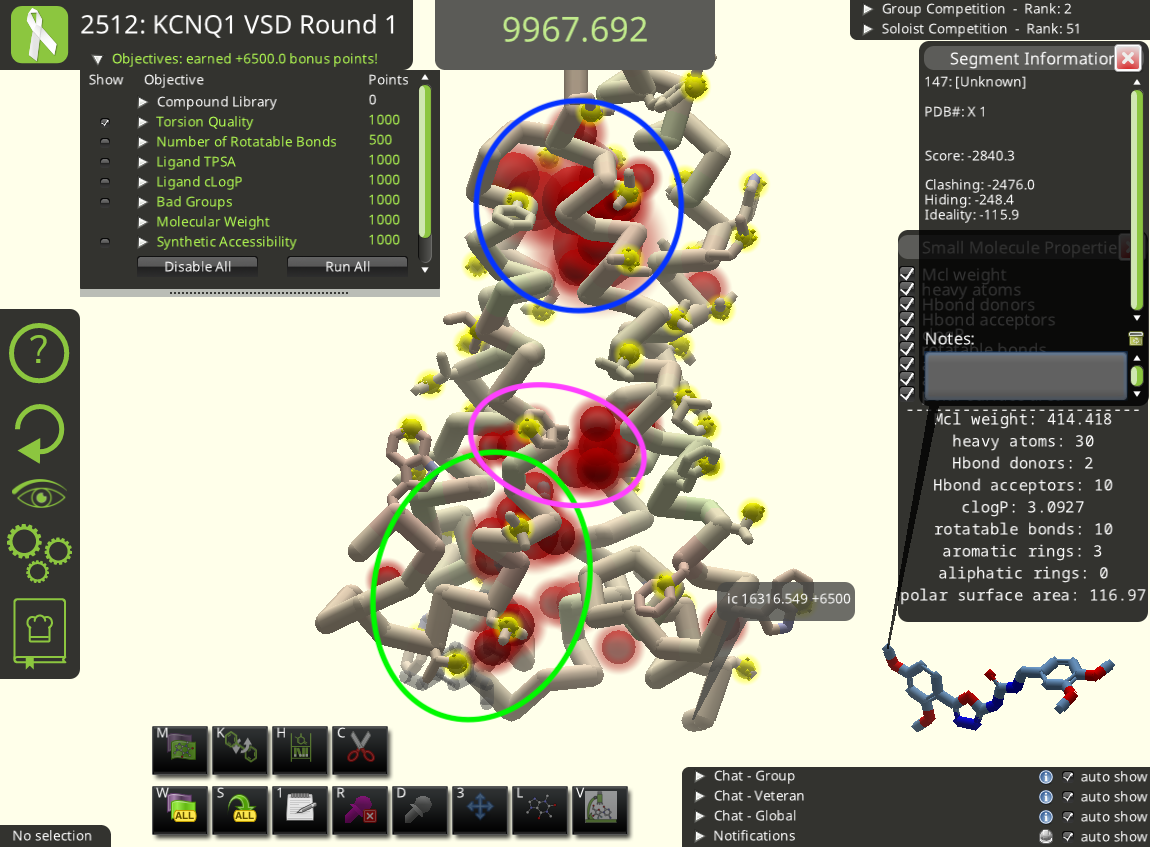
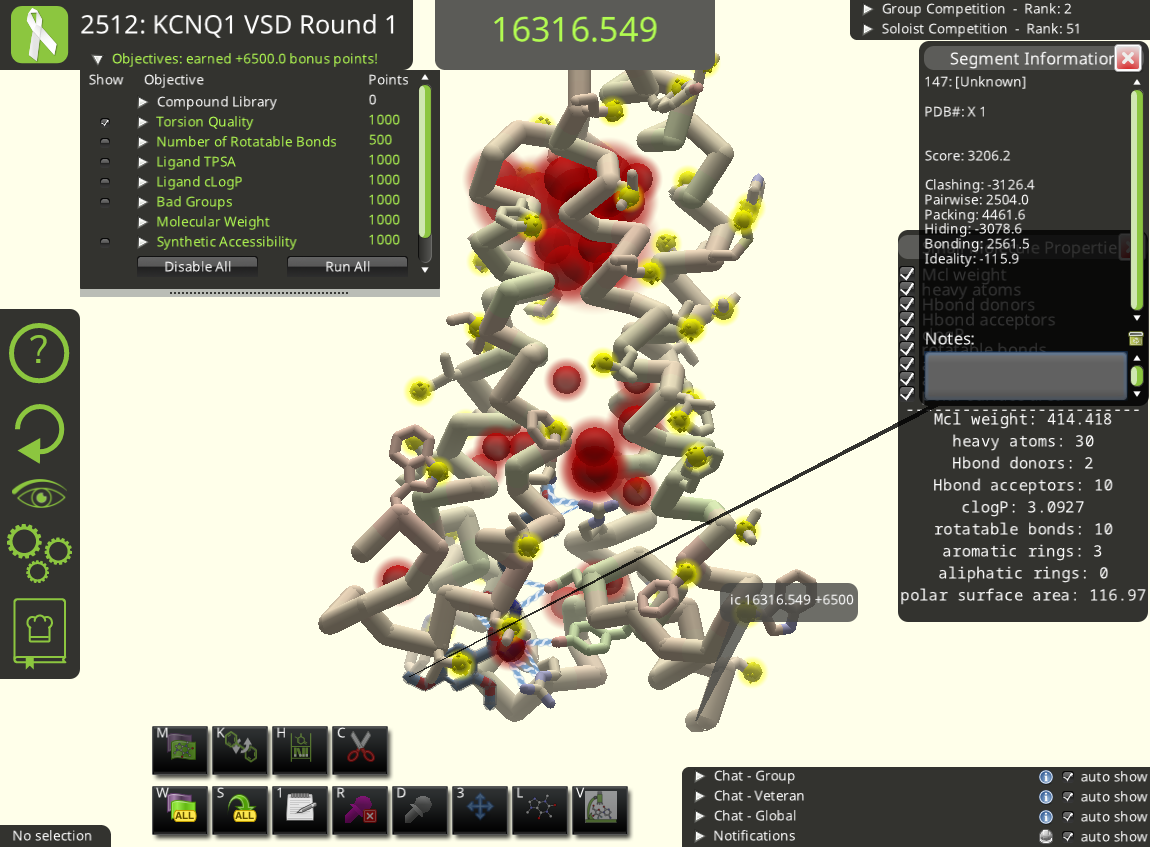
Below are two screenshots from Puzzle 2512. Both were made using the puzzle's starting ligand (I call it ic) in its starting position for the Guide. They also used the View Options: Show torsions, clashes, exposed, voids, bonds (non-protein), guide, & sidechains with clashes or exposeds. They also used Color: Ligand Specific, View Protein: Trace Tube, View Hydrogens: Hide All H, View Sidechains: Don't Show (Fast), Light background, & Orthographic. I did Home right before I took each screenshot.

Screenshot (1) below was taken with the starting ligand (I call it ic) in its starting position so it lined up with the Guide:

Screenshot (2) below was taken after translating the starting ligand (ic) to the left of the protein using the Move Tool:

jeff101 Lv 1

Screenshot (2) above shows with red spheres the many voids within the protein. Screenshot (1) above shows that some of these voids get filled when the ligand is put in its starting position. Do you want us to put our designed ligands close to the starting ligand's position? Would it be wrong to put our designed ligands into the other large clusters of voids in screenshot (2)?

Sciren Staff Lv 1

@jeff101 to try and answer some of your questions:

1. What do you mean by VSD? Is it a certain range of segments in Puzzle 2512?

  • The Voltage Sensing Domain (VSD) is a critical part of the KCNQ1 potassium ion channel responsible for sensing changes in voltage across the cell membrane, leading to the opening or closing of the channel. The structure you are seeing in puzzle 2512 is a truncated version for KCNQ1 that contains the VSD only.

2. Does this mean we should put our ligands anywhere inside the protein visible in Puzzle 2512?

  • While you have flexibility in where to place ligands, it's more effective to target specific regions. Some key interactions can be residues about 5-7 A from the current ligand location in the VSD. This will increase the likelihood of discovering promising designs.

3. Should we try to keep our ligands near certain protein segments? If so, which ones?

  • Yes, targeting specific protein segments within the VSD is ideal. The docking studies propose this pose as a way for the compound to dock to the vsd. Because experimental evaluation of these compounds bound to kcnq1 has not been conducted, you should aim to place ligands near regions of the starting ligand.

4. Should we avoid having our ligands lie on the outer surface of the protein visible in Puzzle 2512?

  • Yes, because our scoring functions aren't as robust against these membrane exposed regions, therefore it is best to keep designs inside of the vsd. It has been proposed to be more effective to target regions where the ligand can interact with buried or semi-buried residues within the VSD.

As always feel free to explore the interaction space but we will get the most return for effort if you focus your designs on regions inside the VSD.

jeff101 Lv 1

Below is screenshot (3). It is a lot like screenshot (2), but here I used the Move Tool to translate & rotate ic (the starting ligand) to a different position outside the protein. Then I put colored ovals around the three main clusters of red voids within the protein. The starting position for the ligand is inside the green oval. If you look closely, you can also see the Guide inside the green oval.

In Puzzle 2512, are we supposed to keep our designed ligand inside the green oval? Would it be wrong to instead put our designed ligand inside the magenta or blue oval?

Sciren Staff Lv 1

@jeff101 building or "growing" your small molecule into the area in magenta is something that we are indeed interested in. I would only caution you about moving too far outside of the green area that you have circled. As for the blue area, it is possible that in later iterations of this puzzle series, or another with a similar objective, we would want to look into the area in blue that you have highlighted, but at the moment it isn't as strong of an area of interest.