



Placeholder image of a protein
Icon representing a puzzle

2582: HIKESHI Round 2

Closed since 12 months ago

Intermediate Overall Small Molecule Design

Summary


Created
March 07, 2025
Expires
Max points
100
Description

HIKESHI Associated Leukodystrophy (HAL), also known as Hypomyelinating Leukodystrophy-13 (HLD13), is a devastating neurodegenerative disease that affects young children. Caused by specific mutations in the Hikeshi protein, HAL leads to severe neurological problems such as developmental delays, muscle stiffness (spasticity), and a smaller-than-normal head size (microcephaly). Tragically, children with HAL often experience a rapid decline or even death after a fever.

Scientists believe that these mutations make Hikeshi unstable, causing it to misfold. But there's hope! Just as small molecules have been used to help stabilize misfolded proteins in other diseases—like cystic fibrosis—we want to find molecules that could do the same for Hikeshi.

In this puzzle series, you'll start with a candidate molecule placed in a potential binding pocket on Hikeshi. Your challenge is to tweak and optimize this molecule to help stabilize the protein's structure. By using your skills, you could contribute to the discovery of a treatment for HAL and related neurodegenerative disorders.

Top groups


  1. Avatar for BearCorp 11. BearCorp 1 pt. 4,526
  2. Avatar for Foldit Staff 12. Foldit Staff 1 pt. 3,970

  1. Avatar for meatexplosion
    1. meatexplosion Lv 1
    100 pts. 18,303
  2. Avatar for JuliaBCollet 2. JuliaBCollet Lv 1 93 pts. 17,862
  3. Avatar for gmn 3. gmn Lv 1 87 pts. 17,477
  4. Avatar for BootsMcGraw 4. BootsMcGraw Lv 1 80 pts. 16,823
  5. Avatar for g_b 5. g_b Lv 1 74 pts. 16,468
  6. Avatar for LociOiling 6. LociOiling Lv 1 69 pts. 16,366
  7. Avatar for dcrwheeler 7. dcrwheeler Lv 1 64 pts. 15,964
  8. Avatar for Bruno Kestemont 8. Bruno Kestemont Lv 1 59 pts. 15,873
  9. Avatar for alcor29 9. alcor29 Lv 1 54 pts. 15,837
  10. Avatar for jamiexq 10. jamiexq Lv 1 50 pts. 15,471

Comments


Sciren Staff Lv 1

Objectives

Maximum bonus: +8000

Compound Library (max +1000)
Gives a bonus if your current compound is in the library. This uses a local cached version of the Compound Library search results to determine if the compound is in the library. If you manually create a compound that happens to be in the library (or if you load a shared solution with an on-library compound), you may need to submit the compound to the compound library search and wait to get the results back before the objective can properly recognize that the compound is in the library. (If the objective is not updating, try wiggling the structure. See this forum post for more discussion.)

Torsion Quality (max +1000)
Keeps bond rotations in a good range. Using Wiggle or Tweak Ligand can fix bad torsions. (Show highlights torsions to be rotated.)

Number of Rotatable Bonds (max +1000)
Intended to keep the ligand from getting too big and floppy. You can reduce rotatable bonds by deleting groups or forming rings. (Show highlights rotatable bonds.)

Ligand TPSA (max +1000)
Topological Polar Surface Area - Keeps the polar surface area (including buried polar surface) low. To improve, try removing oxygens and nitrogens. (Show highlights atoms contributing to higher TPSA.)

Ligand cLogP (max +1000)
A measure of polarity - Keeps the molecule from getting too hydrophobic. To improve, try adding polar oxygens and nitrogens. (Show highlights atoms contributing to higher cLogP.)

Bad Groups (max +1000)
Gives a bonus for avoiding groups that interfere with assays, which are far from the compounds in the library, or which otherwise have issues. (Show highlights groups at issue.)

Molecular Weight (max +1000)
Keeps the ligand within a reasonable size limit.

Synthetic Accessibility (max +1000)
Keeps the ligand from going too far from the compounds in the library. (Show highlights parts of the molecule at issue.)
LociOiling Lv 1

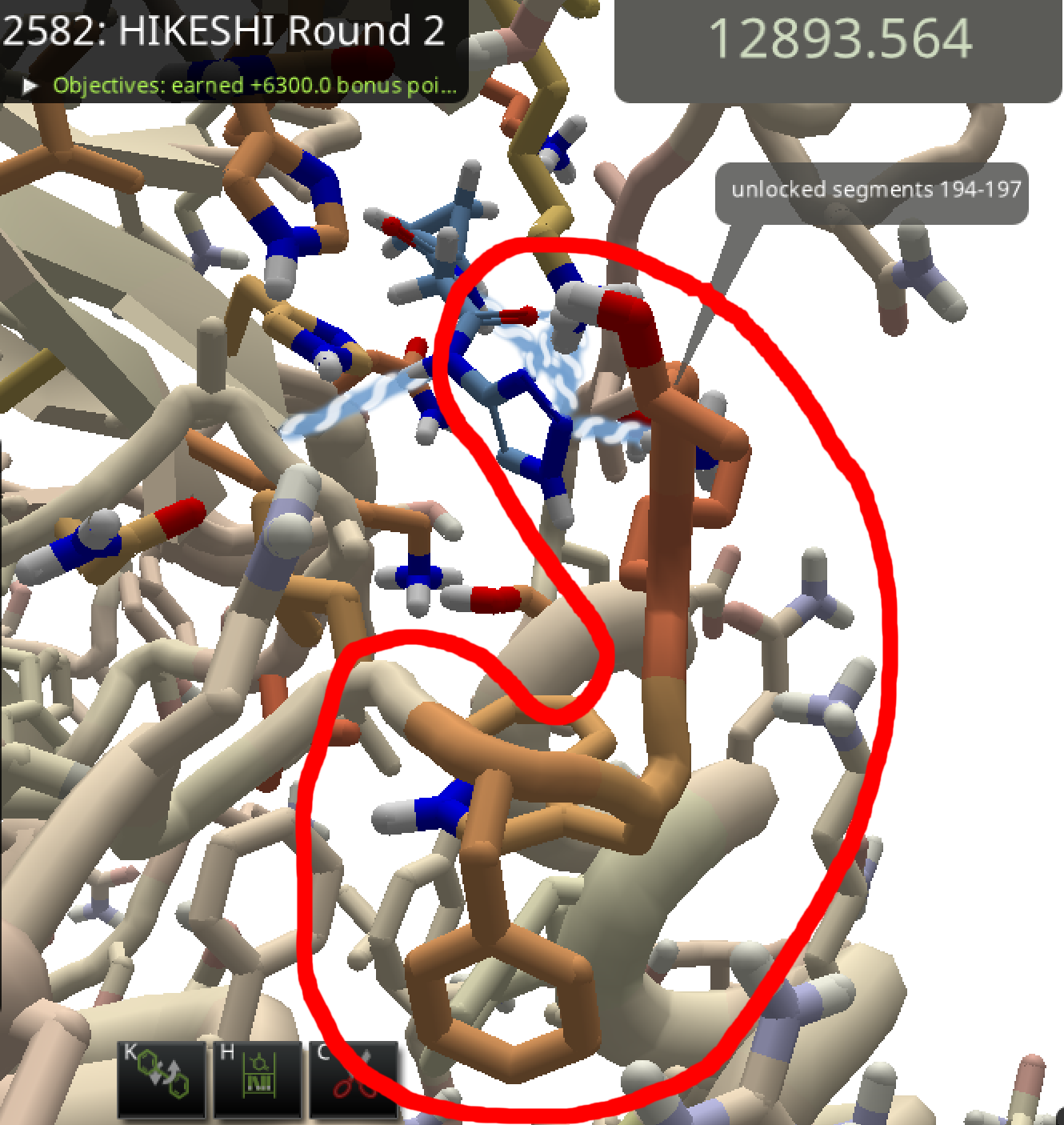
As seen in round 1, protein segments 194 to 197 have both backbone and sidechains unlocked. This is unusual in a ligand design puzzle, where normally only a few protein sidechains are unlocked, and the protein may be entirely locked in some cases.

One suggestion is to simply grab one of these segments and drag it toward the ligand. This seems to unlock a lot of points, with a little shaking and wiggling.

If you're using the "binding site" protein view, segments 194 to 197 might appear to be attached. If you switch to "ligand specific" or another cartoon view, you'll see they're attached to the rest of the protein. Technically, segment 197 is the C terminal of the A chain. (That's right, you should shake the A chain, but it won't get you to Harlem.)

The rebuild and remix tools aren't available in available in this puzzle. You also can't change the secondary structure of the unlocked segments, and there's no "idealize secondary structure" option. There's also no "idealize backbone" tool, but idealize recipes may still manage to find points.

LociOiling Lv 1

The recipe print protein 2.95 shows the locked and unlocked sections of the puzzle. This info appears only in the scriptlog output.

For 2582, protein segments 194 to 197 have unlocked backbone, as shown above. The ligand, which is segment 392 is also regarded as having unlocked backbone.

Also, print protein reports locked and unlocked sidechains. For 2582, there happens to be 11 ranges of locked sidechains, and 11 ranges of unlocked sidechains.

When you select all (ctrl + a), the backbone is highlighted along with the sidechains in the unlocked sidechains sections. This is confusing, since it makes it look like the backbone is also unlocked. When everything is deselected, only the backbone for 194 to 197 and the ligand segment 392 are colorful. The rest of the protein backbone is neutral color that means it's locked.

Here's what print protein shows for 2582:

modifiable sections - results in Lua table format using segment numbers
--
2 locked sections
locked = {
    { 1, 193, },
    { 198, 391, },
}
--
2 unlocked sections
unlocked = {
    { 194, 197, },
    { 392, 392, },
}
--
11 locked sidechain sections
locked_sidechain = {
    { 1, 33, },
    { 36, 80, },
    { 84, 128, },
    { 130, 131, },
    { 133, 192, },
    { 198, 229, },
    { 232, 272, },
    { 274, 276, },
    { 280, 328, },
    { 330, 332, },
    { 334, 391, },
}
--
11 unlocked sidechain sections
unlocked_sidechain = {
    { 34, 35, },
    { 81, 83, },
    { 129, 129, },
    { 132, 132, },
    { 193, 197, },
    { 230, 231, },
    { 273, 273, },
    { 277, 279, },
    { 329, 329, },
    { 333, 333, },
    { 392, 392, },
}

Sciren Staff Lv 1

@LociOiling Indeed this is not something that we normally do for a ligand puzzles, but in this case we wanted to allow a bit more flexibility around the placement of these residues while maintaining their identity. This will more than likely be the case throughout the rest of this puzzle series.