

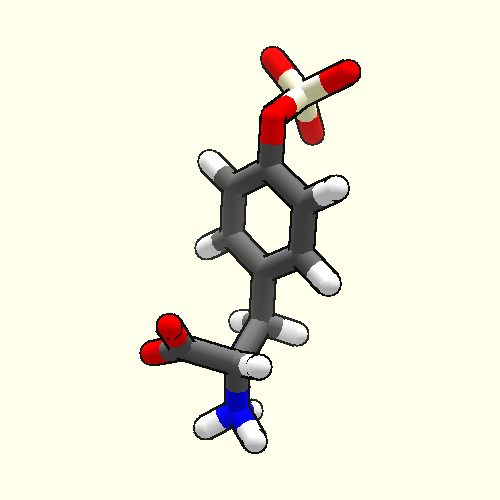


Placeholder image of a protein
Icon representing a puzzle

2000: Symmetric D2 Tetramer Design: Limited Interface

Closed since almost 5 years ago

Intermediate Overall Design Symmetry

Summary


Created
June 03, 2021
Expires
Max points
100
Description

Design a D2 symmetric protein tetramer, with 4 identical chains of 70 residues each! Unlike the cyclical C4 symmetry that we are used to, the proteins in this puzzle will come together as a "dimer of dimers" with D2 symmetry. This puzzle has no H-Bond Network Objective, but there is "Core Limit: Complex" objective meant to regulate the size of the interface between symmetric chains. An interface that is too large, with too many orange hydrophobics, can prevent the individual subunits from folding properly; on the other hand, an interface that is too small does not provide enough interactions for assembly The "Core Limit: Complex" objective will incur penalties if there are too many, or too few buried residues in the total assembly. This puzzle uses the Buried Unsats Objective, with a large penalty for buried polar atoms that can't make H-bonds. See the puzzle comments for more Objective details.

Top groups


  1. Avatar for Go Science 100 pts. 26,394
  2. Avatar for Contenders 2. Contenders 73 pts. 26,078
  3. Avatar for Anthropic Dreams 3. Anthropic Dreams 52 pts. 25,977
  4. Avatar for Beta Folders 4. Beta Folders 36 pts. 25,975
  5. Avatar for Marvin's bunch 5. Marvin's bunch 24 pts. 25,699
  6. Avatar for Gargleblasters 6. Gargleblasters 16 pts. 24,898
  7. Avatar for Void Crushers 7. Void Crushers 10 pts. 24,681
  8. Avatar for Australia 8. Australia 6 pts. 23,070
  9. Avatar for L'Alliance Francophone 9. L'Alliance Francophone 4 pts. 21,804
  10. Avatar for Team China 10. Team China 2 pts. 18,890

  1. Avatar for silent gene
    1. silent gene Lv 1
    100 pts. 26,086
  2. Avatar for infjamc 2. infjamc Lv 1 96 pts. 26,071
  3. Avatar for LociOiling 3. LociOiling Lv 1 91 pts. 25,975
  4. Avatar for grogar7 4. grogar7 Lv 1 87 pts. 25,964
  5. Avatar for sgeldhof 5. sgeldhof Lv 1 83 pts. 25,829
  6. Avatar for spvincent 6. spvincent Lv 1 78 pts. 25,799
  7. Avatar for johnmitch 7. johnmitch Lv 1 75 pts. 25,681
  8. Avatar for Bruno Kestemont 9. Bruno Kestemont Lv 1 67 pts. 25,592
  9. Avatar for frood66 10. frood66 Lv 1 64 pts. 25,569

Comments


bkoep Staff Lv 1

Buried Unsats (max +500)
Penalizes polar atoms that cannot make hydrogen bonds, -200 points per atom (not including symmetric copies).

Core Existence: Monomer (max +2200)
Ensures that at least 20 residues are buried in the core of the monomer unit.

Core Limit: Complex (max +500)
Checks that 88-100 residues are buried in the symmetric complex, including the interface between monomer units.

SS Design (max +500)
Penalizes all CYS residues. Penalizes GLY, ALA residues in sheets. Penalizes GLY, ALA, SER, THR in helices.

Ideal Loops (max +500)
Penalizes any loop region that does not match one of the Building Blocks in the Blueprint tool. Use "Auto Structures" to see which regions of your protein count as loops.

jeff101 Lv 1

<pre>If you have at least 20 residues buried in the core of each monomer and can only have 88-100 residues buried in the overall complex (22-25 residues per monomer), I think this means at most 2-5 orange residues per monomer can be at the interface between the monomers. Is this really enough to hold the complex together, with 70 residues per monomer?

Should we also try to form hydrogen bond networks (HBN's)
between the monomers? Are you scoring things this new way
because the HBN calculation or display isn't working right
for D2 symmetry tetramers? Is there a more physical
justification for this new scoring method?

Thanks!</pre></code>

bkoep Staff Lv 1

Don't worry about creating H-bond networks in these puzzles. Currently the H-bond Network Objective does not work with D2 symmetry in Foldit (but we are working on a fix!).

There are good indications that a small interface is perfectly sufficient for protein association, if the interfaces are tightly packed with orange hydrophobic sidechains and have zero BUNS. This is especially true for closed symmetric assemblies where each subunit in the assembly is stabilized by two interfaces.