

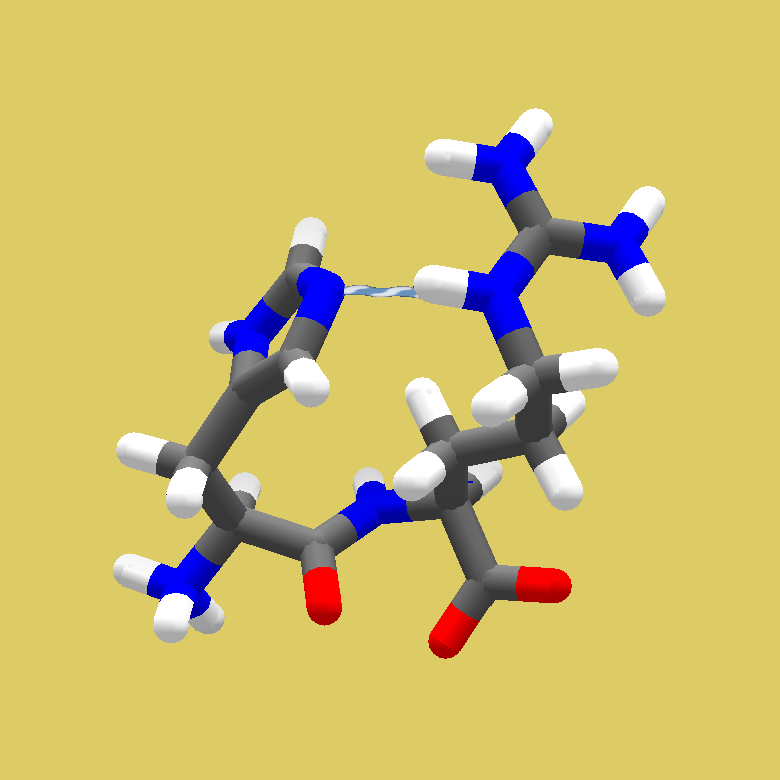
Placeholder image of a protein
Icon representing a puzzle

2038: Symmetric Tetramer Design with AlphaFold Predictions

Closed since over 4 years ago

Intermediate Overall Design Symmetry

Summary


Created
September 01, 2021
Expires
Max points
100
Description

Design a symmetric protein tetramer, with 4 identical chains of 60 residues each! This puzzle enables AlphaFold predictions for the monomer subunit of your design, so you can upload your solution for AlphaFold using the AlphaFold prediction tool. AlphaFold will predict the structure of your monomer subunit only (i.e. in the unbound state, in the absence of other symmetric copies). If you load this prediction, then Foldit will attempt to align the prediction with your solution. If you continue working off of the AlphaFold prediction, you may need to make adjustments at the interface where the monomer subunit interacts with symmetric copies.


This puzzle includes a Secondary Structure Objective, so no more than 50% of your design can form helices. The H-bond Network Objective encourages players to build buried, satisfied H-bond networks at the interface between symmetric chains. H-bond networks are a great way to introduce polar residues at the interface, but it's important that all of the bondable atoms make hydrogen bonds! We've also adjusted the H-bond Network Objective so that poor-scoring H-bonds may not contribute to networks; poor-scoring H-bonds will be displayed in red. This puzzle uses the Buried Unsats Objective, with a large penalty for buried polar atoms that can't make H-bonds. In this puzzle, there are no limits on the Complex Core, but we've included the Complex Core objective so players can see the core residues that can be incorporated into H-bond Networks.

Top groups


  1. Avatar for Go Science 100 pts. 20,091
  2. Avatar for Anthropic Dreams 2. Anthropic Dreams 63 pts. 19,405
  3. Avatar for Gargleblasters 3. Gargleblasters 37 pts. 19,150
  4. Avatar for Contenders 4. Contenders 21 pts. 19,038
  5. Avatar for Marvin's bunch 5. Marvin's bunch 11 pts. 18,751
  6. Avatar for Beta Folders 6. Beta Folders 5 pts. 18,501
  7. Avatar for L'Alliance Francophone 7. L'Alliance Francophone 2 pts. 17,280
  8. Avatar for Void Crushers 8. Void Crushers 1 pt. 16,507
  9. Avatar for Australia 9. Australia 1 pt. 16,307
  10. Avatar for BOINC@Poland 10. BOINC@Poland 1 pt. 14,916

  1. Avatar for ichwilldiesennamen 100 pts. 19,967
  2. Avatar for sgeldhof 2. sgeldhof Lv 1 96 pts. 19,518
  3. Avatar for alcor29 3. alcor29 Lv 1 91 pts. 19,365
  4. Avatar for grogar7 4. grogar7 Lv 1 86 pts. 19,171
  5. Avatar for HuubR 5. HuubR Lv 1 82 pts. 19,144
  6. Avatar for johnmitch 6. johnmitch Lv 1 78 pts. 19,005
  7. Avatar for robgee 7. robgee Lv 1 74 pts. 18,878
  8. Avatar for Bruno Kestemont 8. Bruno Kestemont Lv 1 70 pts. 18,842
  9. Avatar for Deleted player 9. Deleted player pts. 18,772
  10. Avatar for frood66 10. frood66 Lv 1 63 pts. 18,626

Comments


bkoep Staff Lv 1

Buried Unsats (max +500)
Penalizes polar atoms that cannot make hydrogen bonds, -200 points per atom (not including symmetric copies).

Core Existence: Monomer (max +1600)
Ensures that at least 16 residues are buried in the core of the monomer unit.

Core: Complex (max +0)
Awards no bonuses or penalties. Click Show to see which residues count as "Core" for the H-bond Network objective.

H-bond Network (max +2400)
Rewards networks that comprise at least 2 H-bonds involving core residues.
Between 1 and 12 H-bonds should cross the interface between symmetric units.
Networks must be at least 75% satisfied (i.e. 75% of all bondable atoms in a network must make a H-bond).

Interaction Energy (max +500)
Monitors that all large PHE, TYR, and TRP residues are scoring well.

SS Design (max +500)
Penalizes all CYS residues. Penalizes GLY, ALA residues in sheets. Penalizes GLY, ALA in helices.

Ideal Loops (max +500)
Penalizes any loop region that does not match one of the Building Blocks in the Blueprint tool. Use "Auto Structures" to see which regions of your protein count as loops.

Secondary Structure (max +500)
No more than 50% of residues may form helices. Extra helices are penalized at 10 points per residue.

ichwilldiesennamen Lv 1

I am wondering about the phrase "Between 1 and 12 H-bonds should cross the interface between symmetric units". How do I have to understand this? Basically for each Bond in a Tetramer, it will be present 4x (one original plus 3 copies). Shouldn't this phrase then be rather "Between 4 and 12…"? I have shared a design (iw03) which uses 3 residues and has 12 bonds between monomer and (between) symmetric copies which are marked blue and get full bonus because the net is fully satisfied and all bonds are cross-interface. But is this meant here? Because in the extreme I can have a lot more blue bonds (see share iw02b). So why is there an upper limit of 12 and why is the lower limit 1 (I would have assumed this to be 4 for a tetramer since each bond will have 3 copies).
For a trimer you typically write "Between 1 to 9…". So the max value changes with symmetry-degree.
I know it is a minor thing but I would still like to know how you meant it.

jeff101 Lv 1

<pre>For C4 tetramers, one might also consider hydrogen bonds between monomers 0 and 2 and between monomers 1 and 3. This would give a lower limit of 2 H-bonds crossing the interface between symmetric units.

I am also curious how one could have just 1 H-bond
crossing the interface between symmetric units.</pre></code>

bkoep Staff Lv 1

Yes, you are right that the C4 symmetry guarantees at least 4 copies of any H-bond. The HBNet description could just as easily read "Between 4 and 12 H-bonds…"

The upper limit is important because we still want to have some hydrophobics at the interface to ensure binding. If the interface were completely polar and composed entirely of H-bonds, then we would not expect binding between subunits (the protein subunit would be just as happy to make H-bonds with water; there is no gain in stability making H-bonds with a symmetric copy vs. making H-bonds with water).

ichwilldiesennamen Lv 1

Yes, like this it makes sense to me. So in future symmetry puzzles we can expect the lower bound in the description to scale with symmetry-degree I guess.
The upper bound is a different topic. I understand - and it has become very clear in the lab-reports - that structures with only hydrophobics should be avoided at the interfaces because they can potentially misfold. So hydrophylics should be inserted there. But this upper bound condition could still be satisfied even though there would be in the extreme only hydrophylic sidechains at the interface. Because bonds could go between monomer-sidechains only and not cross-interface. Therefore this upper-bound requirement might not lead to what you want to accomplish.
So this brings up the question again how the percentage-ratio between hydrophob and hydrophyl sidechains should be at the interface.
Shouldn't Alphafold reflect this? So if I remove the HBond-network at the interface then the AF values should degrade because there should be a higher chance for misfolding. I haven't seen that yet but it might be worthwhile to investigate this further.

bkoep Staff Lv 1

You're right, there are ways to get around the upper bound and still have an entirely polar interface (although, I think these interfaces will generally have a lower base score, since buried polars are penalized by a solvation term in the Foldit score function).

Ideally, we might like to simply limit the overall proportions of polar/hydrophobic residues in a design. The good news here is that, since the backend update from July, we now have a pretty efficient way to do this. Hopefully we will be able to get that feature out soon!

That said, there don't seem to be any hard rules about the polar/hydrophobic ratio at the interface. My personal suspicion is that just one or two buried H-bonds is sufficient to make a well-behaved interface.

I'm not sure we can expect AlphaFold to necessarily reflect "chances for misfolding" in this way. AlphaFold was not trained to distinguish well-folded from misfolding sequences. In fact, AlphaFold was trained on 100% well-folded sequences; to some degree, you might say that AlphaFold assumes your sequence is well-folded when it makes its prediction. True, we have shown that AlphaFold confidence correlates with folding success in lab experiments. But it's possible that AlphaFold confidence is picking up on other problematic features in Foldit designs, and hydrophobicity may not have anything to do with it.

It's also worth noting that excessive hydrophobics can cause a design to fail for other reasons – not just misfolding. Even if your monomer subunit folds correctly, a surface that is entirely hydrophobic will stick indiscriminately to any other hydrophobic surface it encounters. This can lead to protein aggregation, off-target binding, or even a well-behaved assembly with an off-target symmetry.

ichwilldiesennamen Lv 1

Thanks for these detailed explanations!
So it is probably best to focus on compact (about 3…5 residues and fully satisfied and buried) HBnets with full bonus. These should do the job and that sounds reasonable. If there comes a filter for this this would be nice as long as it doesn't slow things down too much. I have also noted that very hydrophyl interfaces don't score that well and you explained well why this is so. I understand the HBnets as "key&lock" which should assure that the whole structure can just assemble in one position since otherwise BUNs would form. Sounds reasonable that a "small" HBnet will do this job.
Regarding AF I understand that it is best just to come close to the 80% criterion and otherwise not worry about if a HBnet is present.
That answers my questions. Thanks again for the good input!