
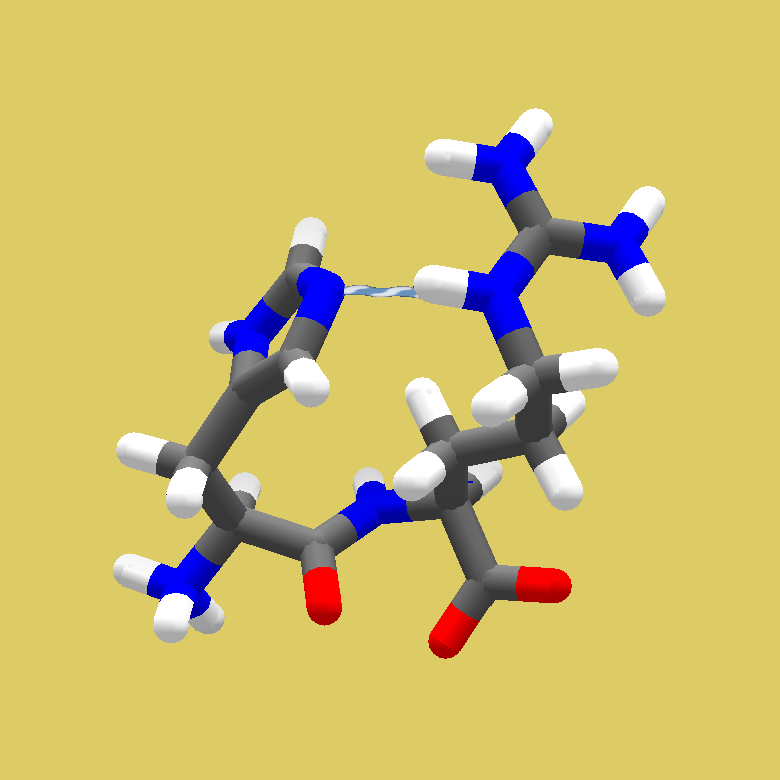





Placeholder image of a protein
Icon representing a puzzle

2074b: VHL ligand design: Round 5b

Closed since over 4 years ago

Intermediate Overall Small Molecule Design

Summary


Created
November 30, 2021
Expires
Max points
100
Description

Note: This is a repost of Puzzle 2074, but without the problematic 'Preserve Structure' objective. Solutions from the previous puzzles can be loaded into this one.


Design a small molecule which can bind VHL! This is the fifth in a series of puzzles using the small molecule design tools to design small molecule binders to the von Hippel-Lindau E3 ubiquitin ligase. We don't want you to modify the protein, but instead we'd like you to build new small molecules which fit into the VHL pocket. See the new "Inside the Pocket" and "Fun with Fragments!" tutorials to learn how to use the small molecule design tools.


Note: To get the most out of the small molecule design tools, we recommend changing you view settings to the Small Molecule Design Preset, or


  • Set Color: Score/Hydro+CPK

  • Set View Protein: Binding Site or Cartoon Ligand

  • Turn on: Show Clashes, Show Voids, Show bonds (non-protein), Show bondable atoms

  • Turn off: Show exposed, Show bonds (sheet), Show bonds (helix), Show bonds (loop), Show bonds (sidechain)


For this round, please focus in on changing the center bit of the molecule. Leave the three-member and the linked five and six member rings alone and change up the bits in between. The 'Alter Core' objective will give a big bonus if you change up the central five-member ring.


Also making an appearance this round are two structural waters. We hope that putting these waters in explicitly will help with maintaining some key interactions to the protein. Also for this purpose is the HBond objective, which identifies the six hydrogen bonding atoms on the protein (and waters) which the starting ligand makes contact to. Their ligand partners can be changed, but another ligand atom should take their place.


This is a project in collaboration with Boehringer Ingelheim. Boehringer Ingelheim has committed to help evaluate and test the molecules which Foldit players have designed. All compounds created as part of the collaboration puzzles will be made publicly available. Experimental results from testing the molecules will also be released publicly. All participants and game sponsors of current and future small molecule design games commit to complying with the Foldit Terms of Service including those pertaining to intellectual property.


Top groups


  1. Avatar for Gargleblasters 100 pts. 26,003
  2. Avatar for Contenders 2. Contenders 73 pts. 25,923
  3. Avatar for Go Science 3. Go Science 52 pts. 25,859
  4. Avatar for Anthropic Dreams 4. Anthropic Dreams 36 pts. 25,807
  5. Avatar for Marvin's bunch 5. Marvin's bunch 24 pts. 25,682
  6. Avatar for Ogre's lab 6. Ogre's lab 16 pts. 25,647
  7. Avatar for Australia 7. Australia 10 pts. 25,635
  8. Avatar for L'Alliance Francophone 8. L'Alliance Francophone 6 pts. 25,598
  9. Avatar for Beta Folders 9. Beta Folders 4 pts. 25,545
  10. Avatar for AlphaFold 10. AlphaFold 2 pts. 25,497

  1. Avatar for Aubade01
    1. Aubade01 Lv 1
    100 pts. 26,027
  2. Avatar for HuubR 2. HuubR Lv 1 96 pts. 26,003
  3. Avatar for Nicm25 3. Nicm25 Lv 1 91 pts. 25,950
  4. Avatar for BootsMcGraw 4. BootsMcGraw Lv 1 87 pts. 25,874
  5. Avatar for silent gene 5. silent gene Lv 1 83 pts. 25,859
  6. Avatar for gmn 6. gmn Lv 1 79 pts. 25,807
  7. Avatar for robgee 7. robgee Lv 1 75 pts. 25,780
  8. Avatar for georg137 8. georg137 Lv 1 71 pts. 25,763
  9. Avatar for ProfVince 9. ProfVince Lv 1 68 pts. 25,748
  10. Avatar for grogar7 10. grogar7 Lv 1 64 pts. 25,714

Comments


rmoretti Staff Lv 1

Information about the objectives in this puzzle. (All objectives give +1000 points when fully satisfied, for a maximum of +10 000.)

  • Alter Core - A large bonus for changing up the central five-member-ring with a hydroxyl oxygen. (Click "Show" to highlight the ring at issue.)
  • HBond - A large bonus for preserving all the existing hydrogen bonding contacts of the starting ligand. (Click "Show" to highlight the atom needing the hydrogen bond.)
  • Bad Groups - Gives a bonus for avoiding groups we're interested in removing, including enol, enamine, thiocarbonyl, hydroxylamines, geminal diols, charged nitrogens, and alpha-beta unsaturated carbonyls. (Click "Show" to highlight groups at issue.)
  • Ligand cLogP - A measure of polarity - Keeps the molecule from getting too hydrophobic. To improve, try adding polar oxygens and nitrogens.
  • Ligand TPSA - Topological Polar Surface Area - Keeps the polar surface area (including buried polar surface) low. To improve, try removing oxygens and nitrogens.
  • Ligand Hydrogen Bond Donors - Keep the number of ligand hbond donors low.
  • Molecular Weight - Intended to keep the ligand from getting too big.
  • Number of Rotatable Bonds - Intended to keep the ligand from getting too big and floppy.
  • Ligand Substructure - Identify areas of the small molecule which aren't very drug-like.
  • Synthetic Accessibility - Identify molecules which are likely to be hard to make in the lab.

Most objectives have a "Show" button which should highlight areas of concern in red. (Even when fully satisfied, objectives may highlight groups which may eventually contribute.)

Aubade01 Lv 1

The program is allowing the formation of a sulfonium ion similar to the ammonium ion previously reported.

On the thiazole, substitute the sulfur with nitrogen to form an imidazole. Then substitute this nitrogen back to sulfur again. You will now have a valid charged sulfonium ion (a protonated sulfur) species. There is no immediate undesired group penalty for doing this as there now is for ammonium ion formation. The hydrogen can be selected, but not deleted. It can also be replaced with carbon to methylate the sulfur. This does give an undesired group penalty.

Aubade00/01