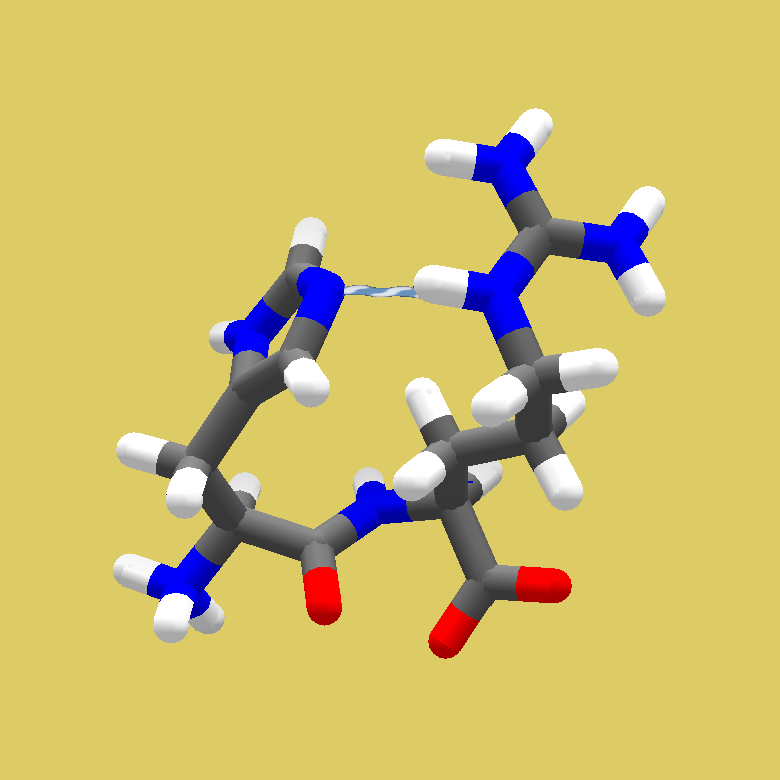
Compete in a challenge to design a drug targeting the SARS-CoV-2 helicase. Use the small molecule design tools and the compound library panel to find library compounds which bind to the active site of the enzyme.
Note: To get the most out of the small molecule design tools, we recommend changing you view settings to the Small Molecule Design Preset.
This puzzle is part of Foldit's participation in the CACHE Challenge. From the set of all compounds submitted in the multiple rounds of puzzles, Foldit scientists will select up to 100 compounds based on the CACHE-provided criteria. Only compounds which are in a commercially available library will be selected, so it's beneficial to make use of the Compound Library panel to search for library compounds similar to your current design. But don't limit yourself to the compound library. You're more likely to get good results by alternating: optimizing the molecule with the small molecule design tools, find the closest library compound, then further refine it with the design tools.
The main change from the second round is the addition of the "Fraction of four-bonded carbon" filter. Compounds which have too many double and triple bonds work poorly as drugs, so the CACHE organizers evaluate molecules based on the fraction of sp3 hybrizdized carbons -- basically, the fraction of carbons bonded with single bonds to four other atoms.
The other change is to the Compound Library panel. Results should now be pre-filtered to get rid of compounds with really bad objective scores, allowing you to focus on results which are more likely to score well.
Participation in CACHE puzzles is subject to the CACHE Terms of Participation, in particular “the Challenge IP [including Challenge Compounds] will be made freely available in the public domain pursuant to Creative Commons Attribution Only (CC-BY 4.0 or subsequent versions) licensing terms, with the intent that such Challenge IP may be Used and practiced by Users for any purpose”.
Objectives in this puzzle are driven primarily by the evaluation criteria used by CACHE.
Maximum bonus: +8 000
Torsion Quality (max +1000)
Keeps bond rotations in a good range. Using Wiggle or Tweak Ligand can fix bad torsions. (Show highlights torsions to be rotated.)
Number of Rotatable Bonds (max +1000)
Intended to keep the ligand from getting too big and floppy. You can reduce rotatable bonds by deleting groups or forming rings. (Show highlights rotatable bonds.)
Ligand TPSA (max +1000)
Topological Polar Surface Area - Keeps the polar surface area (including buried polar surface) low. To improve, try removing oxygens and nitrogens. (Show highlights atoms contributing to higher TPSA.)
Ligand cLogP (max +1000)
A measure of polarity - Keeps the molecule from getting too hydrophobic. To improve, try adding polar oxygens and nitrogens. (Show highlights atoms contributing to higher cLogP.)
Fraction of four-bonded carbons (max +1000)
Measures how carbons with bonds to four atoms ("sp3 hybridized") there are. Too few (too many double and triple bonded carbons) is bad. (Show highlights carbon atoms at issue.)
Bad Groups (max +1000)
Gives a bonus for avoiding groups that interfere with assays, or which are far from the compounds in the library. (Show highlights groups at issue.)
Molecular Weight (max +1000)
Keeps the ligand a reasonable size.
Synthetic Accessibility (max +1000)
Keeps the ligand from going too far from the compounds in the library. (Show highlights parts of the molecule at issue.)
@spvincent The compounds theoretically should be ordered (most similar to least), but it looks like they may be getting scrambled. I'm looking into a fix.
One of my team player found a solution with only one residue (in the ligand) and still 8000 full bonus (and almost 17 000 pts).
My higher scoring ligands are not centered in the protein, but stick at the "surface" (which could be on a hidden part of the protein).
Are there means to avoid these misleading high scores by adding more filters in the futire ?
So far we haven't had issues with decent scoring ligands being out of the pocket. If we do, there are additional objectives we can add in to try to keep things within the pocket.
I have share 2 shares of puzzle 2210 with points 4935 which have 4 hydrogen and after the same with one residue with have 2 hydrogen with 16361 points in the second the objectives is 7600 can you tell me which is wrong? I have share with my group and with the science
The objectives are necessarily for this puzzle – they're measuring a number of compound quality measures which otherwise wouldn't be captured by the Foldit score. We can see a definite difference in compound quality of the top scoring solutions when we adjust the objective settings. We generally set objectives to be positive (with worse structures given a lower bonus), but if things are really bad they may go negative in some instances.
For your shares the main issue is the Bad Group objective – for the one which has a -397924 objective score it's saying there's 217 bad groups on the ligand. You can click "Show" to highlight the atoms at issue. You'll need to change the atom identities and connectivity to get rid of the Bad Group scoring. (I'd certainly recommend monitoring the objectives as you build the ligand, rather than trying to fix things up later.)
Note that 217 might be an over-estimate of the number of atoms involved, as there's potentially a bunch of double counting. Certain bad group patterns are written as disconnected patterns, and having multiple ways of expressing the same combination is counted as separate instances. In your case, the pattern you're most running afoul of is a nitrogen one. The pattern matches on 4 nitrogens of particular types, and it looks like you have 8 or more (depending on solution). So you'll get the combinitorial effect of "8 choose 4" = 70 (or more) instances of a bad group for just that pattern, not to mention potential double counting of other patterns. – This is something I may look to change, as the combinitorial effect may be over penalizing things, but ideally there shouldn't be any bad groups, and the objective does capture that.