



Icon representing a puzzle

2330: KLHDC2 the Next Level: Round 8

Closed since over 2 years ago

Intermediate Overall Small Molecule Design

Summary


Created
July 21, 2023
Expires
Max points
100
Description

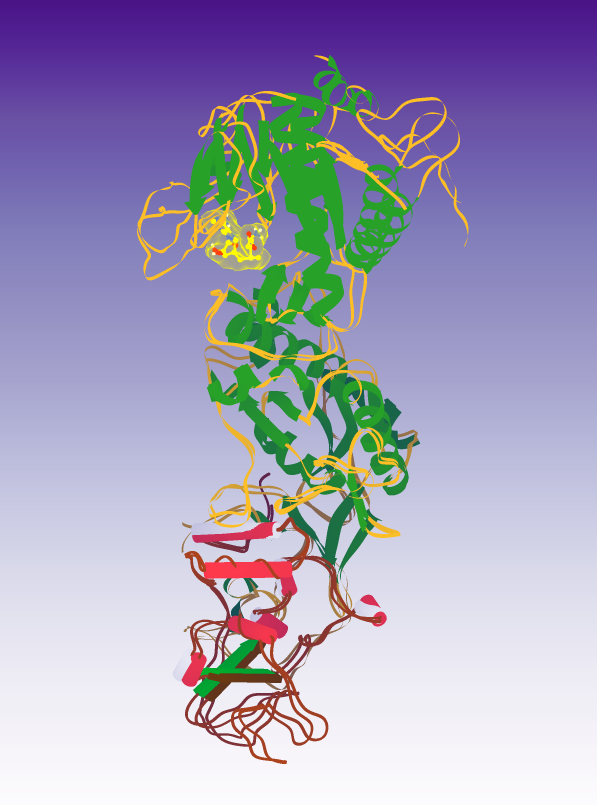
Foldit players have discovered a small molecule fragment which binds well to KLHDC2. Take this starting fragment and expand upon it.

Our collaborators noticed that there's quite a bit more aryl-aryl bonds and phenyl rings in molecules than would be ideal. As such, the "Bad Group" objective has been updated to penalize these groups. (See comments for more details.) We've also increased the Compound Library bonus a bit.

Note: To get the most out of the small molecule design tools, we recommend changing you view settings to the Small Molecule Design Preset.

This is a project in collaboration with Boehringer Ingelheim. The structures of all compounds created as part of the collaboration puzzles as well as any experimental results from testing them will be made publicly available. All participants and game sponsors of current and future small molecule design games commit to complying with the Foldit Terms of Service including those pertaining to intellectual property.

Top groups


  1. Avatar for Anthropic Dreams 100 pts. 25,185
  2. Avatar for Go Science 2. Go Science 65 pts. 24,989
  3. Avatar for L'Alliance Francophone 3. L'Alliance Francophone 41 pts. 24,664
  4. Avatar for AlphaFold 4. AlphaFold 24 pts. 24,654
  5. Avatar for Gargleblasters 5. Gargleblasters 14 pts. 24,531
  6. Avatar for Contenders 6. Contenders 7 pts. 24,158
  7. Avatar for VeFold 7. VeFold 4 pts. 24,043
  8. Avatar for Australia 8. Australia 2 pts. 23,863
  9. Avatar for BIchallenge 9. BIchallenge 1 pt. 23,567
  10. Avatar for Marvin's bunch 10. Marvin's bunch 1 pt. 23,200

  1. Avatar for gmn
    1. gmn Lv 1
    100 pts. 25,180
  2. Avatar for pr0tfold 2. pr0tfold Lv 1 93 pts. 24,989
  3. Avatar for LociOiling 3. LociOiling Lv 1 87 pts. 24,817
  4. Avatar for Sandrix72 4. Sandrix72 Lv 1 80 pts. 24,716
  5. Avatar for nicobul 5. nicobul Lv 1 74 pts. 24,664
  6. Avatar for AlphaFold2 6. AlphaFold2 Lv 1 69 pts. 24,654
  7. Avatar for nspc 7. nspc Lv 1 64 pts. 24,538
  8. Avatar for HuubR 8. HuubR Lv 1 59 pts. 24,531
  9. Avatar for abiogenesis 9. abiogenesis Lv 1 54 pts. 24,429
  10. Avatar for rosie4loop 10. rosie4loop Lv 1 50 pts. 24,347

Comments


rmoretti Staff Lv 1

Objectives

Maximum bonus: +12 500

Core (max +1000)
Does the small molecule design contain the starting molecule as a substructure, or the essential features from one of the known binders?

HBond (max +1000)
Is the ligand making hydrogen bonds to the same groups on the protein as the starting structure does? (Show highlights the groups on the protein which need to be hydrogen bonded.)

Ligand Hydrophobic Interaction (max +1000)
Is the ligand making good hydrophobic packing interactions with specific residues? (Show highlights the residues on the protein which should be involved in the interaction.)

Compound Library (max +500)
Gives a bonus if your current compound is in the library. This uses a local cached version of the Compound Library search results to determine if the compound is in the library. If you manually create a compound that happens to be in the library (or if you load a shared solution with an on-library compound), you may need to submit the compound to the compound library search and wait to get the results back before the objective can properly recognize that the compound is in the library. (If the objective is not updating, try wiggling the structure. See this forum post for more discussion.)

Torsion Quality (max +1000)
Keeps bond rotations in a good range. Using Wiggle or Tweak Ligand can fix bad torsions. (Show highlights torsions to be rotated.)

Number of Rotatable Bonds (max +1000)
Intended to keep the ligand from getting too big and floppy. You can reduce rotatable bonds by deleting groups or forming rings. (Show highlights rotatable bonds.)

Ligand TPSA (max +1000)
Topological Polar Surface Area - Keeps the polar surface area (including buried polar surface) low. To improve, try removing oxygens and nitrogens. (Show highlights atoms contributing to higher TPSA.)

Ligand cLogP (max +1000)
A measure of polarity - Keeps the molecule from getting too hydrophobic. To improve, try adding polar oxygens and nitrogens. (Show highlights atoms contributing to higher cLogP.)

Ligand Hydrogen Bond Donors (max +1000)
Keep the number of ligand hbond donors low. (Show highlights atoms which are counted as hydrogen bond donors.)</li>

Bad Groups (max +1000)
Gives a bonus for avoiding groups that interfere with assays, which are far from the compounds in the library, or which otherwise have issues. (Show highlights groups at issue.)

Element Counts (max +1000)
Gives a bonus for not having too many of particular elements. (Show highlights atoms which are over represented.)

Molecular Weight (max +1000)
Keeps the ligand a reasonable size.

Synthetic Accessibility (max +1000)
Keeps the ligand from going too far from the compounds in the library. (Show highlights parts of the molecule at issue.)
rmoretti Staff Lv 1

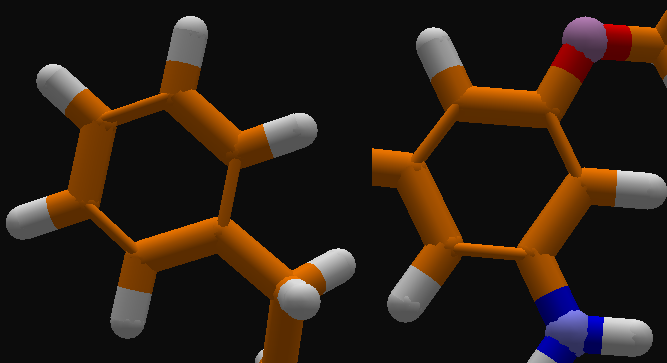
Phenyl (benzene) rings are 6-member all carbon rings with alternating single/double bonds:

They may be "terminal" (at the edge of the molecule) or in the These should be only weakly penalized, so you should see if you can replace them, but you might not need to, if it's actually the best choice.

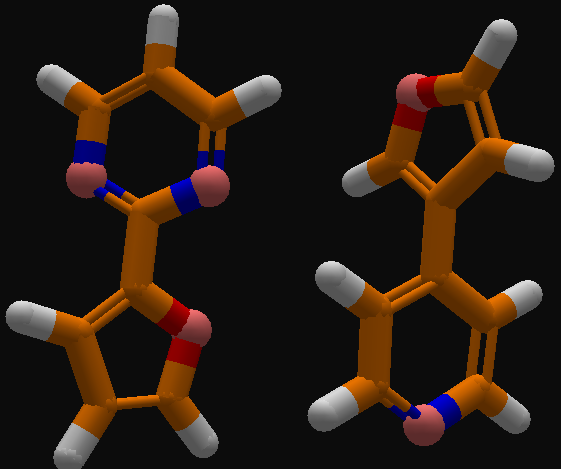
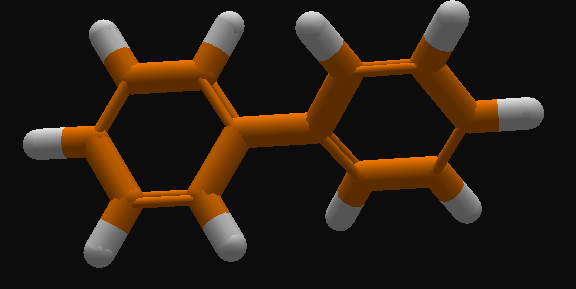
Much more heavily penalized are aryl-aryl rings. The key feature of these are single, non-ring bonds between phenyl-like rings.

But we are also penalizing such bonds between "aromatic" rings which aren't strictly phenyl rings – basically, if you have a flat 5- or 6-member ring with alternating single and double bonds, that's likely a ring which would be penalized if there's a single bond between them:

(P.S. Our BI collaborators have sent a link to this paper for suggested alternatives to phenyl rings. Don't worry too much if you can't access it due to a paywall – it's targeted toward experts, so if you're not accustom to reading medchem papers, it may be of limited help.)

jeff101 Lv 1

What if we replace R1-R2 with R1-CH2-R2 or R1-CH2-CH2-R2 ?
In the line above, R1 and R2 are rings, CH2 is a carbon with
two attached hydrogen atoms, and - is a single bond.

jeff101 Lv 1

The article above led me to the two articles below.
Again, for each one, my computer just lets me see an image and an abstract.

"Fluorine and Fluorinated Motifs in the Design and Application of Bioisosteres for Drug Design"
https://pubs.acs.org/doi/full/10.1021/acs.jmedchem.7b01788

It seems like fluorine can play many different roles in small molecules.

"'Magic Chloro': Profound Effects of the Chlorine Atom in Drug Discovery"
https://pubs.acs.org/doi/full/10.1021/acs.jmedchem.2c02015
It seems like replacing -H with -Cl can make a small molecule 500 to 100,000 times more potent.

I wonder if similar articles can be found for other halogens, like bromine (Br) and iodine (I).

rosie4loop Lv 1

Here's a database of bioisostere:
http://www.swissbioisostere.ch/

For example, searching for benzene analogues attached 1 atom away from other parts of compound with the following SMILES (or draw it in the editor, remember to put the R1 for the point of attachment if you draw it)
[*]C1=CC=CC=C1

This returns many pages of mostly aromatic moieties, but should have something non-aromatic. Sort by similarity for better results.

rosie4loop Lv 1

Aryl-aryl fragment in my design are generally for the interaction with the hydrophobic pocket, because the distance is just right.

Originally, I use aliphatic chain or ring there, but the compound library always suggesting aromatic replacement (thats easier to handle in terms of torsions, compounds with rigid ring has fewer torsional issues).

It's going to be nice if we can really have a checkbox for filtering in library search for this purpose.

rosie4loop Lv 1

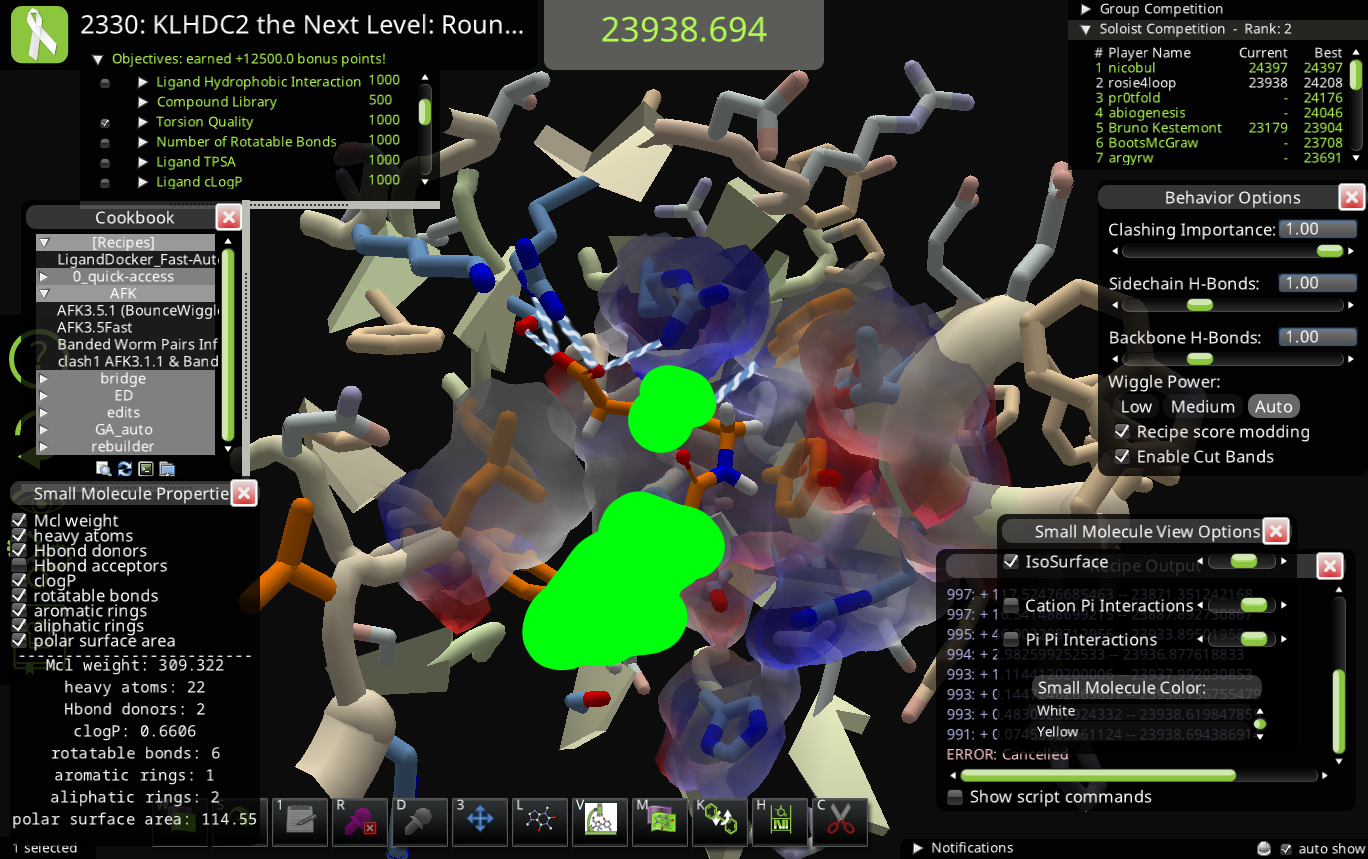
Some quick feedback on the performance of the scoring scheme in this puzzle after ~5 hrs of playing.

I'm still getting high score for the (analogues of) previous design with aryl-aryl bond because the full hydrophobic interaction bonus (1000) > > > > bad group penalty of two benzenes with 1 atom apart (1000-860=240, if its fused benzene 100-840=260). Its also easy to get rid of the torsional penalty. Let's say it is compound A.

Library search of compound A returns a single compound without bad group penalty, and gives full bonus after manually adjusting torsions and positions.

I didn't have time to futher modify the compounds yet, in theory I can refer to e.g. the bioisostere database that I posted earlier for inspiration on how to replace the aromatics or optimize the full-bonus compound. I am just too busy to do the manual adjustment this week, particularly the full-bonus compound (as shown in figure) has a linear chain, making it tricky to fix the torsions.

(Remarks:

  • I don't want to limit the creativity of players or reduce compound diversity for the round, hence I am hiding several fragments of the compounds. Interested players may guess it from the molecular properties, though it's not good for increasing diversity.
  • I hope the database I mentioned that I also use in my own research could help Foldit players to increase their score, improve affinity of their designs and chemical diversity.)