

Placeholder image of a protein
Icon representing a puzzle

2372: CCHFV Protease Round 6

Closed since over 2 years ago

Intermediate Overall Small Molecule Design

Summary


Created
October 27, 2023
Expires
Max points
100
Description

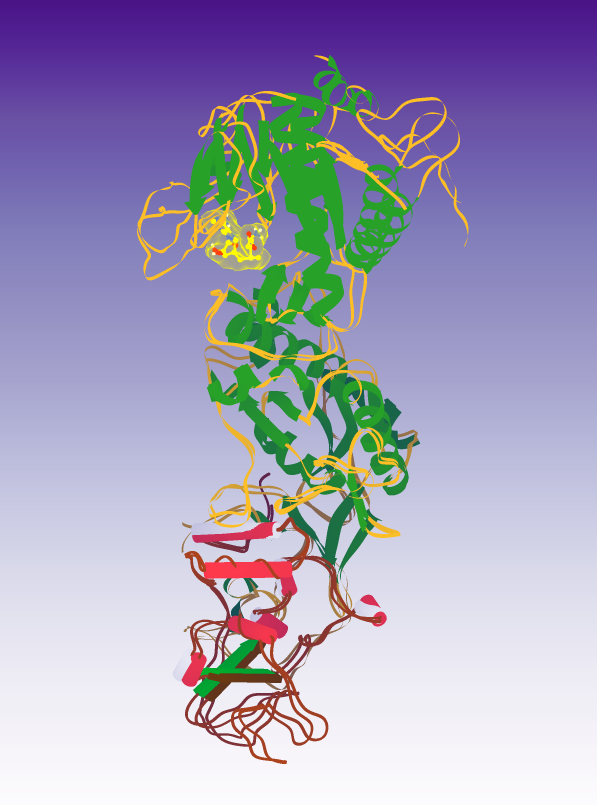
The Crimean-Congo Hemorrhagic Fever (CCHF) is a life-threatening zoonotic disease caused by a tick-borne virus. Recent research has revealed the significant role of the viral-encoded Ovarian Tumor (OTU) deubiquitinase in the CCHFV replication process. Based on the most promising compounds, this puzzle will focus on getting an inhibitor for this protein. As the CCHFV-OTU protease interacts with another protein (ubiquitin), the interaction surface is quite large and superficial, making it a challenging binding pocket. For this round we will be focusing on the lower binding pocket. We have also adjusted the objectives to accommodate larger small molecules, as one of our goals is to inhibit protein-protein interactions. In many cases, such inhibitors possess a higher molecular weight. For more details check out the Crimean-Congo Hemorrhagic Fever blog post.

Top groups


  1. Avatar for Go Science 100 pts. 25,238
  2. Avatar for AlphaFold 2. AlphaFold 70 pts. 24,912
  3. Avatar for Contenders 3. Contenders 47 pts. 24,810
  4. Avatar for Anthropic Dreams 4. Anthropic Dreams 30 pts. 24,619
  5. Avatar for Gargleblasters 5. Gargleblasters 19 pts. 23,900
  6. Avatar for VeFold 6. VeFold 11 pts. 23,488
  7. Avatar for FamilyBarmettler 7. FamilyBarmettler 7 pts. 22,719
  8. Avatar for Czech National Team 8. Czech National Team 4 pts. 22,657
  9. Avatar for L'Alliance Francophone 9. L'Alliance Francophone 2 pts. 22,539
  10. Avatar for Marvin's bunch 10. Marvin's bunch 1 pt. 22,388

  1. Avatar for Sandrix72
    1. Sandrix72 Lv 1
    100 pts. 25,238
  2. Avatar for AlphaFold2 2. AlphaFold2 Lv 1 94 pts. 24,912
  3. Avatar for BootsMcGraw 3. BootsMcGraw Lv 1 88 pts. 24,810
  4. Avatar for gmn 4. gmn Lv 1 82 pts. 24,615
  5. Avatar for HuubR 5. HuubR Lv 1 76 pts. 23,900
  6. Avatar for guineapig 6. guineapig Lv 1 71 pts. 23,850
  7. Avatar for abiogenesis 7. abiogenesis Lv 1 66 pts. 23,570
  8. Avatar for rosie4loop 8. rosie4loop Lv 1 61 pts. 23,565
  9. Avatar for jeff101 9. jeff101 Lv 1 56 pts. 23,512
  10. Avatar for nspc 10. nspc Lv 1 52 pts. 23,494

Comments


Sciren Staff Lv 1

Objectives

Maximum bonus: +7750

Compound Library (max +750)
Gives a bonus if your current compound is in the library. This uses a local cached version of the Compound Library search results to determine if the compound is in the library. If you manually create a compound that happens to be in the library (or if you load a shared solution with an on-library compound), you may need to submit the compound to the compound library search and wait to get the results back before the objective can properly recognize that the compound is in the library. (If the objective is not updating, try wiggling the structure. See this forum post for more discussion.)

Torsion Quality (max +1000)
Keeps bond rotations in a good range. Using Wiggle or Tweak Ligand can fix bad torsions. (Show highlights torsions to be rotated.)

Number of Rotatable Bonds (max +1000)
Intended to keep the ligand from getting too big and floppy. You can reduce rotatable bonds by deleting groups or forming rings. (Show highlights rotatable bonds.)

Ligand TPSA (max +1000)
Topological Polar Surface Area - Keeps the polar surface area (including buried polar surface) low. To improve, try removing oxygens and nitrogens. (Show highlights atoms contributing to higher TPSA.)

Ligand cLogP (max +1000)
A measure of polarity - Keeps the molecule from getting too hydrophobic. To improve, try adding polar oxygens and nitrogens. (Show highlights atoms contributing to higher cLogP.)

Bad Groups (max +1000)
Gives a bonus for avoiding groups that interfere with assays, which are far from the compounds in the library, or which otherwise have issues. (Show highlights groups at issue.)

Molecular Weight (max +1000)
Keeps the ligand a reasonable size.

Synthetic Accessibility (max +1000)
Keeps the ligand from going too far from the compounds in the library. (Show highlights parts of the molecule at issue.)
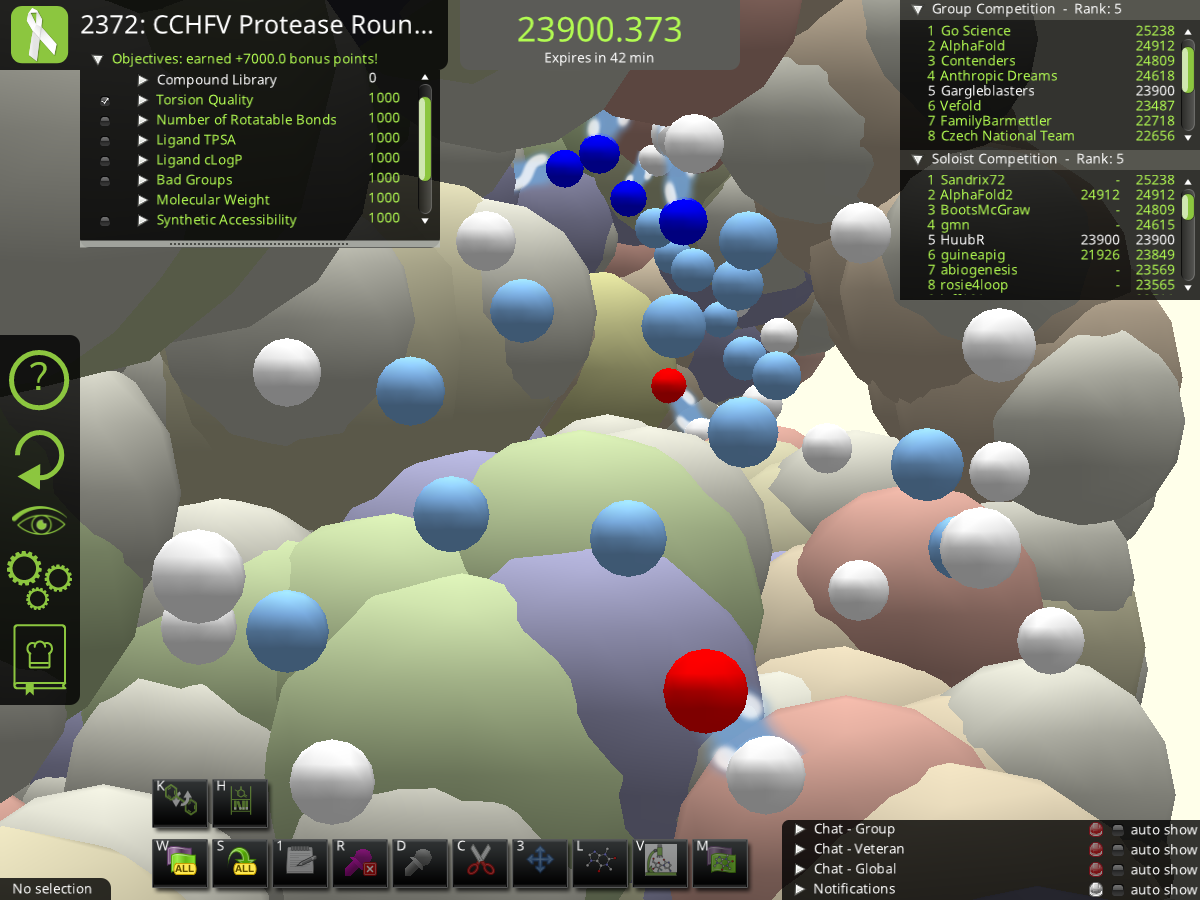
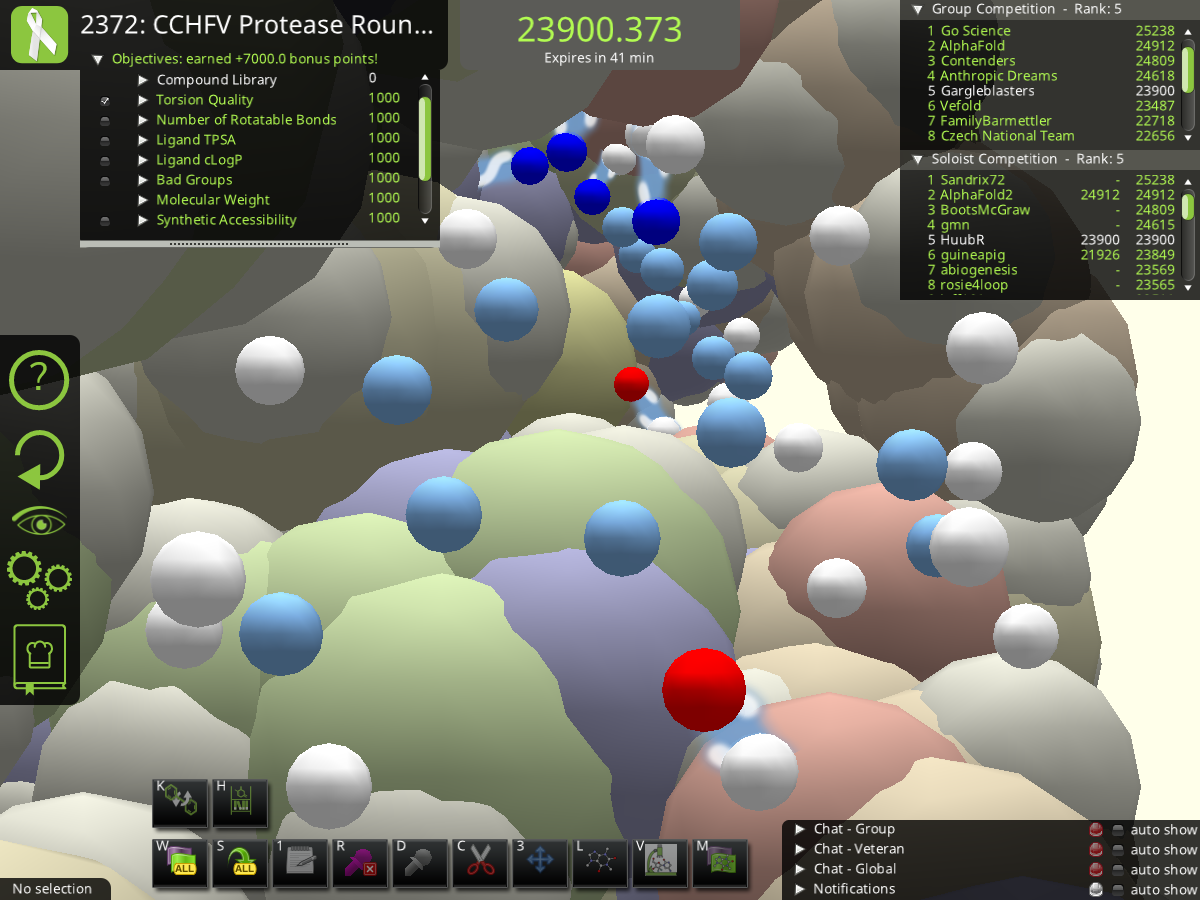
HuubR Lv 1

For those of you who can cross their eyes, I've made a stereoscopic pair:

If you're not familiar with this way of viewing a 3D image, I'll try to explain how it works.

The left image is for your right eye, and vice versa. The way to view it without any tools is to cross your eyes, by holding a fingertip about halfway the screen, or a bit closer to your nose when you have a large screen. First, focus on your fingertip. Then, shift your attention to one of the red oxygen atoms (or any other part that you can easily "catch" with your eyes), but do so without looking at the screen. Just imagine the red ball is sitting on your fingertip, not on the screen. Move your finger towards your nose or away from it, until the two images (both eyes) merge into one 3D image. You may find that you need to tilt your head a bit, to make the images overlap. After some practice, you should be able to move your eyes around the entire 3D image, and you can put your hand to rest.

Don't worry if this does not work for you the first time you try it. And, definitely, do not overstrain your eyes. Give your eyes some rest, and try again later.

Hope you enjoy it!