



Bruno Kestemont Lv 1
Compound library returns "error"

Closed since over 2 years ago
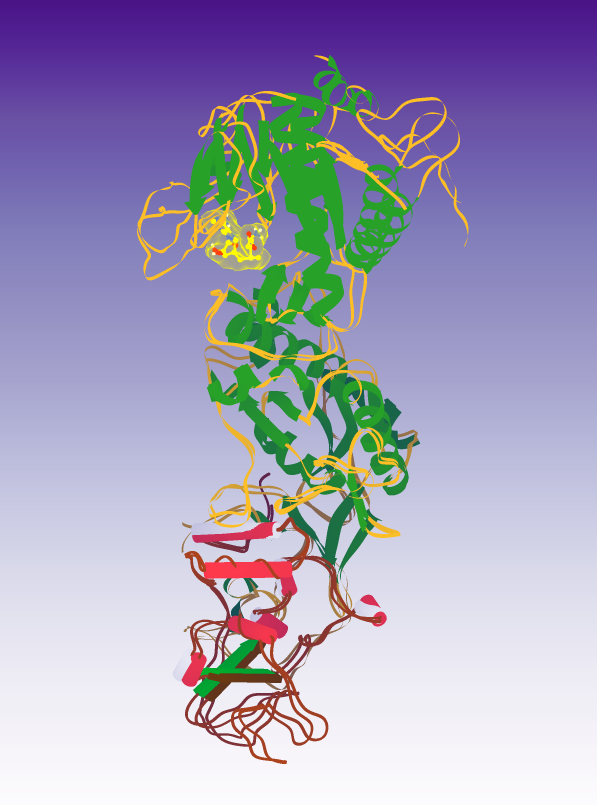
Intermediate Intermediate Intermediate Intermediate Intermediate Intermediate Intermediate Intermediate Intermediate Overall Overall Overall Overall Overall Overall Overall Overall Overall Small Molecule Design Small Molecule Design Small Molecule Design Small Molecule Design Small Molecule Design Small Molecule Design Small Molecule Design Small Molecule Design Small Molecule DesignCompete in a challenge to design a drug targeting the SARS-CoV-2 Nsp3 macrodomain. Use the small molecule design tools and the compound library panel to find library compounds which bind to the active site of the enzyme. -- Only compounds which come from the Compound Library panel and get the Compound Library objective bonus will be experimentally tested.
Note: To get the most out of the small molecule design tools, we recommend changing you view settings to the Small Molecule Design Preset.
This puzzle is part of Foldit's participation in CACHE Challenge #3. We're following up on promising compounds from the first round. For this puzzle series, we're looking to examine the Structure Activity Relationship (SAR) of the hit compounds from the previous series. As such, we ask that you attempt to find things which are similar to the starting molecule, rather than creating something completely new. There's a Similarity objective which should show when you're going too far afield.
For this first puzzle in the series, we're starting you with a third-party prediction of where the compound will bind. This isn't necessarily where this compound was designed to bind, so feel free to move the ligand around in the pocket to find where it (and more importantly derivatives) bind best.
Participation in CACHE puzzles is subject to the CACHE Terms of Participation, in particular “the Challenge IP [including Challenge Compounds] will be made freely available in the public domain pursuant to Creative Commons Attribution Only (CC-BY 4.0 or subsequent versions) licensing terms, with the intent that such Challenge IP may be Used and practiced by Users for any purpose”.


Compound library returns "error"

Same here. All library searches error out. Please fix. Thank you.
Also, can someone please explain why changing an atom from chlorine to hydrogen drops the similarity from 100% to less than 74%? I changed less than 3% of the molecule.
The definitions of the "Objectives" were left out.
why changing an atom from chlorine to hydrogen drops the similarity from 100% to less than 74%? I changed less than 3% of the molecule.
From the explanation in previous puzzles, similarity should be calculated from chemical fingerprints which consider not only identity of atom in molecular formula but also chemical features. Changing halogens to hydrogen can be quite a difference in chemistry.
Borrowing the info from a previous CACHE follow-up puzzle
https://fold.it/puzzles/2013684#post_76900
Gives a bonus if the current compound is "similar enough" to the starting (hit) compound. The "percent similarity" being calculated is not quite linear from a visual perspective (search for Tanimoto Similarity for further discussion), and is different from the similarity value being calculated for the Compound Library.

Objectives in this puzzle are driven primarily by the evaluation criteria used by CACHE.
Maximum bonus: +11 000
Similarity (max +1000)
Gives a bonus if the current compound is "similar enough" to the starting (hit) compound. The "percent similarity" being calculated is not quite linear from a visual perspective (search for Tanimoto Similarity for further discussion), and is different from the similarity value being calculated for the Compound Library.
Compound Library (max +1000)
Gives a bonus if your current compound is in the library. This uses a local cached version of the Compound Library search results to determine if the compound is in the library. If you manually create a compound that happens to be in the library (or if you load a shared solution with an on-library compound), you may need to submit the compound to the compound library search and wait to get the results back before the objective can properly recognize that the compound is in the library. (If the objective is not updating, try wiggling the structure. See this forum post for more discussion.)
Acid groups (max +1000)
Certain groups like carboxylate and phosphate would make compounds not ideal for drug usage. This gives a bonus if the compound is missing these problematic groups. (Show highlights regions of the molecule at issue.)
Torsion Quality (max +1000)
Keeps bond rotations in a good range. Using Wiggle or Tweak Ligand can fix bad torsions. (Show highlights torsions to be rotated.)
Number of Rotatable Bonds (max +1000)
Intended to keep the ligand from getting too big and floppy. You can reduce rotatable bonds by deleting groups or forming rings. (Show highlights rotatable bonds.)
Ligand TPSA (max +1000)
Topological Polar Surface Area - Keeps the polar surface area (including buried polar surface) low. To improve, try removing oxygens and nitrogens. (Show highlights atoms contributing to higher TPSA.)
Ligand cLogP (max +1000)
A measure of polarity - Keeps the molecule from getting too hydrophobic. To improve, try adding polar oxygens and nitrogens. (Show highlights atoms contributing to higher cLogP.)
Fraction of four-bonded carbons (max +1000)
Measures how carbons with bonds to four atoms ("sp3 hybridized") there are. Too few (too many double and triple bonded carbons) is bad. (Show highlights carbon atoms at issue.)
Bad Groups (max +1000)
Gives a bonus for avoiding groups that interfere with assays, or which are far from the compounds in the library. (Show highlights groups at issue.)
Molecular Weight (max +1000)
Keeps the ligand a reasonable size.
Synthetic Accessibility (max +1000)
Keeps the ligand from going too far from the compounds in the library. (Show highlights parts of the molecule at issue.)
@"Bruno Kestemont" Apologies for the issue with the compound library – this should be fixed for new compounds. Previously submitted compounds should get reset sometime later today.
@BootsMcGraw Regarding the similarity objective, the similiarity is based on "atom environment" similarity. (Details, this is the Tanimoto similarity using ECFP fingerprints - basically, break the molecule up into overlapping local neighborhoods, centered on each atom and going out two bonds. The similarity is roughly the fraction of those environments the two molecules have in common.) A single atom change can sometimes cause a outsized change in similarity due to the number of atoms within two bonds. The similarity is also not "linear" in changes, as multiple atom changes in close proximity "overlap" in the changed atom environment, to some extent. – It shouldn't matter too much, as anything above 40% similarity should give you the full bonus. (And, roughly speaking, 40% is roughly where medicinal chemists start to view compounds as being unrelated.)