

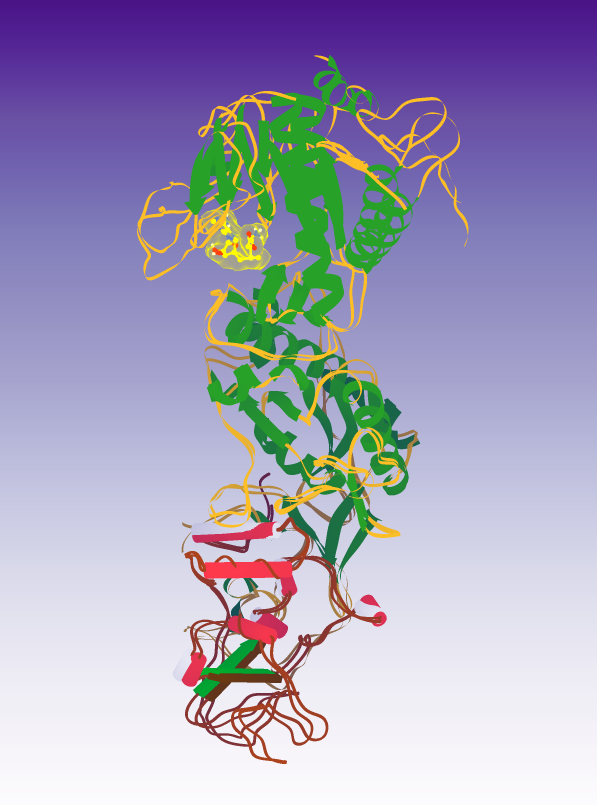

Placeholder image of a protein
Icon representing a puzzle

2410: Y4R: Round 1

Closed since about 2 years ago

Intermediate Overall Small Molecule Design

Summary


Created
January 25, 2024
Expires
Max points
100
Description

Neuropeptide Y receptor subtype 4 (Y4R) is a key player in the fight against obesity. Y4R is a type of receptor found in the body, particularly in the brain, that helps control appetite and manage energy. It's part of a larger family known as the NPY receptors, which includes four subtypes: Y1R, Y2R, Y4R, and Y5R. Y4R is especially important because it plays a big role in regulating hunger and weight. Scientists have recently discovered that Y4R is crucial for reducing appetite and helping with weight loss in both humans and mice. They've found some special molecules, called allosteric modulators, that can interact with Y4R in a unique way. Unlike typical drugs that bind directly to the main part of a receptor (called the orthosteric site), allosteric modulators attach to a different part (the allosteric site). This is like using a backdoor to influence how the receptor works. By targeting these backdoor sites, we can more precisely control the receptor's activity without interfering with other similar receptors. This means we can create safer and more specific drugs. In this puzzle, your challenge is to design small molecules that can cleverly and safely interact with Y4R's backdoor sites. These molecules could play a crucial role in creating new treatments for obesity. This puzzle is an opportunity for you to dive into the world of drug discovery and make a difference in the battle against obesity. Your creativity and problem-solving skills can help us find new ways to target Y4R and improve health!

Top groups


  1. Avatar for Anthropic Dreams 100 pts. 13,301
  2. Avatar for Go Science 2. Go Science 65 pts. 12,703
  3. Avatar for Contenders 3. Contenders 41 pts. 12,670
  4. Avatar for Gargleblasters 4. Gargleblasters 24 pts. 11,998
  5. Avatar for Australia 5. Australia 14 pts. 11,436
  6. Avatar for FamilyBarmettler 6. FamilyBarmettler 7 pts. 11,277
  7. Avatar for VeFold 7. VeFold 4 pts. 10,892
  8. Avatar for L'Alliance Francophone 8. L'Alliance Francophone 2 pts. 10,833
  9. Avatar for BOINC@Poland 9. BOINC@Poland 1 pt. 10,819
  10. Avatar for Marvin's bunch 10. Marvin's bunch 1 pt. 10,391

  1. Avatar for Hexafluorouranate 100 pts. 13,306
  2. Avatar for LociOiling 2. LociOiling Lv 1 94 pts. 13,295
  3. Avatar for rosie4loop 3. rosie4loop Lv 1 88 pts. 12,988
  4. Avatar for Dr.Sillem 4. Dr.Sillem Lv 1 82 pts. 12,674
  5. Avatar for BootsMcGraw 5. BootsMcGraw Lv 1 76 pts. 12,670
  6. Avatar for ucad 6. ucad Lv 1 71 pts. 12,596
  7. Avatar for pr0tfold 7. pr0tfold Lv 1 66 pts. 12,468
  8. Avatar for nspc 8. nspc Lv 1 61 pts. 12,435
  9. Avatar for MicElephant 9. MicElephant Lv 1 57 pts. 12,148
  10. Avatar for spvincent 10. spvincent Lv 1 53 pts. 12,075

Comments


Sciren Staff Lv 1

Objectives

Maximum bonus: +8000

Compound Library (max +1000)
Gives a bonus if your current compound is in the library. This uses a local cached version of the Compound Library search results to determine if the compound is in the library. If you manually create a compound that happens to be in the library (or if you load a shared solution with an on-library compound), you may need to submit the compound to the compound library search and wait to get the results back before the objective can properly recognize that the compound is in the library. (If the objective is not updating, try wiggling the structure. See this forum post for more discussion.)

Torsion Quality (max +1000)
Keeps bond rotations in a good range. Using Wiggle or Tweak Ligand can fix bad torsions. (Show highlights torsions to be rotated.)

Number of Rotatable Bonds (max +1000)
Intended to keep the ligand from getting too big and floppy. You can reduce rotatable bonds by deleting groups or forming rings. (Show highlights rotatable bonds.)

Ligand TPSA (max +1000)
Topological Polar Surface Area - Keeps the polar surface area (including buried polar surface) low. To improve, try removing oxygens and nitrogens. (Show highlights atoms contributing to higher TPSA.)

Ligand cLogP (max +1000)
A measure of polarity - Keeps the molecule from getting too hydrophobic. To improve, try adding polar oxygens and nitrogens. (Show highlights atoms contributing to higher cLogP.)

Bad Groups (max +1000)
Gives a bonus for avoiding groups that interfere with assays, which are far from the compounds in the library, or which otherwise have issues. (Show highlights groups at issue.)

Molecular Weight (max +1000)
Keeps the ligand within a reasonable size limit.

Synthetic Accessibility (max +1000)
Keeps the ligand from going too far from the compounds in the library. (Show highlights parts of the molecule at issue.)

jeff101 Lv 1

In this puzzle, how do we know if we are binding to the back door sites and not the front door site? Which residues qualify as the front door site? Which ones qualify as the back door sites? Do we just try to bind anywhere on the protein?

jeff101 Lv 1

I did some internet browsing and found a few useful-looking papers:

https://journals.plos.org/plosone/article?id=10.1371/journal.pone.0157146 from 2016
"Discovery of small-molecule modulators of the human Y4 receptor"
I was able to download its pdf from home.
It says pancreatic polypeptide is the native ligand.
Fig.1 on p.5 shows 3 positive allosteric modulators.
Fig.2 on p.6 shows 5 more, plus 2 Y4R-inactive molecules.
Fig.5 on p.8 shows some other molecules.

The next 3 did not give me access to pdf files from home,
but they did show me a picture near each one's abstract
(may I attach screenshots of these pictures here?):

https://pubmed.ncbi.nlm.nih.gov/28795803/ from 2017
https://pubs.acs.org/doi/10.1021/acs.jmedchem.7b00976
“Identification and Characterization of the First Selective
Y4 Receptor Positive Allosteric Modulator”
It says tBPC (tert-butylphenoxycyclohexanol) is a novel
and selective Y4R positive allosteric modulator
that has no effect on the binding of orthosteric ligands.

https://pubmed.ncbi.nlm.nih.gov/33595306/ from 2021
https://pubs.acs.org/doi/10.1021/acs.jmedchem.0c02000
“Highly Selective Y4 Receptor Antagonist Binds in an Allosteric Binding Pocket“
It says Y1R Y2R Y4R and Y5R are all human neuropeptide Y receptors
that belong to the superfamily of G-protein coupled receptors.
It says (S)-VU0637120 is the first selective Y4R allosteric antagonist.
It binds an allosteric site below the binding pocket of the endogenous
ligand pancreatic polypeptide in the core of the Y4R transmembrane
domains. The article shows the antagonist, its binding site, and
where the pancreatic polypeptide binds to the protein.

https://pubmed.ncbi.nlm.nih.gov/37339079/ from 2023
https://pubs.acs.org/doi/10.1021/acs.jmedchem.3c00383
“Structure-Activity Relationship Study of the High-Affinity
Neuropeptide Y4 Receptor Positive Allosteric Modulator VU0506013”
It says Y4R is a G-protein coupled receptor. It says they tried 603
compounds before finding VU0506013. It says they did a structure activity
relationship (SAR) study using 27 VU0506013 analogs. It says they have
found a potential binding mode for VU0506013.

If you find any errors above, please send me a Foldit e-mail about them.

rosie4loop Lv 1

generally most protein being studied (if not all) would have information in the uniprot database, possibly with links to pdb entry (if exists) and an alphafold model.
Uniprot entry of Y4R can be found in:
https://www.uniprot.org/uniprotkb/P50391/entry

The next 3 did not give me access to pdf files from home,

some of them has supplementary information with more figures, not sure how useful these additional data are for this puzzle though. supplementary files are usually free for everyone.

rosie4loop Lv 1

its probably better to avoid compounds from that paper, but the supplementary pdf or structures in csv/xlsx may inspire on how to modify your design.

jeff101 Lv 1

I agree with rosie4loop that the starting ligand in Puzzle 2410 is VU0506013 in
https://pubmed.ncbi.nlm.nih.gov/37339079/ from 2023
https://pubs.acs.org/doi/10.1021/acs.jmedchem.3c00383
I believe this ligand's SMILES code is
Cc1ccccc1OCC(=O)Nc3cc(C(=O)N2CCCC2)cn(C)c3=O

The protein in Puzzle 2410 comes in 2 parts: (a) segments 1-12 with sequence rryinmltrpry
and secondary structure LHHHHHHLLLLL, and (b) segments 13-180 with many helices.
Are segments 1-12 part of pancreatic polypeptide (PP) or neuropeptide Y (NPY) ?
Wikipedia says PP and NPY have similar structures, both with 36 amino acids.