





bkoep Staff Lv 1
We're very curious to hear what you think about this new type of puzzle. Please read the recent blog post by Baker Lab scientist Vikram Mulligan, and leave your comments on the blog page here:
http://fold.it/portal/node/996287


Closed since over 12 years ago
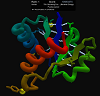
Intermediate Intermediate Intermediate Intermediate Intermediate Intermediate Intermediate Intermediate Intermediate Intermediate Overall Overall Overall Overall Overall Overall Overall Overall Overall Overall Design Design Design Design Design Design Design Design Design DesignThis is a different type of design puzzle from those you are most familiar with. Instead of designing a single long chain, here you can design a set of short peptides as disjointed sections of a larger protein—we don't want you to worry about designing connections between the short chains in this puzzle. See the new blog post about this for more information. The Abeta protein backbone is frozen in this puzzle, but there are eight short chains that you can completely redesign. This puzzle also includes a Residue IE filter, which monitors that all PHE, TYR, and TRP residues are scoring well. Remember, you can use the Upload for Scientists button for up to 3 designs that you want us to look at, even if they are not the best-scoring solutions. Help us design a tight-binding protein for Abeta!


We're very curious to hear what you think about this new type of puzzle. Please read the recent blog post by Baker Lab scientist Vikram Mulligan, and leave your comments on the blog page here:
http://fold.it/portal/node/996287

First, can we place the "pieces" anywhere around the locked segment? or are place we should not have them?
Second, how bad is having 2,3, or 6 Low Scoring Residues??

First, can we place the "pieces" anywhere
around the locked segment? or are place
we should not have them?
Yes, you can place them anywhere. Remember, though, that the goal is to come up with a plausible design for a folded protein that has bound to the Abeta peptide. This means that designs that fail to bury hydrophobic residues well (e.g. ones that leave a bunch of Abeta's hydrophobic residues exposed) won't be very good designs. Isolated secondary structure elements that don't contact or support one another at all (especially isolated beta-strands) are probably also not terrific designs. Beyond those vague, qualitative guidelines, though, you've got a lot of leeway. We don't want to restrict you too much. Be creative!
Second, how bad is having 2,3, or 6 Low
Scoring Residues??
It's hard to say for certain. The score should be used as a guide (and a VERY low-scoring residue is almost certainly "bad"), but real proteins do sometimes have a residue or two that are in somewhat non-ideal or unusual configurations (and which would be scored somewhat poorly by Foldit).
Good questions, by the way!
If the conserved portion is buried within our fragments, how will it perform its function?
That's a very good question, brow42. First, to clarify: by "the conserved portion", do you mean the part with a fixed backbone shape? That's the ABeta molecule, which we want to bind up in order to block its toxic effects.
It is counter-intuitive, but real proteins sometimes bury the molecules that they bind pretty deeply – which seems strange, since how the heck would the bound molecule get into or out of the binding site? The reality is that proteins aren't the static, rigid structures that we think of when we look at a Foldit model. Proteins – and the water molecules that surround them – are constantly jiggling and jittering around. On average, there is one state (the "native state", which is what we ask Foldit players to design or predict) that they tend to occupy, but they can deviate from that for short periods of time. Here's a short Youtube video of a molecular dynamics simulation of the sorts of motions that a folded protein might undergo. (Keep in mind that this is a simulation, and that actual protein motions are very difficult to study experimentally.) Although this simulation seems to show a pretty leisurely wobbling motion, the entire 34-second movie represents two billionths of a second of simulated time. Over longer periods of time – milliseconds or seconds, for example – a protein can, for brief instants, sample conformations that are farther from the folded state, including fairly open conformations in which a deeply-bound molecule could get in or out.
Even more counter-intuitively, a very buried binding site might result in slower binding or release (meaning that binding could take milliseconds or seconds instead of microseconds) as compared to a more exposed binding site, but since burial slows both binding and release, it will not necessarily reduce the fraction of protein molecules that have successfully bound the target molecule once the system reaches its equilibrium between bound and unbound states. On the contrary, greater burial can result in more favourable interactions between the binding protein and the molecule that it binds, meaning that at equilibrium, more of the target molecule will be bound.
Does this make sense?
This explanation was very helpful. I thought the small peptide itself disrupted Abeta sheets. I understand now that it is the target of our design.